15 Fun Stargazing Activities for Family Night Adventures

You’ll find endless ways to transform ordinary evenings into cosmic adventures with your family. Start by creating custom constellation maps, hosting meteor shower watch parties with hot chocolate, or playing celestial scavenger hunts that turn observation into exploration. Track moon phases together in a family journal, learn ancient myths behind star patterns, and capture the night sky through smartphone photography challenges. Add cosmic-themed treats and shadow puppet shows to blend education with entertainment. These activities await your discovery in the comprehensive guide below.
Key Takeaways
- Create constellation maps by sketching visible stars into meaningful shapes, building observational skills and artistic expression.
- Host meteor shower watch parties with blankets, snacks, and star charts for interactive family counting competitions.
- Track moon phases together through nightly journals, sketches, and photographs documenting its 29.5-day transformation cycle.
- Learn constellation mythology from various cultures while locating star patterns, blending education with imaginative storytelling.
- Capture night sky photos using smartphones and tripods, creating family challenges to document favorite celestial objects.
Create Your Own Constellation Map
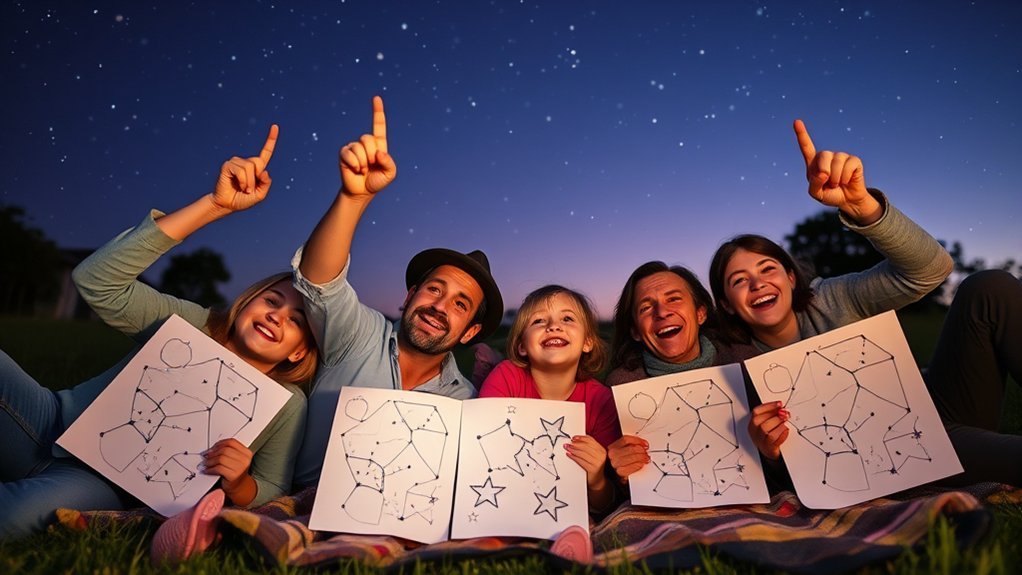
Before you head outside, gather some basic supplies: a flashlight covered with red cellophane, a notebook or clipboard, and a pencil. The red light preserves your night vision while you work on your constellation design.
Red cellophane over your flashlight is the secret to preserving night vision while sketching constellations outdoors.
Find a comfortable spot with minimal light pollution and let your eyes adjust for ten minutes. Look up and identify patterns that spark your imagination. Don’t limit yourself to traditional constellations—create your own!
Sketch the stars you see, connecting them into shapes that mean something to your family. Label each constellation design with creative names.
This star mapping activity helps children understand how ancient cultures created stories from the night sky. You’ll build lasting memories while developing observational skills and artistic expression together.
Host a Meteor Shower Watch Party
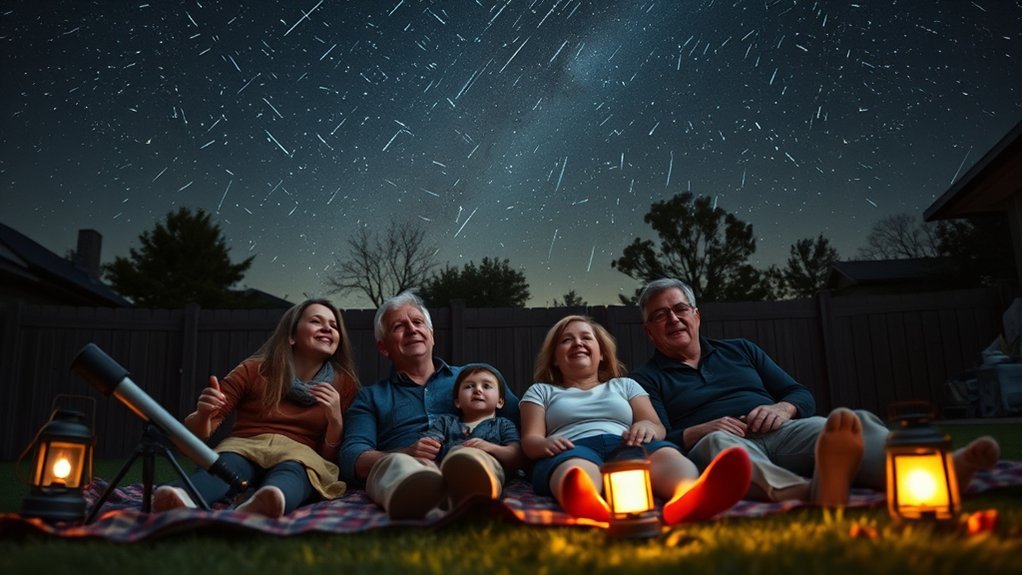
Meteor showers transform ordinary nights into celestial celebrations your family won’t forget. Check online calendars for peak viewing dates of major showers like the Perseids or Geminids, then plan your watch party accordingly.
Set up a comfortable viewing station with blankets, sleeping bags, and reclining chairs in your backyard or at a dark-sky location. Arrive early to let everyone’s eyes adjust to the darkness—this takes about 30 minutes.
Bring hot chocolate, snacks, and downloadable star charts to identify constellations between meteor sightings.
Make it interactive by having each family member count meteors they spot, turning observations into a friendly competition. Download apps that send alerts when meteor shower activity peaks, ensuring you don’t miss the best moments of celestial action overhead.
Learn the Stories Behind the Constellations
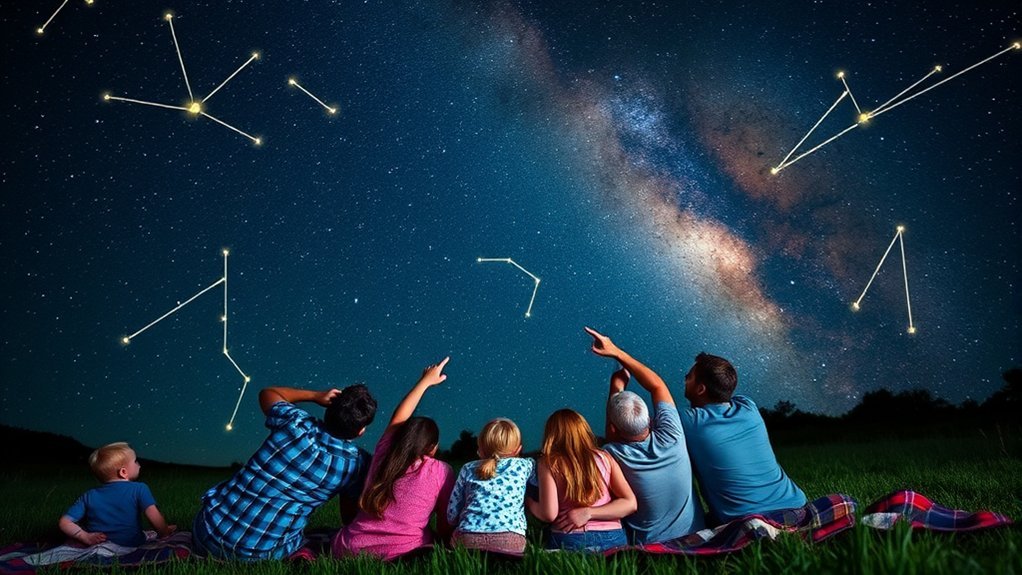
While counting shooting stars excites the eyes, discovering the ancient myths behind constellation patterns captivates the imagination.
You’ll transform ordinary stargazing into storytelling adventures when you share mythical tales with your family.
Start with recognizable patterns like Orion the Hunter or Ursa Major. Print constellation maps beforehand, then gather everyone to locate these celestial figures. As you point out each star grouping, narrate the constellation legends from Greek, Roman, or Native American traditions.
Encourage your kids to create their own stories about the star patterns they observe. You can assign different family members various constellations to research during the week, then take turns sharing their discoveries during your next stargazing session.
This activity blends education with entertainment, making astronomy memorable and personally meaningful.
Play Stargazing Scavenger Hunt
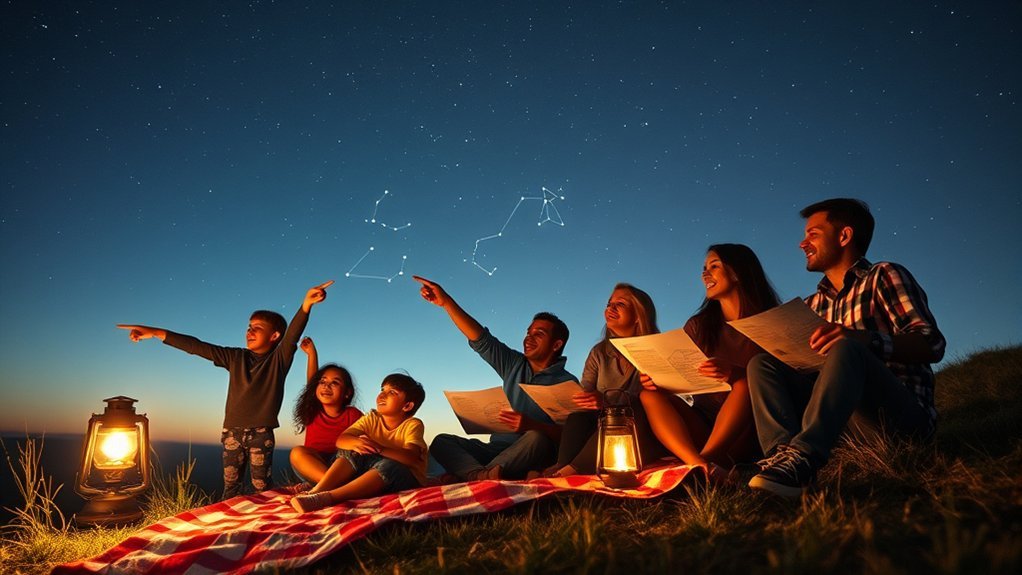
Transform your family’s stargazing session into an interactive game by creating a celestial scavenger hunt. Design challenge cards listing specific objects to find: the Big Dipper, a red star, three constellations, or a satellite passing overhead. Award points for each discovery and include stargazing trivia questions as bonus rounds.
Make it hands-on by pairing findings with constellation crafts. Kids can sketch what they spot or create dot-to-dot star patterns on paper. You’ll keep everyone engaged while teaching astronomical concepts naturally.
Customize difficulty levels for different ages. Younger children can search for the moon’s phases or brightest stars, while older kids tackle harder targets like identifying specific constellations or spotting meteor trails.
This competitive element motivates reluctant stargazers and transforms passive observation into active exploration.
Track the Moon Phases Together
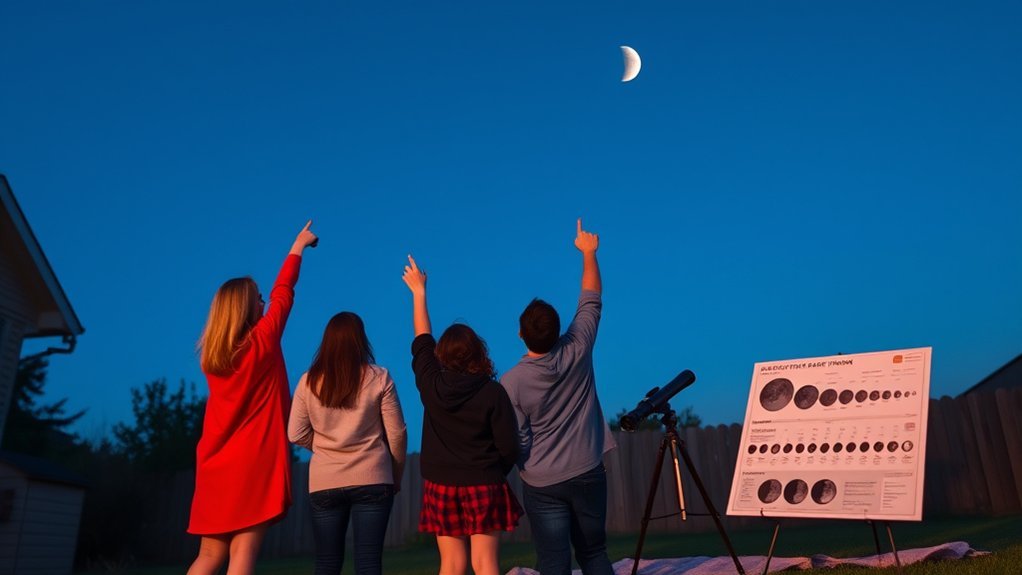
Why does the moon look different every night? That’s the perfect question to spark your family’s moon phase tracking adventure.
Start lunar cycle exploration by creating a simple moon journal where everyone sketches what they observe each evening. You’ll notice the moon transitions through eight distinct phases over approximately 29.5 days.
Create a family moon journal to sketch nightly observations and watch the complete 29.5-day lunar cycle unfold together.
Make it interactive by printing a moon phase chart and challenging your kids to predict what shape they’ll see next. Use a smartphone app to identify the current phase and learn why these changes occur as the moon orbits Earth.
You can even photograph the moon weekly to document its transformation.
This ongoing activity teaches patience, scientific observation, and celestial mechanics while building anticipation for each night’s viewing session together.
Spot Satellites and the International Space Station
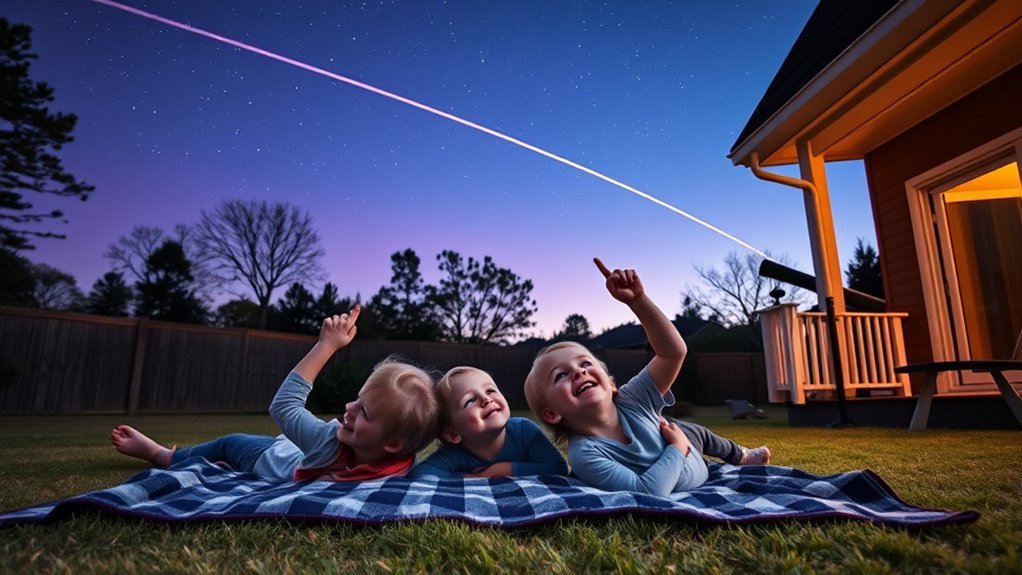
After you’ve grown comfortable observing the moon’s predictable patterns, it’s time to spot something far more thrilling—human-made objects zipping across the night sky.
Satellite tracking transforms ordinary stargazing into an exciting treasure hunt your family will love.
The International Space Station appears as a brilliant, fast-moving light. For successful ISS viewing, follow these steps:
- Download apps like ISS Detector or Heavens-Above for precise flyover predictions
- Head outside 10 minutes early to let your eyes adjust to darkness
- Face the direction indicated by your tracking app
- Watch for a steady white light moving smoothly across the sky
You’ll witness astronauts orbiting 250 miles above Earth, traveling at 17,500 mph—an unforgettable experience that connects your family to space exploration.
Build a Backyard Observatory Space

Your family’s stargazing adventures deserve a dedicated space where telescopes stay ready and equipment remains protected from the elements.
Creating a backyard observatory doesn’t require professional construction—start with a simple weatherproof shed or canopy that shields your gear while providing quick access for spontaneous viewing sessions.
Consider your telescope setup carefully when choosing a location. Select a spot away from house lights with clear views of the southern sky. A concrete pad prevents wobbling and moisture damage, while a roll-off roof design allows easy equipment access.
Your observatory design can evolve over time. Begin with basic storage solutions, then add comfortable seating, red-light illumination, and star charts.
Even a modest structure transforms casual stargazing into a serious family hobby that’s always ready for clear nights.
Try Smartphone Stargazing Apps as Learning Tools
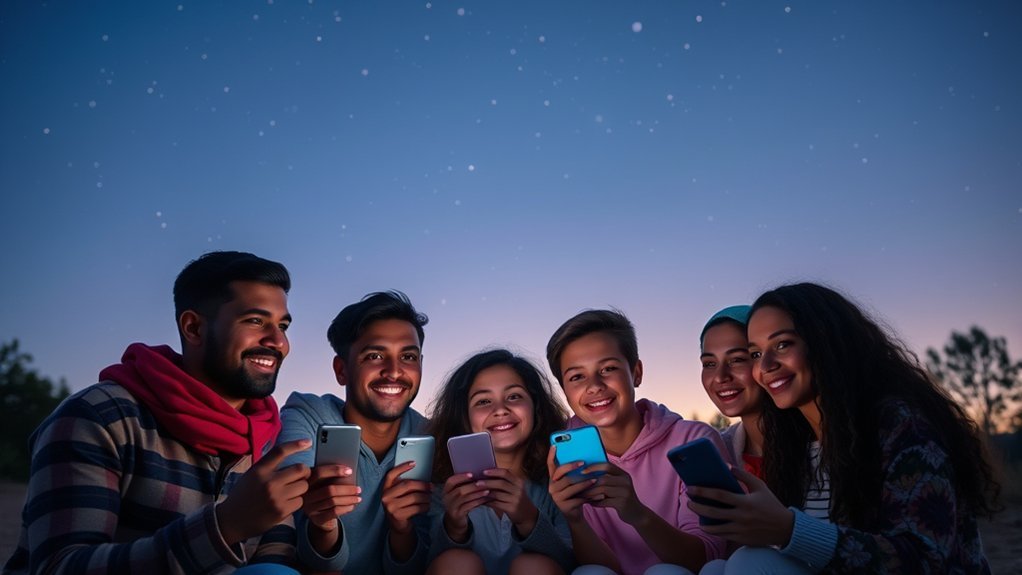
Modern smartphones transform into powerful astronomical guides that identify constellations, track satellite passes, and reveal celestial objects invisible to the naked eye.
You’ll find stargazing apps offer interactive educational resources that make astronomy accessible for all family members.
Popular options to explore:
- SkyView – Point your device upward to identify stars, planets, and constellations in real-time
- Star Walk 2 – Features augmented reality overlays with detailed information about celestial bodies
- NASA App – Provides astronomy picture of the day, mission updates, and space station tracking
- Stellarium Mobile – Shows realistic sky simulations with customizable viewing times
These apps transform casual observation into engaging learning experiences.
You’ll encourage children to ask questions about space while building scientific curiosity through hands-on exploration.
Make Star-Themed Snacks and Treats

Between stargazing sessions, you’ll want to keep your family energized and engaged with themed refreshments that complement the astronomical adventure.
Star shaped cookies are perfect for younger children to decorate with yellow icing and edible glitter.
Galaxy cupcakes feature swirled purple, blue, and pink frosting that mimics distant nebulae.
Moon phase brownies can be cut into circles and decorated with white frosting to represent different lunar stages, making them both delicious and educational.
Comet ice pops made with layers of fruit juice create a stunning tail effect when frozen.
Nebula fruit skewers combine colorful berries, melon balls, and grapes arranged to resemble cosmic clouds.
These treats transform snack time into an interactive learning experience that reinforces astronomical concepts you’re observing overhead.
Keep a Family Astronomy Journal
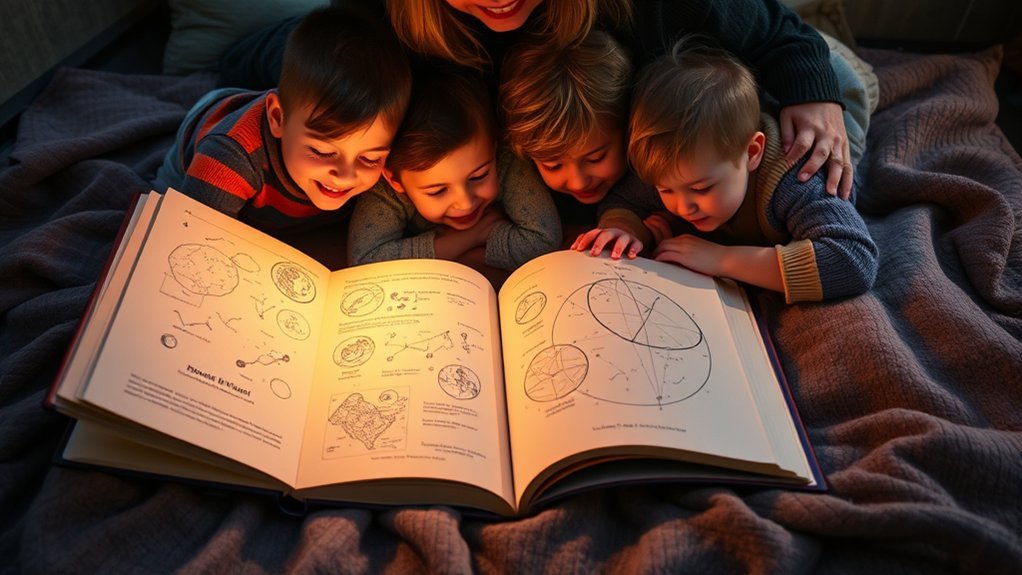
Recording celestial observations creates a lasting keepsake that tracks your family’s astronomical discoveries over time.
You’ll build meaningful memories while documenting what you’ve seen in the night sky together.
Your family observation journal should include:
- Date and time of each stargazing session with weather conditions and moon phase
- Sketches or photos of constellations, planets, and celestial events you’ve witnessed
- Descriptions of what you observed, including colors, brightness, and movement patterns
- Personal reflections from each family member about their favorite sights
Encourage everyone to contribute their own entries and drawings.
You can also paste in printed star charts, track meteor shower counts, and note upcoming celestial events you’d like to observe.
This journal becomes your family’s unique astronomical story.
Identify Planets With the Naked Eye
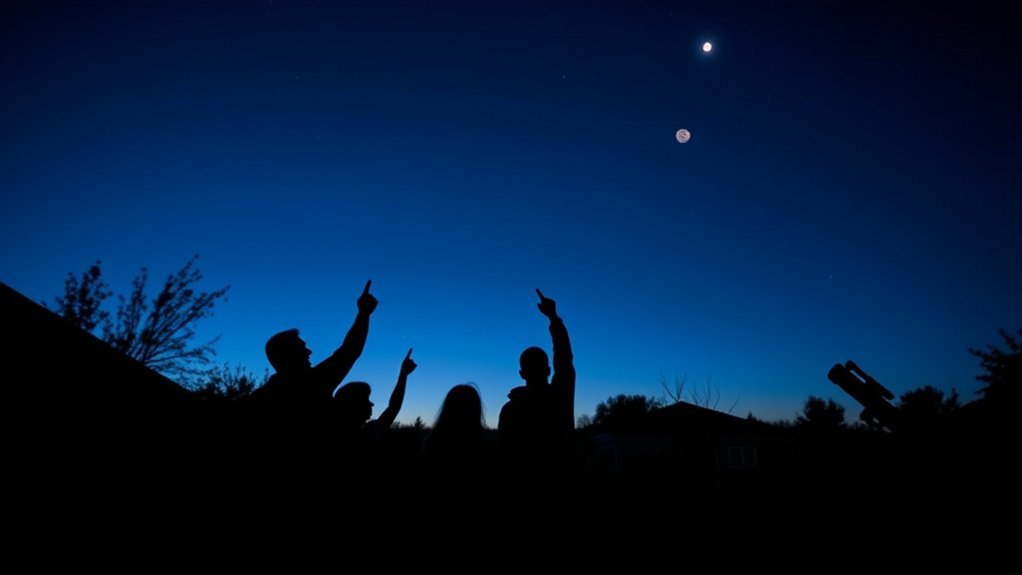
While your astronomy journal helps you document discoveries, one of the most rewarding skills you’ll develop is spotting planets without any equipment. Venus, Mars, Jupiter, and Saturn shine brightly enough for easy naked-eye identification.
You’ll recognize planets because they don’t twinkle like stars—they emit steady light. Venus appears as the brilliant “evening star” or “morning star,” while Mars glows distinctively red. Jupiter shines white and exceptionally bright, and Saturn displays a yellowish hue.
Track planetary alignment by noting when multiple planets appear in a straight line across the sky. This spectacular phenomenon occurs several times yearly.
Teaching your family celestial navigation basics enhances the experience—planets travel along the ecliptic, that imaginary path the sun follows. Download a simple sky map to confirm your sightings and celebrate each successful identification together.
Create Shadow Puppets by Flashlight

Flashlights transform ordinary stargazing breaks into impromptu entertainment when your family needs a moment to rest tired necks.
Position your hands between the flashlight beam and a flat surface to craft shadow shapes that spring to life. You’ll create everything from barking dogs to flying birds with simple finger positions.
Turn individual gestures into engaging puppet stories by following these steps:
- Assign characters to each family member based on their shadow-making skills
- Choose a simple plot like a forest adventure or space journey
- Add sound effects and voices to enhance the performance
- Rotate storytellers so everyone contributes ideas
This activity keeps younger children engaged between constellation viewings while teaching them about light, shadows, and creative collaboration under the stars.
Time Travel Through Light Years
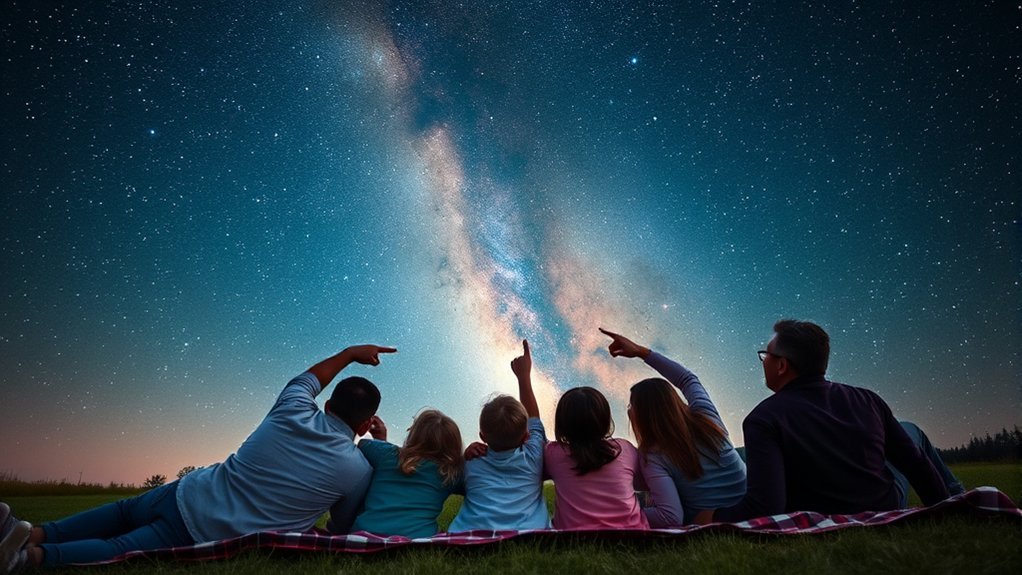
When you gaze at stars with your family, you’re literally looking backward in time.
Light year exploration becomes tangible when you explain that starlight takes years to reach Earth. Point out Proxima Centauri—its light traveled over four years to meet your eyes tonight.
Make cosmic time travel interactive by comparing stellar distances. Show your kids that Polaris’s light left 433 years ago, during Shakespeare’s era.
The Andromeda Galaxy reveals light from 2.5 million years past, when early humans walked Earth.
Create a timeline game: assign each family member a star and research what happened on Earth when that light began its journey.
You’ll transform abstract astronomical concepts into memorable stories, helping everyone grasp how stargazing connects past and present across unimaginable distances.
Photograph the Night Sky Together
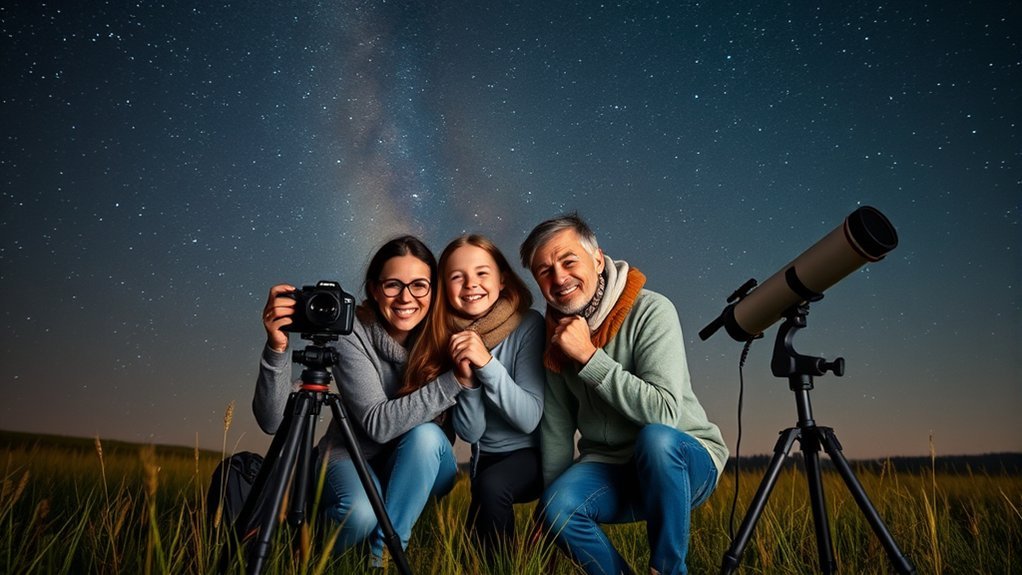
After marveling at time-traveling starlight, capturing those celestial wonders through photography creates lasting memories your family can revisit for years.
Night sky photography doesn’t require expensive equipment—smartphones work perfectly for getting started. Create a family photo challenge where each member captures their favorite constellation or moon phase.
Try these techniques together:
- Use a tripod or stable surface to prevent blurry images during long exposures
- Adjust your camera’s night mode or manual settings for better star visibility
- Experiment with foreground objects like trees or silhouettes to add depth
- Compare everyone’s photos and vote on the most creative shot
You’ll develop new skills while documenting your astronomical adventures, building a personal collection of celestial moments.
Plan a Dark Sky Location Road Trip
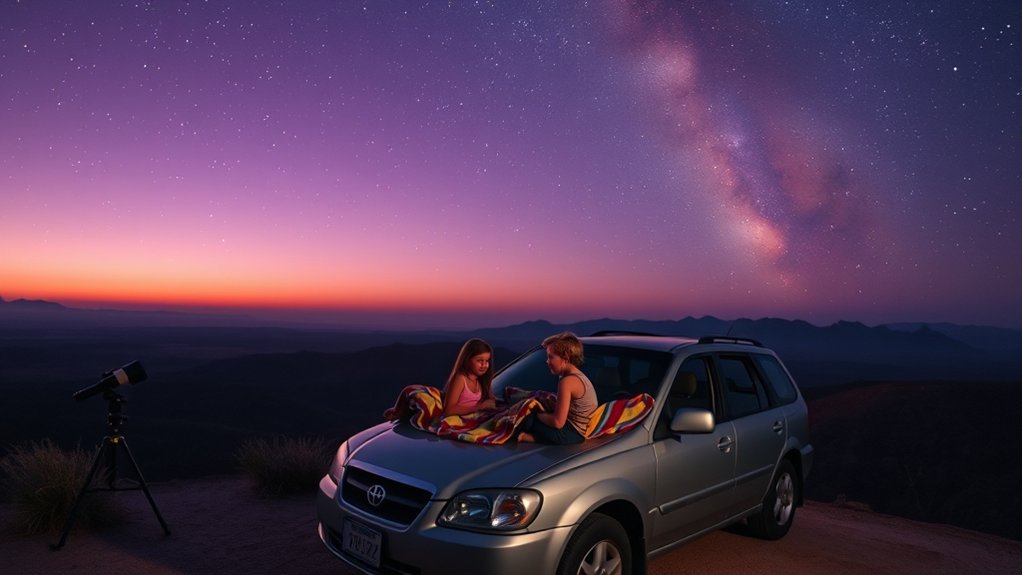
Once you’ve mastered backyard stargazing, elevating your family’s astronomical adventures to an official Dark Sky location transforms the experience entirely.
These designated sites offer minimal light pollution, revealing thousands more stars than you’ll see from home.
Start planning by researching International Dark Sky Parks within driving distance. Create a comprehensive stargazing checklist including telescopes, red flashlights, star charts, warm blankets, and snacks.
Don’t forget your road trip essentials: fully charged devices, navigation tools, emergency supplies, and entertainment for the drive.
Book accommodations early, as these remote locations fill quickly during peak seasons. Check moon phases before departing—new moon periods provide optimal viewing conditions.
Pack layers since temperatures drop significantly at night, even during summer months. Turn this outing into an educational adventure your family won’t forget.
In case you were wondering
What Weather Conditions Are Best for Stargazing With Children?
You’ll want clear, moonless nights with minimal cloud cover for the best stargazing experience. Ideal conditions include low humidity, calm winds, and darkness away from city lights. Check weather forecasts beforehand to ensure you’re planning successfully.
How Can We Keep Kids Warm During Cold-Weather Stargazing Sessions?
Layer your kids in thermal clothing, including base layers, insulated jackets, and warm hats. You’ll also want to bring hot beverages like cocoa or tea in thermoses. Don’t forget blankets and hand warmers for extra comfort.
What Age Is Appropriate to Start Stargazing Activities With Children?
You can start stargazing with children as young as three or four years old. Age recommendations vary, but even toddlers enjoy moon-watching. As your young astronomers grow, they’ll appreciate constellations, planets, and deeper sky observations increasingly more.
How Do We Deal With Light Pollution in Our Neighborhood?
Like curtains blocking your view, light pollution obscures stars, but you can fight back. Advocate for community awareness about shielding streetlights, use red flashlights during stargazing, and explore light pollution solutions like visiting darker observation sites nearby.
What Safety Precautions Should Families Take During Nighttime Outdoor Stargazing?
You’ll need bright flashlights with red filters for nighttime visibility, reflective clothing, and a buddy system. Always check weather forecasts, bring warm layers, tell someone your location, and maintain outdoor safety by staying aware of your surroundings.
Conclusion
You’ve now got nine whole ways to drag your screen-addicted family outside to stare at glowing dots they can’t double-tap or screenshot. Sure, they’ll complain it’s cold, boring, and “there’s no Wi-Fi,” but you’ll create “memories” while mosquitoes feast on your ankles. Don’t worry when little Timmy asks why you’re forcing bonding time under a sky he can Google—you’re being an excellent parent, obviously.