What Are the Best No-Mess Kids’ Art Activities?
Skip spills and spark creativity with water-reveal coloring books, magnetic drawing boards, sticker collage stations, and reusable gel window clings. Add dry-erase pockets for mazes, paint dabbers on disposable mats, and tidy playdough on non-slip mats with silicone tools. Try washi tape on cardboard for stripes and mosaics, plus simple stylus-based drawing apps. Use chunky, non-toxic materials, set clear boundaries, and supervise scissors and refills. You’ll get playful prompts, skill-building tips, and cleanup tricks next.
Key Takeaways
- Water-reveal coloring books use only water, dry cleanly for reuse, and build fine-motor skills without stains.
- Magnetic drawing boards and stamps let kids sketch, erase, and practice shapes with zero paper waste.
- Sticker collages and reusable window clings offer peel-and-place art that’s tidy, reusable, and great for fine-motor practice.
- Stencils with paint dabbers and foam shapes create patterns and textures while keeping surfaces clean with disposable mats.
- Digital drawing apps with a stylus provide guided, mess-free creativity; enable child-safe settings and short practice bursts.
Water-Reveal Coloring Books That Magically Refill
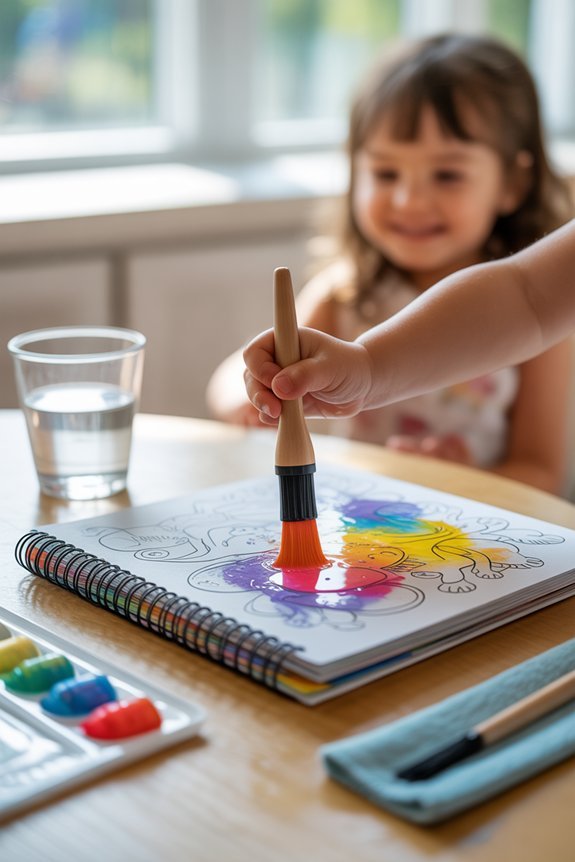
Because a little water can feel like magic, water-reveal coloring books let kids paint vibrant scenes with a refillable brush—no ink, no stains, no cleanup. You fill the brush, swipe on the page, and watch water magic bring out colors and hidden details. Kids get coloring fun without waiting for paint to dry or worrying about markers.
Set up at a table, show how to dip and dab gently, and remind kids not to drink the water. Offer a cloth for drips and supervise refills to prevent spills.
Rotate pages to build fine-motor skills, hand strength, and focus. Name colors and shapes, count objects, and invite storytelling about the scene. When pages dry, colors fade, so you can reuse them—again and again.
Reusable Gel Window Clings for Stick-and-Create Scenes

Two sticky-sweet perks in one: kids build scenes while your windows stay clean. Hand them reusable gel window clings and invite playful scene creation—oceans, cities, zoos—right on the glass.
They’ll practice fine-motor control, storytelling, and spatial awareness as they layer shapes, overlap colors, and reposition pieces. You’ll love that the window decor wipes off easily and leaves no residue.
Set clear rules: clings go on windows, not mouths or hair. Supervise toddlers, and choose BPA- and phthalate-free sets.
Set simple rules: clings stay on windows—never mouths or hair. Supervise toddlers and pick BPA- and phthalate-free sets.
Before play, wash hands and the glass; clean clings with mild soap if dusty. Rotate themes to spark new narratives, or challenge kids to mirror patterns, count objects, or build from “top to bottom.”
When finished, press clings onto plastic sheets, store flat, and reuse.
Magnetic Drawing Boards for Sketching on Repeat

One swipe, endless do-overs—magnetic drawing boards let kids sketch, stamp, and erase without paper scraps or dried-out markers.
You’ll love how magnetic creativity turns quick doodles into repeatable practice for lines, shapes, and letters. Kids enjoy sketching fun while strengthening pencil grasp, bilateral coordination, and spatial planning without mess.
1) Choose a board with a tethered stylus, chunky stampers, and rounded edges.
Check the seal so metal filings stay contained.
2) Set playful prompts: draw a map to snack time, design a silly robot, or trace your hand and add patterns.
Erase and try again—confidence grows with each swipe.
3) Keep it safe and calm: supervise toddlers, store stampers in a snap-close pouch, and wipe surfaces to reduce dust before play.
Sticker Collage Stations With Peel-And-Place Shapes

While little hands stay busy and tables stay clean, sticker collage stations turn simple peel-and-place shapes into open-ended art. Set out sheets with bold sticker themes—animals, shapes, faces, vehicles—plus sturdy paper or folders. Invite kids to plan, place, and try creative layering: put stars over skies, windows on buses, or hats on dinos. You’ll build fine-motor strength, color naming, and spatial language as they press, peel, and reposition.
Choose large, non-toxic, easy-peel stickers to prevent frustration and keep small pieces away from mouths. Pre-cut backing slits help beginners lift edges safely. Offer a visual prompt—“Make a park” or “Design a city”—then step back so they direct the story.
Rotate themes weekly, store sheets flat in envelopes, and celebrate the collage as a finished, mess-free masterpiece.
Dry-Erase Pockets and Marker Mazes
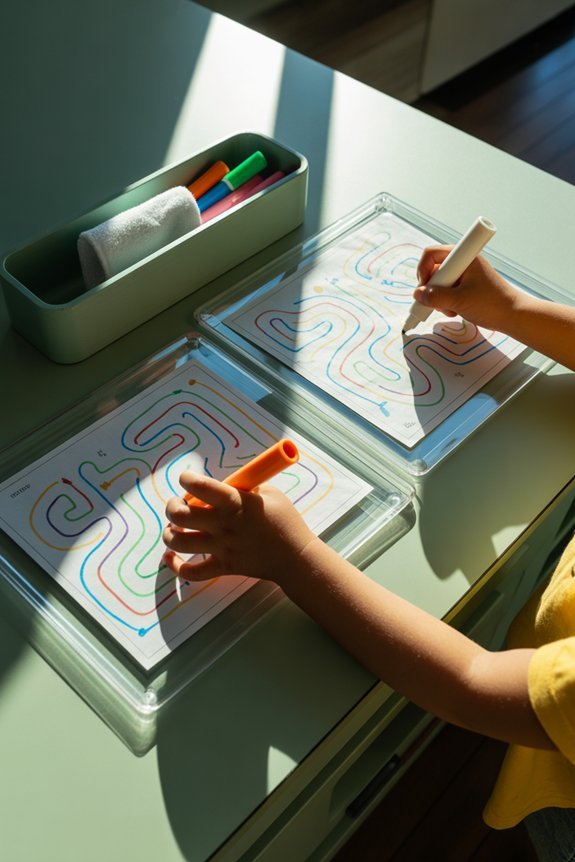
Slip your reusable maze templates into dry-erase pockets so kids can trace, wipe, and try again without a mess.
You’ll boost fine-motor control and planning skills while you guide them to use smudge-free marker tips that are non-toxic and easy to grip.
Keep caps clicked on when not in use and place a soft cloth nearby for safe, quick cleanups.
Reusable Maze Templates
Because mess-free doesn’t have to mean boring, reusable maze templates turn quick doodles into focused fun. Slip printed paths into dry-erase pockets and let kids trace, backtrack, and celebrate wins without wasting paper.
You’ll build fine-motor control, visual scanning, and persistence while keeping cleanup simple.
Lean into maze design: try straight corridors for beginners, then add forks, loops, and themed paths. Encourage template creativity—invite kids to draw obstacles, friendly helpers, or story goals, then trade and solve.
1) Start simple: thick lines, clear start/finish, minimal crossings.
2) Level up: timed hunts, arrows for directions, symbols to decode.
3) Create together: kids sketch, you outline, then test and tweak.
Use chisel-tip, low-odor, non-toxic markers. Supervise cap handling, avoid mouth contact, and rotate hand rests to prevent fatigue.
Smudge-Free Marker Tips
Even with eager hands and speedy tracing, you can keep lines crisp and sleeves clean by setting up smart marker habits. Use dry-erase pockets for maze sheets so little artists glide, erase, and replay without wet smears. Teach a light grip and slow-release strokes—these smudge proof techniques reduce drag and keep colors bright. Place a felt square under wrists to catch extra ink, and rotate pages so hands travel away from fresh lines.
Try this quick guide:
| Tip | Why it helps |
|---|---|
| Cap-click routine | Prevents dry nibs and leaks |
| Vertical drying | Ink sets before touch |
| Pocket + microfiber | Clean resets, fewer fumes |
Choose low-odor, chisel-tip markers. Practice “draw, pause, air-dry, wipe.” Finish by snapping lids and using upright marker storage solutions for safe, tidy shelves.
Scratch-Art Sheets for Surprise Designs
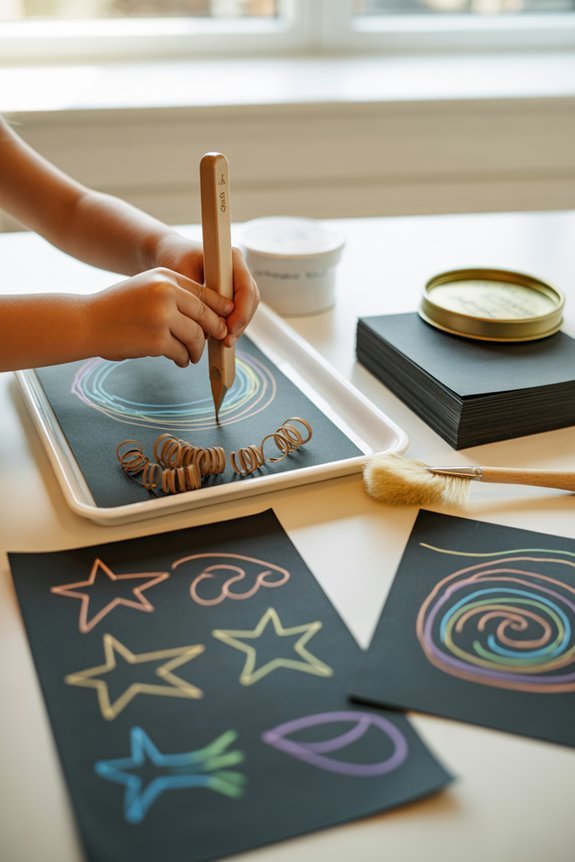
One swipe of a wooden stylus turns matte black into bursts of color, giving kids an instant “wow” with minimal mess.
You’ll guide little hands to practice fine-motor control while they explore scratch art techniques like lines, dots, swirls, and gentle shading. The surprise reveal keeps focus high and frustration low, making it great for mixed ages.
1) Set up: Tape a sheet to the table, offer a blunt wooden stylus, and model light strokes before heavier pressure.
2) Play prompts: “Draw a path for an ant,” “Trace your hand,” or “Hide a rainbow under zigzags,” to scaffold creativity and sequencing.
3) Safety check: Supervise stylus use, avoid sharp tools, and remind kids not to scrape skin or eyes. Dispose of scratch dust with a damp cloth.
Mess-Free Paint Dabbers on Disposable Paper Mats
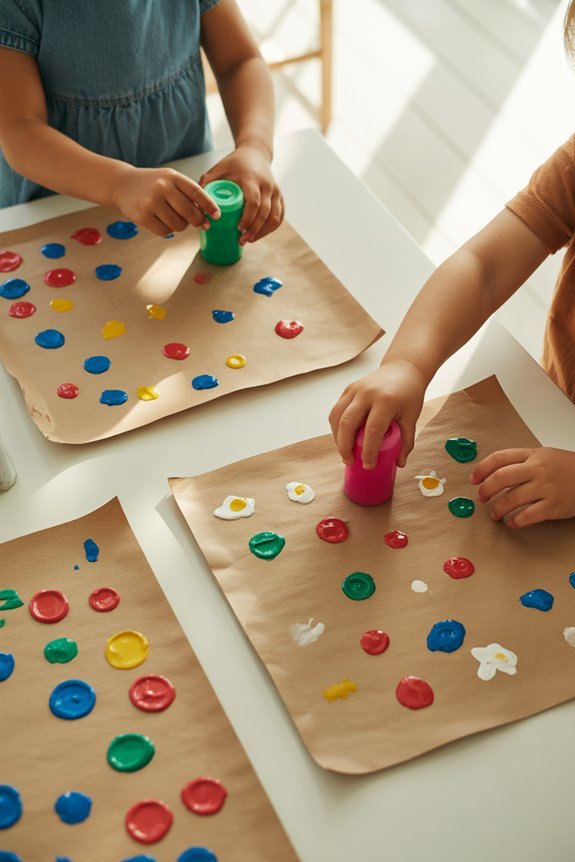
Set out disposable paper mats and twist open paint dabbers for quick setup and faster cleanup.
Show your child how to dot two colors side by side and tap-tap to blend safely without splatter.
Add simple stencils and shape outlines so little hands can press, lift, and see crisp patterns appear.
Quick Setup and Cleanup
While curiosity is bubbling, keep art time simple with mess-free paint dabbers on disposable paper mats. You’ll set up fast, invite playful exploration, and keep hands and tables clean.
Place a mat, hand over a dabber, and you’re ready. Use these quick organization tips to streamline the flow and keep kids focused on creating, not waiting.
1) Lay a mat, put a dabber in each small tray, and add a damp wipe nearby—instant station.
2) Teach a clear routine: dab, press, wipe fingertips, then swap colors. Simple cues support independence and safety.
3) Finish with efficient storage solutions: drop used mats in recycling, cap dabbers, and stand them tip-up in a caddy.
Stay within reach, supervise, and choose washable, non-toxic dabbers for worry-free fun.
Color Blending Basics
With your quick stations ready, invite kids to mix colors right on the mat using two dabbers at a time. Show how yellow meets blue to make green, and red plus yellow makes orange.
Keep it playful: say, “Tap, tap, swirl,” as they explore simple color theory without brushes or spills. Model gentle pressure so the paint doesn’t pool.
Guide short experiments in blending techniques: side-by-side dots that overlap, a light swirl to soften edges, and a slow tap-to-tap path that creates gradients. Encourage naming colors they discover; label dabbers clearly and cap them between turns.
Use disposable paper mats to contain extra moisture and toss when finished. Seat kids with sleeves rolled, tie back hair, and remind them: dabbers touch mats, not faces.
Stencil and Shape Play
Two simple stencils and a few chunky shapes turn dabbers into magic wands for pattern play.
Place a disposable paper mat, tape the corners, and invite your child to try easy stencil techniques: dot around edges, fill the center, then lift for a reveal.
Rotate stencils for symmetry, overlap colors for gentle surprises, and cheer small efforts.
Add shape exploration with foam circles, triangles, and squares; name shapes, trace outlines, and compare sizes.
1) Set up: use non-toxic dabbers, low-tack tape, and a recycle bin nearby; swap mats when saturated.
2) Guide safely: supervise dabbing, model gentle pressure, and keep caps away from mouths.
3) Extend learning: create simple patterns (ABAB), count dots, and invent shape stories together.
Playdough Mats and Silicone Tools for Clean Sculpting

One simple switch makes playdough time cleaner and more engaging: set out a non-slip playdough mat and a few silicone tools. You’ll keep crumbs contained, protect tables, and give kids a defined workspace.
Offer rollers, blunt cutters, and textured stamps; silicone grips well, washes fast, and won’t splinter. Invite open play: press, pinch, roll, poke, and snip. Narrate simple sculpting techniques—make coils, flatten pancakes, form balls, and join pieces with a gentle press.
Rotate colors and scents from favorite playdough recipes to boost sensory interest while keeping ingredients safe and washable. Set clear boundaries: dough stays on the mat, tools return to a tray.
Supervise for mouthing and keep small add-ins away from toddlers. When you’re done, lift the mat, shake, rinse, and air-dry—cleanup’s easy.
Washi Tape Art on Cardboard Canvases

Although it looks simple, washi tape on cardboard turns into a low-mess invitation to design, layer, and peel—perfect for little hands. You’ll set out precut cardboard squares and a few bright rolls, then model gentle ripping and smooth rubbing for adhesion. Kids explore washi tape techniques—stripes, grids, mosaics—fueling cardboard creativity without sticky residue.
Low-mess washi tape play: rip, rub, layer, and peel for colorful cardboard creations.
1) Offer prompts: “Make roads,” “Frame a photo,” or “Build a sunset.” Add a blunt kid-safe scissor for edge trimming if your child’s ready.
2) Scaffold skills: toddlers press long strips; preschoolers overlap colors; early graders create patterns, letters, and arrows to practice directionality.
3) Keep safety first: avoid mouth play, supervise cutting, and remove loose bits to prevent slipping.
Peel-and-reposition tape invites risk-free edits, strengthens fine-motor control, and finishes cleanly—no paint, brushes, or drying.
Digital Drawing Apps With Stylus Practice
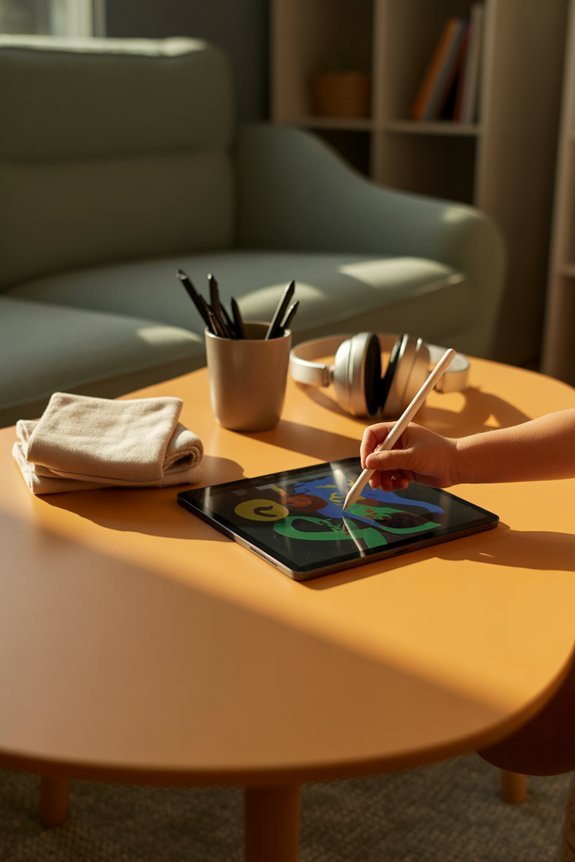
When screens serve as your canvas, a stylus turns swipes into purposeful strokes and keeps fingers mess-free. Choose simple digital art apps with big icons, undo buttons, and child locks. Start with playful prompts: trace shapes, connect dots, or “paint” with stamps. You’ll build stylus skills—pincer grip, hand strength, and controlled lines—without spills.
Invite practice bursts: draw for five minutes, shake out hands, then add color or texture. Use layers to experiment safely; nothing stains, and every mark can be undone. Encourage creative rules like “three colors only” or “draw with circles” to boost focus.
Prioritize safety: enable guided access, disable in-app purchases, and keep brightness low.
Join in—mirror drawing or take turns—to model technique and celebrate progress.
In case you were wondering
How Do I Store Finished No-Mess Art Without Clutter?
Store finished no-mess art by photographing pieces for digital storage, then curate seasonal favorites in slim art portfolios. Rotate displays, date everything, and secure small parts. Let kids help choose keepers, frame a few, and recycle responsibly.
What Age Ranges Suit Each No-Mess Activity Best?
Like stepping-stones across a puddle, you match ages to mess-free fun: toddler activities (12–36 months) favor sensory bags and sticker collages; preschool projects (3–5) love paint-in-bag prints and tape-resist; early elementary (5–8) enjoy scratch art—supervise, check materials.
How Can I Incorporate Learning Goals Into Mess-Free Art?
Pair each project with a goal: reinforce letters with reusable sticker collages, patterns with water-brush tracing, shapes via gel-bag drawing. You’ll weave creative learning and sensory exploration while keeping it play-based, developmentally appropriate, and safe with supervision.
Are There Eco-Friendly or Recyclable No-Mess Art Options?
Yes—use eco friendly supplies and recyclable materials. You’ll tape collage shapes from packaging, make crayon rubbings on scrap paper, create sticker stories, and reuse lids as stampers. Supervise choking hazards, round sharp edges, and model gentle, playful exploration.
What Travel-Friendly No-Mess Art Fits in a Small Bag?
You tuck portable supplies beside snacks—coincidence becomes creativity. Choose travel kits: water-reveal pads, reusable sticker scenes, mess-free gel crayons, magnetic doodle boards, mini washi tape, and foldable sketchbooks. Pack wipes, supervise small parts, rotate prompts, and celebrate quick, playful process art.
Conclusion
You’ve got a treasure trove of tidy, tactile tinkering at your fingertips. Pick a project, set simple safety rules, and watch little learners light up. With washable wonders, wipe-clean surfaces, and wisely chosen tools, you’ll spark creativity without chaos. Keep supplies stored, supervise smartly, and celebrate small steps. Let curious hands color, stick, sketch, and sculpt while you stay stress-free. Play with purpose, protect their pace, and savor the sweet, steady joy of mess-free making.