How To Deal With A Kid Who’s Always Bored Even Though They Have Alot Of Toys?
When your child says they’re bored despite a room full of toys, it’s actually a sign of sensory overload—not a lack of options. Too many choices prevent deep engagement and creative play. You’ll want to reduce the number of available toys and rotate them every few weeks, which sparks renewed curiosity. By embracing boredom as a developmental opportunity rather than a problem to solve, you’ll help your child build resilience and discover what truly captures their imagination below.
Why Too Many Toys Actually Create More Boredom

When you walk into a playroom overflowing with toys, you might assume your child has everything they need for hours of entertainment.
However, research shows that toy abundance often produces the opposite effect.
When children face too many choices, they experience sensory overload that paralyzes their ability to engage deeply with any single item.
Instead of diving into imaginative play, they flit from toy to toy, never developing sustained focus or creativity.
Studies demonstrate that children with fewer toys actually play longer and more creatively with each one.
They’re forced to problem-solve, invent new uses, and engage their imagination rather than relying on novelty.
You’re not depriving your child by limiting options—you’re giving their developing brain the space it needs to truly play.
The Power of Toy Rotation to Spark Fresh Interest
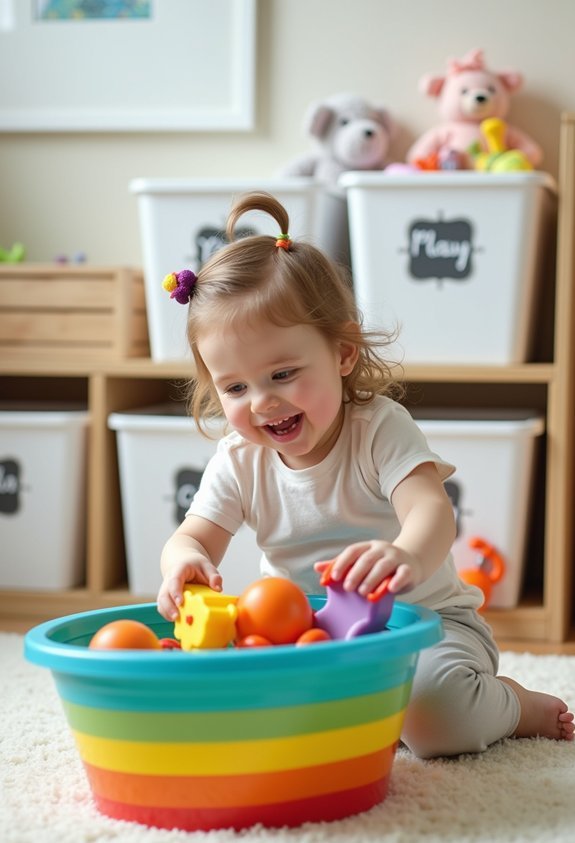
Although decluttering your playroom might feel drastic, toy rotation offers a practical middle ground that keeps your child engaged without permanently parting with beloved items. Research shows children play more deeply and creatively when they’ve fewer options available at once.
Toy rotation lets children rediscover what they already own—fewer choices spark deeper, more imaginative play.
Start by dividing toys into three or four groups. Store most away and present only one set at a time. Your toy selection should include variety—building toys, pretend play items, puzzles, and art supplies work well together.
Establish a playtime schedule that introduces “new” rotations every two to three weeks. This interval allows enough time for thorough exploration while maintaining novelty.
When you swap sets, you’ll notice your child approaching familiar toys with renewed curiosity, as if seeing them for the first time.
Teaching Your Child the Art of Independent Play
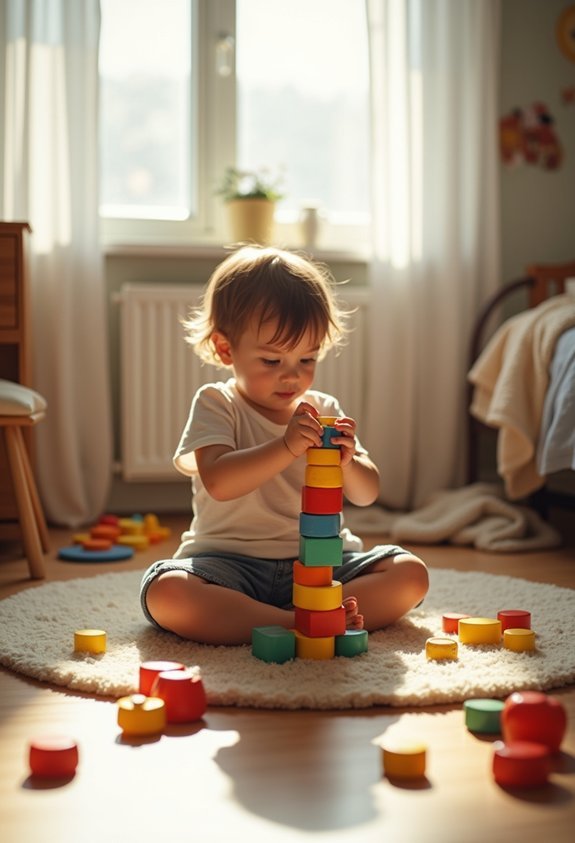
Because children aren’t born knowing how to entertain themselves, independent play is a skill you’ll need to nurture deliberately over time. Start by setting up short, unstructured play sessions where your child can engage in independent exploration without your direct involvement.
Research shows that children who develop strong independent play skills demonstrate greater creativity and problem-solving abilities. You can support this by stepping back gradually—begin with five-minute intervals and slowly increase the duration as your child builds confidence.
Create spaces that invite imaginative scenarios, such as a cozy corner with open-ended toys like blocks or dress-up clothes. Resist the urge to direct their play or solve problems immediately.
When you allow your child to work through boredom, you’re teaching them resilience and fostering their natural creativity.
Creating Open-Ended Play Opportunities With What You Already Have

Cardboard boxes, wooden spoons, and empty containers aren’t just household clutter—they’re powerful tools for cognitive development. When you offer these simple materials, you’re inviting resourceful creation that store-bought toys can’t replicate.
Research shows children engage in deeper imaginative play when objects don’t have predetermined purposes.
Transform your home into an open-ended play environment:
- Fabric scraps and blankets become capes, tents, or rivers to cross
- Kitchen items transform into musical instruments or science experiments
- Cardboard tubes serve as telescopes, tunnels, or building materials
- Nature collections like sticks and rocks inspire sorting, counting, and storytelling
You don’t need expensive supplies to spark creativity.
Setting Boundaries Around Screen Time and Instant Entertainment

While screens offer convenient relief during chaotic moments, they can quietly reshape how your child responds to boredom. Research shows that instant entertainment can reduce a child’s tolerance for slower-paced activities, making unstructured time feel unbearable.
Establishing clear screen limits doesn’t mean eliminating technology entirely. Instead, you’re helping your child develop patience and self-directed play skills. Consider creating predictable windows for screen use rather than offering devices whenever boredom strikes.
Finding entertainment balance requires intentionality. When your child complains of boredom, resist immediately reaching for a tablet. That uncomfortable pause actually builds crucial problem-solving abilities.
You can acknowledge their feelings while encouraging them to explore other options first.
When Boredom Becomes a Gateway to Creativity and Growth
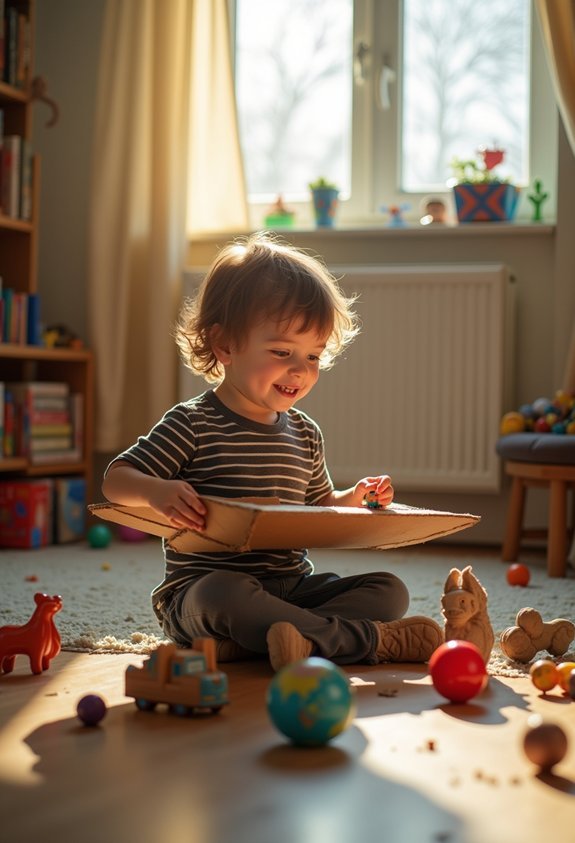
When your child sits with boredom instead of escaping it, something remarkable happens in their brain. Research shows that unstructured time activates the default mode network, which drives imaginative play and problem-solving abilities.
You’re witnessing the foundation of creative exploration when your child finally invents their own game.
Boredom teaches essential developmental skills:
- Self-direction: Children learn to generate their own ideas without external prompts
- Frustration tolerance: They build resilience by working through uncomfortable feelings
- Intrinsic motivation: Kids discover what genuinely interests them
- Cognitive flexibility: Their minds practice shifting between different possibilities
You don’t need to rescue your child from every dull moment.
When you allow space for boredom, you’re giving them permission to discover their own creativity and develop independence that toys simply can’t provide.
In case you were wondering
What Age Should I Start Teaching My Child to Play Independently?
You can start encouraging independent play around 6 months when your baby reaches key developmental milestones. You’ll notice they’re ready when they begin grasping toys and exploring objects, building crucial skills for independent play.
How Do I Handle Tantrums When I Refuse to Entertain My Bored Child?
Stay calm and offer emotional support by acknowledging their feelings: “I see you’re upset.” Understanding tantrum triggers helps you respond consistently. You’re teaching self-regulation skills when you don’t give in but remain empathetically present.
Should I Buy Educational Toys Instead of Regular Toys to Reduce Boredom?
You don’t necessarily need educational toys—what matters is toy variety that sparks creativity. Research shows open-ended toys offer educational benefits by encouraging problem-solving. Focus on developmental focus rather than quantity, and rotate toys regularly.
How Many Toys Should a Child Ideally Have at One Time?
You’ll want to keep about 10-15 toys accessible through toy rotation, storing the rest away. This toy organization approach prevents overwhelm and reignites curiosity, as research shows fewer choices actually boost deeper, more creative play.
Is My Child’s Constant Boredom a Sign of ADHD or Another Condition?
Constant boredom alone isn’t a definitive boredom sign of ADHD. However, if you’re noticing attention issues alongside restlessness and difficulty focusing, it’s worth consulting your pediatrician for a proper developmental evaluation.
Conclusion
You’ve now discovered that boredom isn’t a problem to solve—it’s a powerful pathway to personal growth. By providing purposeful play opportunities and practicing patience, you’re helping your child build brilliant skills they’ll carry forever. Remember, research shows children thrive when they learn to lead their own learning. Trust the process, embrace the empty moments, and watch your child’s creativity and confidence flourish beautifully.