Why Music Activities Help Toddlers Learn Better?
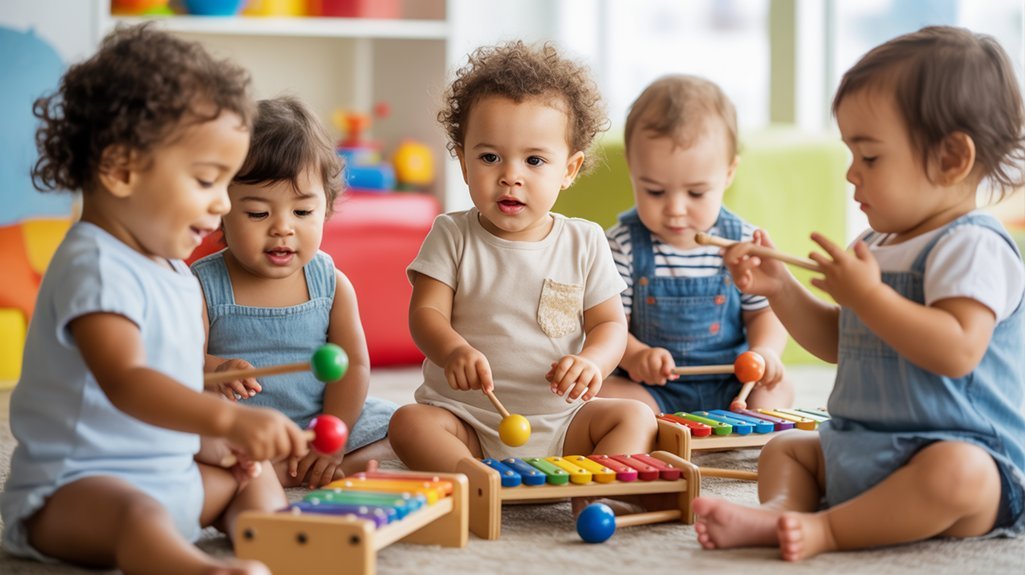
Music activities supercharge your toddler’s learning by simultaneously activating multiple brain regions that enhance memory, language, and problem-solving skills. When your child sings, claps, or dances, they’re building critical neural pathways that support cognitive flexibility, pattern recognition, and mathematical reasoning. These musical experiences also strengthen social skills through group interaction while refining both gross and fine motor coordination. The rhythmic and melodic structures naturally mirror speech patterns, making vocabulary retention easier and more enjoyable. Discover how these powerful connections shape your child’s development for years to come.
Key Takeaways
- Music activates multiple brain regions simultaneously, strengthening neural connections that enhance memory retention, cognitive flexibility, and overall learning capacity.
- Rhythmic and melodic patterns in songs mirror natural speech, accelerating language development through improved phonetic recognition and vocabulary retention.
- Musical activities develop both gross and fine motor skills through dancing, instrument playing, and clapping games that improve coordination.
- Group music sessions teach essential social skills including turn-taking, cooperation, and emotional expression while fostering empathy and belonging.
- Rhythmic patterns and counting songs build mathematical foundations by introducing concepts like sequencing, timing, and relationships between sounds.
Music Strengthens Memory and Cognitive Development in Young Children
When toddlers engage with music, their brains form neural connections that support both memory retention and cognitive growth. You’ll notice your child remembers song lyrics and melodies quickly because music activates multiple brain regions simultaneously. This process strengthens memory recall, helping toddlers retain information more effectively.
Musical activities enhance cognitive flexibility by teaching your child to recognize patterns, anticipate sequences, and adapt to rhythm changes. When your toddler claps along to beats or identifies different instruments, they’re developing critical thinking skills that transfer to other learning areas.
Through rhythmic play and musical exploration, toddlers build pattern recognition and adaptability skills that strengthen their cognitive development across all learning domains.
Research shows that children exposed to regular music activities demonstrate improved language acquisition, mathematical reasoning, and problem-solving abilities.
You’re essentially giving your toddler’s brain a comprehensive workout that builds foundational skills for future academic success.
How Rhythm and Melody Enhance Language Acquisition
Music’s cognitive benefits extend directly into language development through its rhythmic and melodic structures. When you expose your toddler to songs, you’re teaching them about syllable patterns and word stress through melodic patterns that mirror natural speech rhythms.
Singing helps your child recognize phonetic distinctions and remember new vocabulary more easily. The repetitive nature of children’s songs reinforces language concepts while making learning enjoyable. You’ll notice your toddler naturally begins mimicking rhythmic speech patterns they hear in music.
Research shows that musical training strengthens the same neural pathways used for processing language. When your child claps along to beats or sways to melodies, they’re developing timing skills essential for understanding sentence structure and conversational flow, accelerating their overall linguistic capabilities.
Physical Coordination and Motor Skills Through Musical Movement
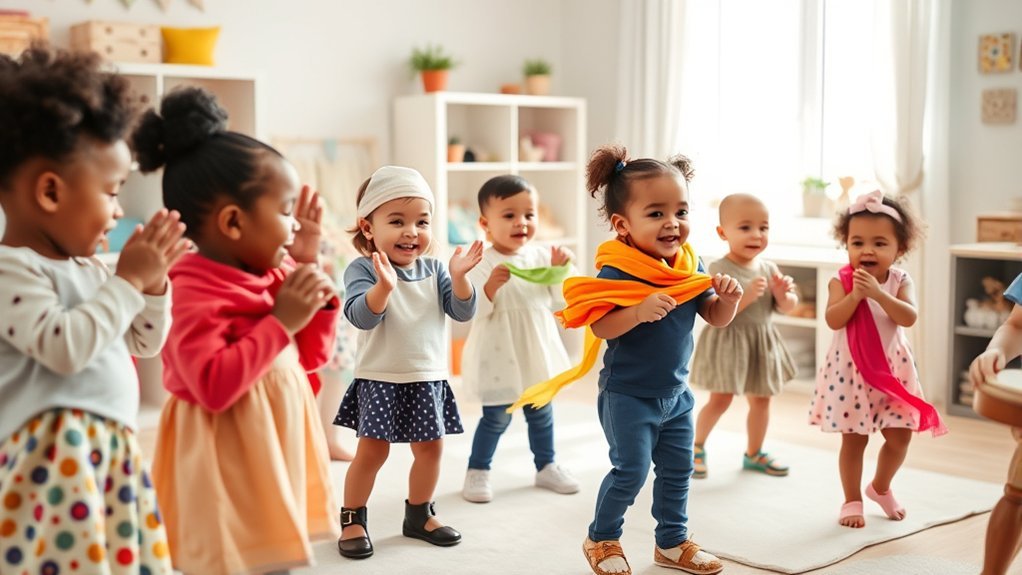
Through musical movement activities, your toddler develops essential gross and fine motor skills that form the foundation for physical competence.
Musical movement builds the physical foundation your toddler needs, developing both gross and fine motor skills through joyful, active play.
Dancing, jumping, and marching to music strengthen large muscle groups while improving balance and spatial awareness. These gross motor skills enable your child to navigate their environment confidently.
Meanwhile, playing simple instruments like shakers, tambourines, and drums refines fine motor skills. Grasping instruments, tapping rhythms, and coordinating hand movements enhance hand-eye coordination and dexterity.
These precise movements prepare your toddler for future tasks like writing and self-care activities.
Musical movement naturally integrates both skill types. Clapping games combine rhythm recognition with hand coordination, while action songs like “Head, Shoulders, Knees, and Toes” teach body awareness.
This multi-sensory approach accelerates physical development through enjoyable, repetitive practice.
Building Social Skills and Emotional Intelligence With Group Music Activities
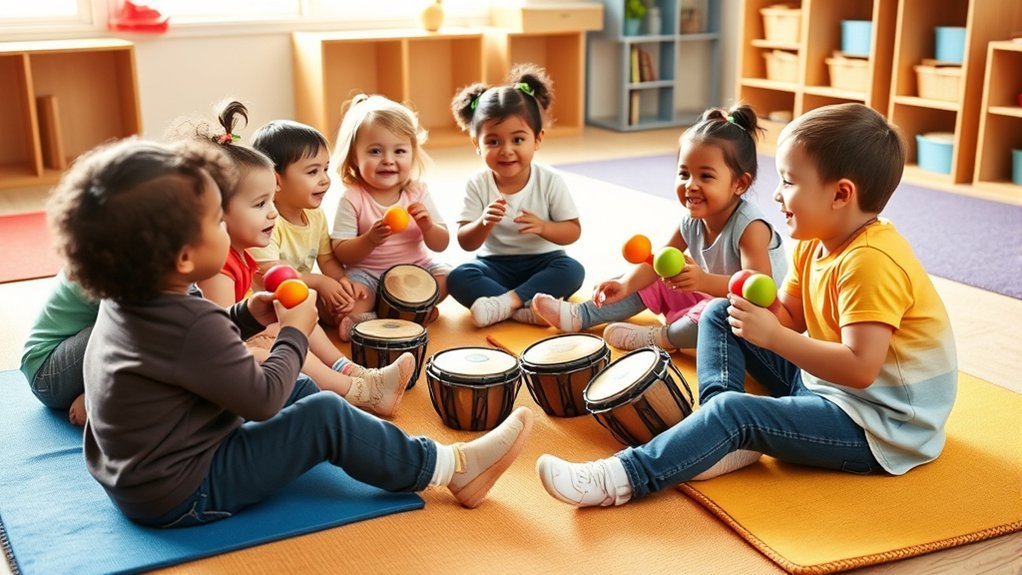
Group music activities transform individual physical development into shared experiences that teach toddlers how to interact, cooperate, and understand emotions.
When your toddler participates in musical circles, they’ll learn to take turns with instruments, wait for their cue to sing, and respond to others’ rhythms. This collaborative play naturally builds patience and respect for peers.
Music sessions give your child safe opportunities for emotional expression. They’ll learn to recognize feelings through song lyrics, identify emotions in others’ voices, and express their own moods through instrument choices or volume.
Clapping games teach timing and reciprocity, while group singing creates belonging and unity.
You’ll notice your toddler developing empathy as they observe classmates’ reactions to different musical activities, strengthening their social awareness and emotional intelligence.
Pattern Recognition and Mathematical Thinking Through Musical Elements
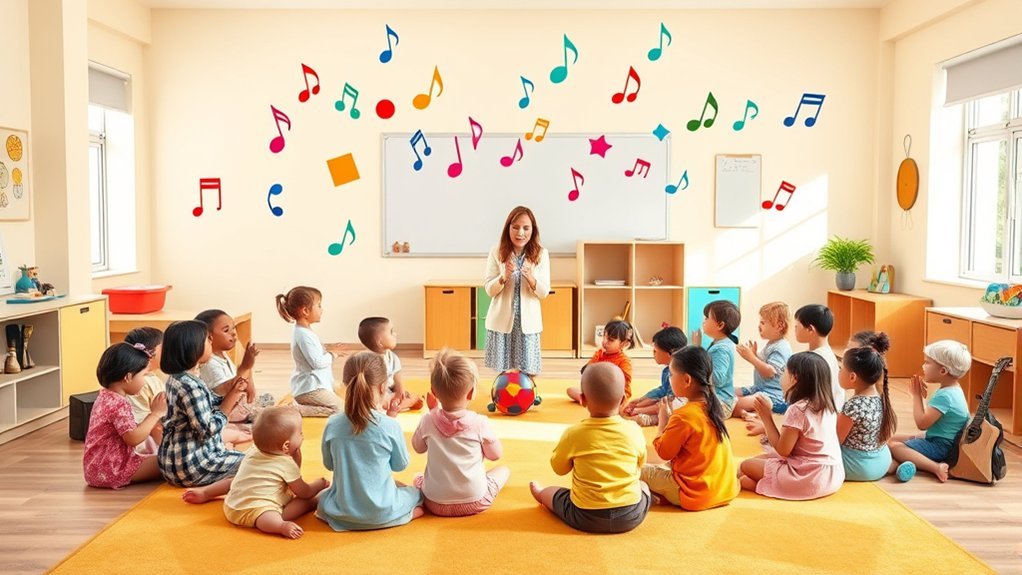
Every time your toddler claps to a beat or sings a repetitive song, they’re building foundational math skills without realizing it. Music naturally introduces patterns through rhythm, melody, and repetition. When your child recognizes that verses repeat or choruses return, they’re developing cognitive patterns essential for mathematical thinking.
Musical intervals teach your toddler about relationships between sounds—higher, lower, louder, softer. These comparisons directly translate to understanding more than, less than, and equal to. Counting songs reinforce number sequencing, while keeping steady beats develops timing and measurement concepts.
Through simple activities like clapping rhythms or playing instruments in patterns, you’re helping your toddler grasp sequences, predictability, and numerical relationships.
These early musical experiences create neural pathways that support future success in mathematics and logical reasoning.
Creating Lasting Neural Connections That Support Lifelong Learning
The musical patterns your toddler learns today aren’t just fleeting moments of fun—they’re actually sculpting their brain architecture for decades to come.
When your child engages with music repeatedly, they’re strengthening neural pathways that’ll support learning throughout their life. These connections don’t disappear after toddlerhood; they form the foundation for complex thinking skills.
Music activities create networks between different brain regions, enhancing cognitive flexibility—your child’s ability to switch between tasks and adapt to new situations.
This mental agility becomes crucial for problem-solving in school and beyond. The rhythm, melody, and coordination required in musical play literally rewire your toddler’s brain, establishing robust connections that make future learning easier.
You’re not just teaching songs; you’re building your child’s learning capacity for life.
In case you were wondering
What Age Should Toddlers Start Participating in Structured Music Activities?
You can start structured music activities when your toddler shows readiness around 18-24 months. Look for signs of music engagement like moving to rhythms, attempting to sing, or showing interest in instruments. They’ll naturally demonstrate when they’re prepared to participate.
How Much Daily Music Exposure Is Recommended for Optimal Toddler Development?
You’ll want 15-30 minutes of daily music exposure for optimal toddler development. Think of it like watering a plant—consistent, moderate amounts work best. Short, frequent musical moments throughout your day create lasting benefits without overwhelming your little one.
Do Toddlers Need Formal Music Lessons or Is Casual Exposure Sufficient?
Casual music engagement is sufficient for toddlers. You don’t need formal lessons yet. Simply singing, dancing, and playing with instruments together provides excellent learning benefits. Your interactive, playful approach naturally supports their development without structured instruction.
What Instruments Are Safest and Most Appropriate for Toddlers to Use?
You’ll find safe instruments for toddler play include shakers, tambourines, maracas, and xylophones with rounded edges. Avoid small parts that pose choking hazards. Wooden rhythm sticks and large drums also work perfectly for little hands exploring music.
Can Too Much Screen-Based Music Negatively Impact Toddler Learning Outcomes?
Yes, excessive screen time with music apps can reduce your toddler’s hands-on learning opportunities. The learning impact suffers when passive watching replaces active music-making, which develops crucial motor skills, social interaction, and sensory exploration through real instruments.
Conclusion
You’re not just teaching your toddler songs—you’re literally rewiring their brain for genius-level success! Every clap, dance move, and silly tune is building superhighways of intelligence that’ll last forever. Miss out on music now, and you’re closing doors that might never open again. Your child’s future brilliance starts with today’s singalongs. Don’t wait another second—their extraordinary potential is waiting to explode through music’s transformative power!