13 Educational Crafts That Make Learning Fun
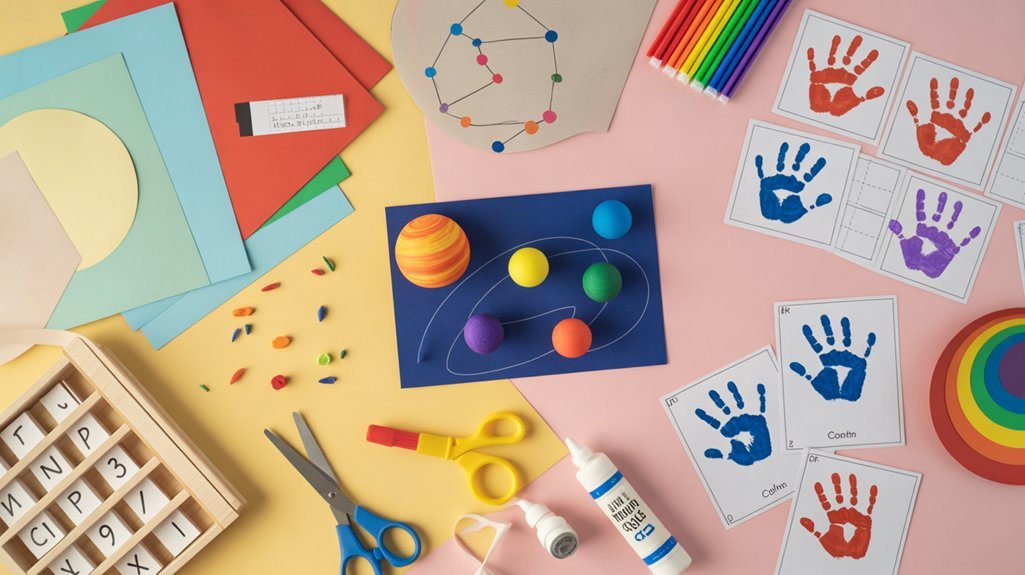
You can transform learning into hands-on adventures with crafts like DIY alphabet sensory bottles that make letter recognition tangible, math bead bracelets that turn counting into wearable fun, and volcano experiments that teach chemistry through exciting eruptions. Create fraction pizzas with felt pieces, grow crystal gardens to explore molecular structures, or build paper plate solar system mobiles that bring astronomy to life. Map treasure hunts develop spatial reasoning while handprint growth charts teach measurement skills. Below, you’ll discover detailed instructions for implementing each educational craft effectively.
Key Takeaways
- Sensory bottles with alphabet beads transform letter learning into tactile exploration, developing literacy and fine motor skills simultaneously.
- Math bead bracelets and fraction pizzas convert abstract mathematical concepts into tangible, manipulable objects for hands-on counting practice.
- Volcano experiments and crystal gardens teach scientific principles through interactive demonstrations of chemical reactions and molecular structures.
- Treasure hunts with homemade maps develop geography skills by teaching compass directions, scales, and spatial reasoning through adventure.
- Creative projects like solar system mobiles and handprint growth charts combine art with measurement, scale, and data tracking skills.
DIY Alphabet Sensory Bottles for Letter Recognition
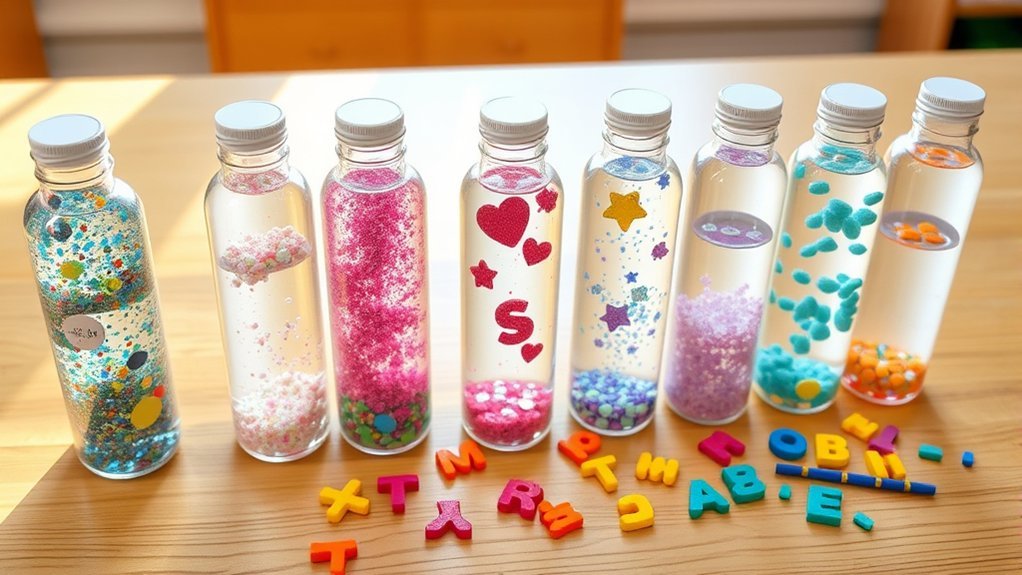
Sensory bottles transform letter learning into a hands-on adventure that captures children’s attention far better than flashcards alone.
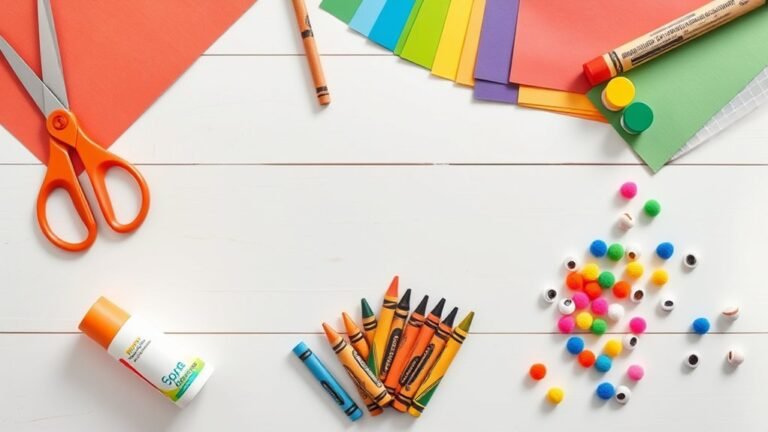
You’ll need clear plastic bottles, alphabet beads or foam letters, and colorful fillers like rice, glitter, or small pom-poms.
Fill each bottle with your chosen base material and add 3-4 letters of the alphabet. Seal the caps tightly with hot glue to prevent spills. Kids can shake, turn, and hunt for hidden letters, making sensory play an engaging educational tool.
Create themed bottles by grouping letters that form simple words or matching letters with objects that start with them. This approach encourages letter exploration while developing fine motor skills and visual tracking abilities.
You’re building foundational literacy skills through interactive discovery rather than passive memorization.
Paper Plate Solar System Mobile
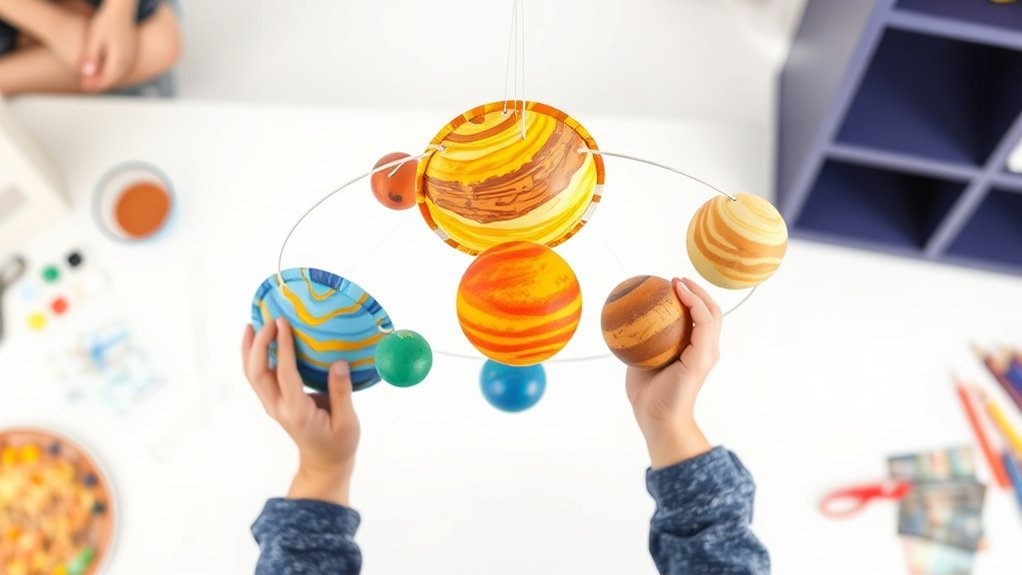
A paper plate solar system mobile brings astronomy to life while teaching children planetary order, relative sizes, and basic space concepts.
You’ll transform simple paper plates into planets by painting them with accurate colors—Jupiter’s swirling storms, Saturn’s distinctive rings, and Mars’s rusty red surface. This mobile craft reinforces spatial reasoning as kids arrange planets in correct orbital sequence.
Essential Learning Components:
- Scale awareness – Comparing planet sizes helps children grasp astronomical proportions.
- Orbital mechanics – Hanging planets at varying distances demonstrates solar system structure.
- Scientific observation – Researching each planet’s characteristics develops investigation skills.
Suspend your completed solar system from a coat hanger or embroidery hoop, creating a three-dimensional reference tool.
You’ll find children naturally memorize planetary facts while admiring their handmade celestial creation.
Math Bead Bracelets for Counting and Patterns

While exploring space concepts develops children’s understanding of the cosmos, math bead bracelets bring numerical learning directly to their wrists as wearable teaching tools.
You’ll create these bracelets by threading colorful beads onto elastic string, establishing bead color patterns that reinforce mathematical concepts. Start with simple sequences like red-blue-red-blue, then progress to complex patterns requiring prediction skills.
These bracelets transform abstract numbers into tangible objects children can touch and count. You can assign values to different colors, making addition and subtraction interactive. String ten beads to demonstrate place value fundamentals.
Incorporate counting games by asking children to identify specific beads or skip-count using their bracelets. They’ll practice multiplication tables by creating groups of identical colors.
The wearable nature ensures continuous learning reinforcement throughout the day, turning jewelry into functional mathematical references children proudly display.
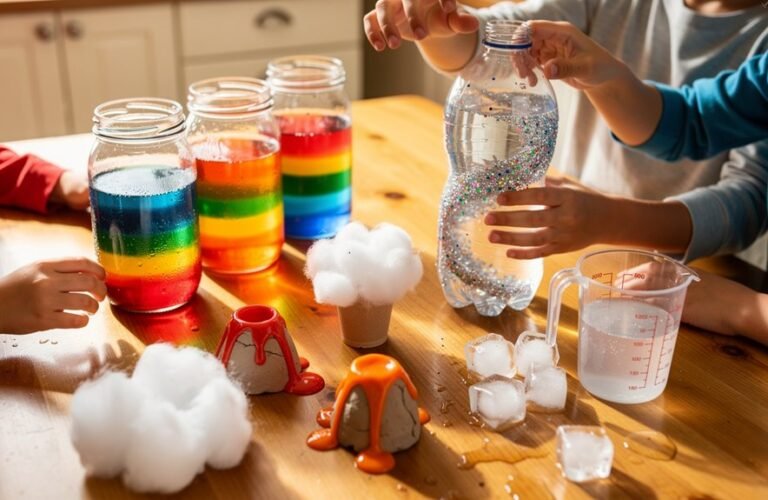
Volcano Science Experiment With Clay Modeling

Building on hands-on mathematical learning, volcano experiments combine geological education with chemical reactions that’ll captivate young scientists.
You’ll mold a volcano using clay composition techniques, creating realistic layers and crater formations while discussing Earth’s structure.
The lava eruption occurs when you mix these three ingredients inside your volcano:
- Baking soda (base compound representing magma)
- Vinegar (acid triggering the chemical reaction)
- Red food coloring (simulating molten lava flow)
When combined, they’ll produce carbon dioxide gas, causing dramatic foaming that mimics real volcanic activity.
You’re teaching children about acid-base reactions, tectonic plate movements, and volcanic formation simultaneously.
This hands-on experiment reinforces scientific method principles—hypothesizing, observing, and concluding—while developing fine motor skills through clay modeling and measuring ingredients accurately.
Handprint Growth Chart for Measuring and Tracking
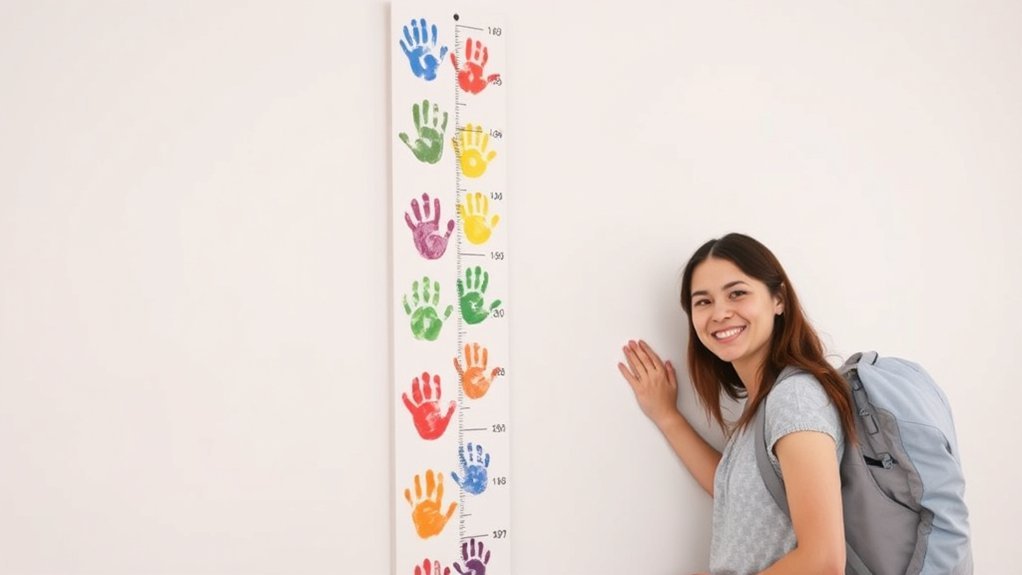
Moving from volcanic reactions to personal milestones, you’ll find that handprint growth charts transform mathematical measurement into treasured keepsakes. This craft teaches children about units, increments, and data tracking while documenting their physical development.
Create your chart using canvas or sturdy poster board marked with inch or centimeter intervals. Your child practices measuring skills by reading their current height and calculating growth between measurements.
Canvas or poster board with measurement intervals helps children practice reading heights and calculating personal growth between recording dates.
Add painted handprints at each recording date, incorporating colors that represent different seasons or years. This height tracking system introduces concepts like estimation, comparison, and timeline creation.
Children observe growth milestones quarterly or annually, learning to interpret visual data patterns. They’ll practice addition by calculating how many inches they’ve grown, making abstract math concepts tangible through personal experience.
Recycled Materials Robot Building for Engineering Skills
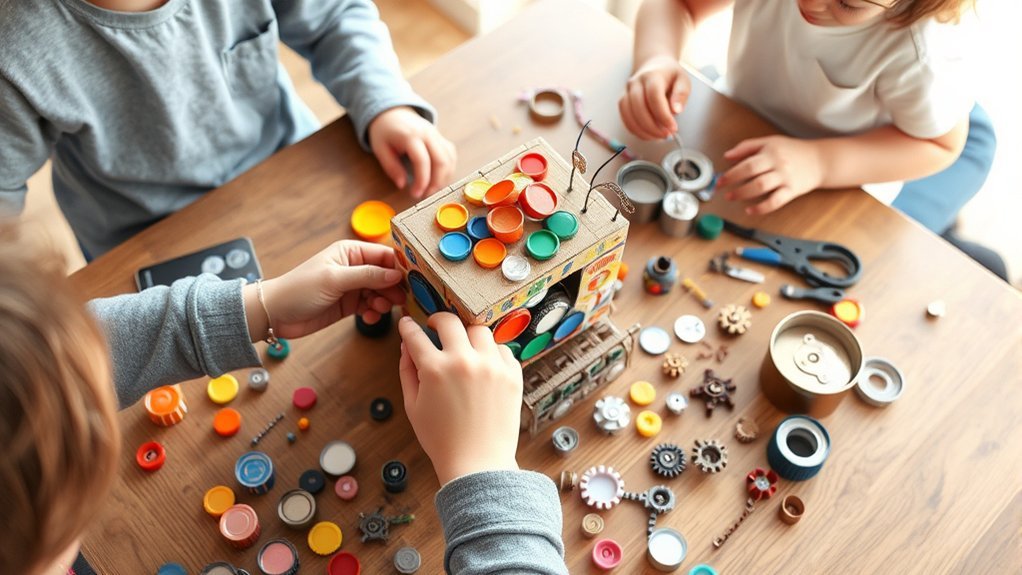
After documenting growth patterns, you can shift focus to hands-on engineering by transforming household recyclables into functional robots.
Robot recycling teaches children fundamental engineering creativity while promoting environmental awareness. Kids learn problem-solving as they design mechanical features using everyday materials.
Essential components for building include:
- Structural pieces: Cardboard boxes, plastic bottles, and food containers form the robot’s body and limbs.
- Moving parts: Bottle caps, straws, and paper fasteners create joints and rotating mechanisms.
- Decorative elements: Buttons, foil, and wire add personality while reinforcing circuitry concepts.
You’ll watch your child experiment with balance, stability, and basic mechanics.
They’ll discover how different materials affect movement and functionality. This engineering creativity activity builds spatial reasoning, critical thinking, and persistence—skills that extend far beyond craft time into real-world applications.
Watercolor Color Wheel for Art and Science
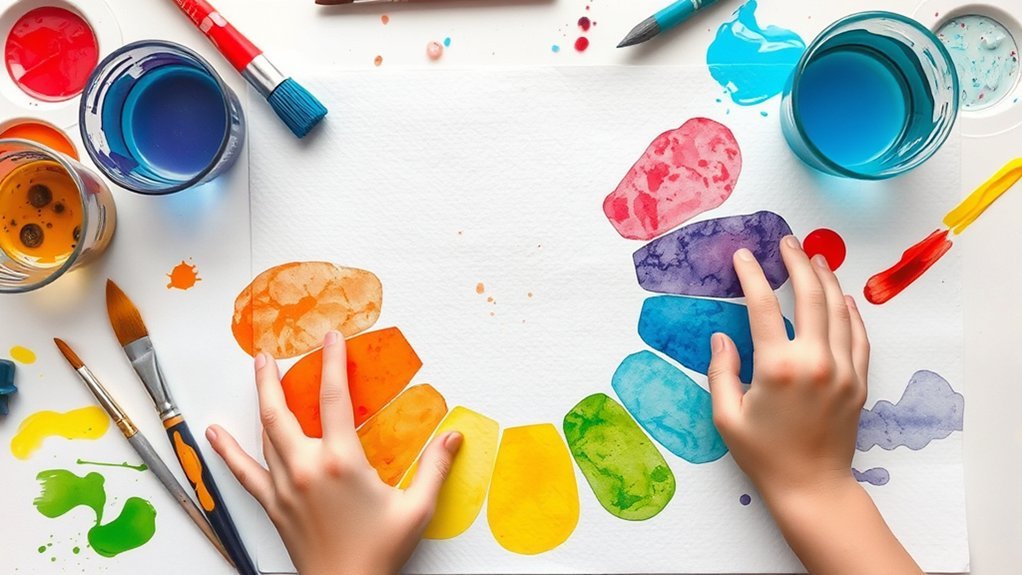
While robot building explores mechanical principles, watercolor color wheels introduce children to the science behind pigments and light. You’ll help kids understand primary, secondary, and tertiary colors through hands-on experimentation with paints.
Start by drawing a circle divided into twelve sections. Your child paints red, blue, and yellow in alternating segments, leaving spaces between them. They’ll then practice color mixing by blending adjacent primaries to create secondary colors—orange, green, and purple.
The remaining sections showcase tertiary hues made by combining primary and secondary colors. This activity demonstrates art integration by merging creative expression with scientific observation.
Children document how different pigment ratios affect outcomes, learning about color theory while developing fine motor skills and patience through careful brushwork.
DIY Clock Craft for Teaching Time

Clock-making projects shift focus from color theory to practical math skills, giving children a tactile way to grasp time-telling concepts.
You’ll find that hands-on construction helps kids understand how hours and minutes relate to each other on a functional level.
Start with clock face templates that children can personalize through coloring and decoration.
Here’s what makes this craft effective:
- Paper plate foundations let kids draw numbers while learning clockwise progression
- Movable brass fasteners create interactive hour and minute hands for manipulation practice
- Decorated bezels transform learning tools into bedroom décor they’ll actually use
After assembly, you can transition seamlessly into time telling games where children set specific times, reinforcing their understanding through repetition and play-based learning activities.
Shape Collage Creatures for Geometry Learning

When children transform geometric shapes into whimsical creatures, they’re absorbing spatial reasoning concepts without realizing they’re in a math lesson.
Learning disguised as play proves most effective—children develop mathematical thinking while believing they’re simply creating art and having fun.
You’ll need construction paper in various colors, scissors, glue, and markers. Cut out circles, triangles, squares, rectangles, and hexagons in different sizes. Let your child arrange these shapes to create animals, monsters, or imaginary beings. A circle becomes a face, triangles form ears or spikes, and rectangles create legs.
This activity strengthens shape recognition as children identify and manipulate geometric forms. They’ll discover how shapes combine to create complex images while practicing creative storytelling by inventing personalities and adventures for their creatures.
Display finished collages and encourage your child to explain which shapes they used and why, reinforcing mathematical vocabulary through artistic expression.
Growing Crystal Gardens for Chemistry Exploration
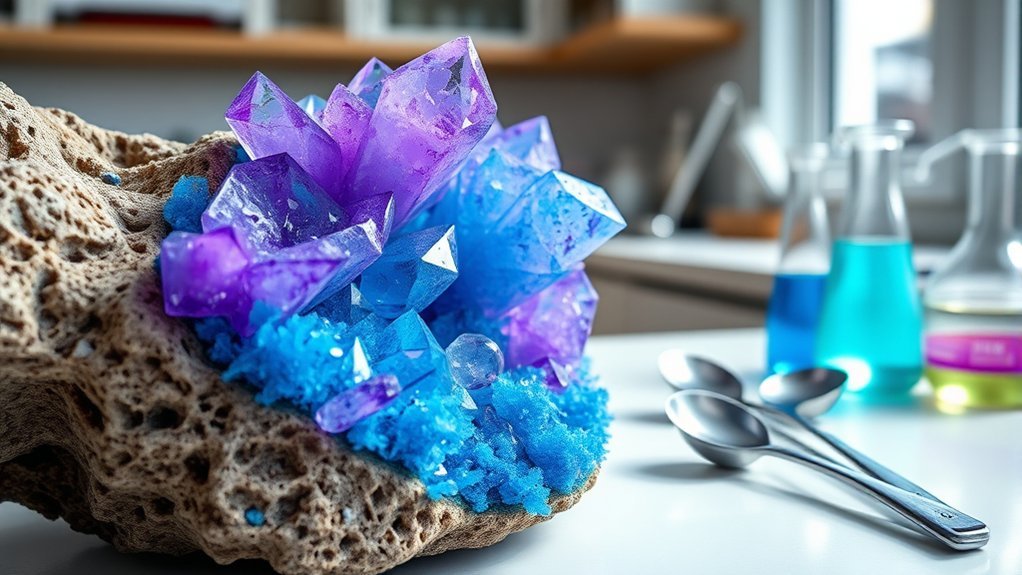
Just as shapes combine to form creatures, simple household ingredients can merge to create spectacular crystal formations that teach children about molecular structures and chemical reactions.
You’ll watch your child’s eyes light up as they observe crystal formation happening before them, transforming salt, sugar, or borax solutions into geometric wonders.
This hands-on experiment reinforces scientific concepts through three key learning stages:
- Solution preparation – Measuring and dissolving substances teaches ratios and saturation
- Observation period – Daily monitoring develops patience and data recording skills
- Crystal analysis – Examining shapes introduces molecular geometry concepts
Your budding scientist will discover how temperature affects chemical reactions while creating beautiful keepsakes.
These glittering gardens make abstract chemistry concepts tangible and memorable.
Map Skills Treasure Hunt Craft

By transforming your home or backyard into an adventure zone, you’ll teach children essential geography and spatial reasoning skills while they hunt for hidden treasures.
Start by creating a simple map of your space, marking landmarks like trees, furniture, or playground equipment. Add compass directions and a basic scale to introduce foundational map reading concepts.
Hide small prizes throughout the area and develop treasure clues that require children to interpret the map’s symbols and follow directional instructions. Each clue should challenge them to measure distances, identify coordinates, or navigate using cardinal directions.
You can increase difficulty by adding riddles or requiring multiple map references.
This hands-on activity transforms abstract cartography concepts into an exciting adventure that kids will remember long after the treasure’s found.
Fraction Pizza With Felt or Paper
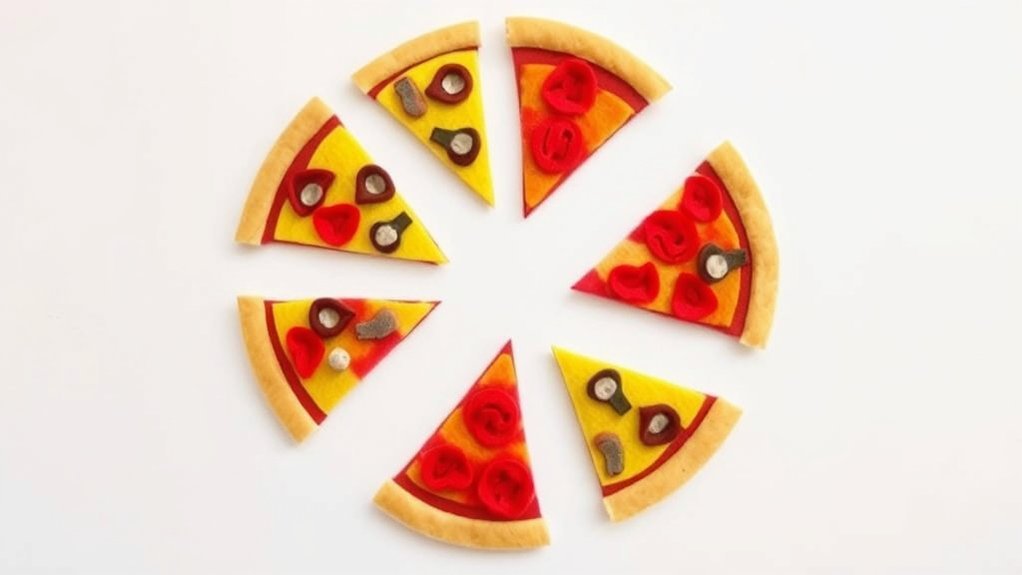
Since pizza is already divided into slices, it’s the perfect real-world model for teaching fractions to elementary-aged children. This hands-on craft transforms abstract mathematical concepts into tangible learning experiences through interactive fraction activities.
You’ll need felt or construction paper in various colors to create your pizza base and toppings. Cut a large circle, then divide it into equal slices—quarters, eighths, or sixths work well.
Benefits of this craft include:
- Students physically manipulate pieces to understand equivalent fractions
- Different pizza toppings represent various fraction combinations
- Children practice addition and subtraction by combining or removing slices
Let kids customize their pizzas with pepperoni, mushrooms, and other felt toppings. They’ll visualize how 2/8 equals 1/4 while building their perfect pie, making fraction concepts stick.
Life Cycle Wheel for Biology Concepts

A rotating wheel craft helps students grasp complex biology concepts by breaking down life cycles into manageable, visual segments.
You’ll create two circular discs—one slightly larger than the other—connected by a brass fastener at their centers. Cut a wedge-shaped window in the top disc to reveal different stages as it rotates.
This interactive tool works perfectly for teaching the life cycle of butterflies, frogs, plants, or any organism. Students draw each developmental stage in sequential order around the bottom disc’s perimeter. As they spin the wheel, they’ll visualize the continuous progression from one phase to the next.
You can differentiate this activity by having younger students illustrate basic stages while older learners add detailed descriptions of biological processes occurring during each transformation.
In case you were wondering
What Age Groups Are These Educational Crafts Most Appropriate For?
You’ll find these crafts work best for children aged 3-12 years. The craft age ranges span multiple educational levels, from preschoolers developing motor skills to elementary students exploring complex concepts. You can easily adapt activities for your child’s abilities.
How Can I Adapt These Crafts for Children With Special Needs?
You’ll find it’s no coincidence that adaptive strategies work beautifully for all children. You can modify crafts by incorporating sensory materials like textured fabrics, adjusting complexity levels, providing visual supports, and allowing extra time for completion.
Where Can I Find Affordable Supplies for Multiple Classroom Craft Projects?
You’ll find affordable craft supplies through bulk purchasing from wholesale retailers like Oriental Trading or Discount School Supply. Don’t overlook local thrift stores, where you can discover unique materials at fraction of regular costs for your classroom projects.
How Do I Assess Learning Outcomes After Completing Educational Crafts?
Studies show 73% of students retain information better through hands-on activities. You can assess learning outcomes by implementing craft reflection discussions and creating simple learning assessment rubrics that measure students’ understanding of concepts explored during their creative projects.
Can These Crafts Align With State or National Curriculum Standards?
Yes, you can easily align educational crafts with curriculum standards by mapping activities to specific learning objectives. This curriculum alignment ensures you’re maximizing educational benefits while meeting state or national requirements for your students’ grade levels.
Conclusion
You’ve just unlocked a treasure chest of hands-on learning that’ll transform your home into a buzzing classroom. These crafts aren’t just glue and glitter—they’re seeds you’re planting in young minds, ready to bloom into curiosity and understanding. Watch as abstract concepts crystallize into tangible creations, making those “aha!” moments sparkle like the crystals in your homemade garden. Education doesn’t have to feel like climbing a mountain; sometimes it’s more like painting one.