What Are The Best Educational Outdoor Activities?
You’ll find the best educational outdoor activities combine learning with adventure. Nature scavenger hunts sharpen observation skills while teaching local ecosystems, and geocaching turns exploration into high-tech treasure hunts that develop GPS navigation abilities. Set up outdoor science experiments to study weather patterns, or start a garden where children witness plant life cycles firsthand. Archaeological digs and historical site visits teach research methods and critical thinking. These hands-on experiences transform any outdoor space into a dynamic classroom, and there’s so much more you can discover about each activity.
Key Takeaways
- Nature scavenger hunts and bird watching sharpen observation skills while teaching children about local ecosystems and wildlife.
- Geocaching and orienteering develop navigation abilities through GPS technology, map reading, and problem-solving with outdoor treasure hunts.
- Outdoor science experiments and weather stations make scientific principles tangible by tracking conditions and analyzing soil properties.
- Gardening projects teach life cycles, composting, and ecosystem interdependence through hands-on plant cultivation and pollinator gardens.
- Archaeological digs and historical site exploration build critical thinking, research methods, and scientific methodology through excavation techniques.
Nature Scavenger Hunts and Wildlife Observation

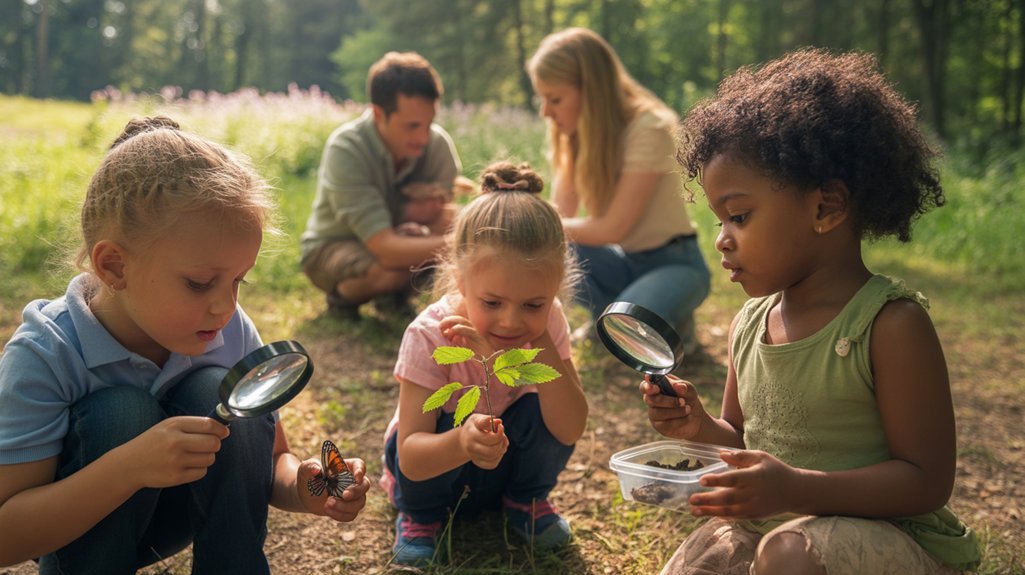
Nature scavenger hunts transform ordinary walks into exciting detective missions where children actively search for specific leaves, rocks, insects, or animal tracks.
You’ll find these activities sharpen observation skills while teaching kids about local ecosystems and biodiversity.
Bird watching adds another dimension to outdoor learning. You can equip children with binoculars and field guides to identify different species by their colors, songs, and behaviors.
Bird watching transforms children into patient observers as they learn to identify species through colorful plumage, distinctive songs, and unique behaviors.
They’ll develop patience and attention to detail while recording their findings.
Nature photography encourages creative documentation of discoveries. Give kids cameras or smartphones to capture interesting specimens, patterns, and wildlife moments.
This combines artistic expression with scientific observation, creating lasting records of their outdoor experiences.
You’ll notice improved focus and appreciation for natural details they’d otherwise overlook during casual outdoor time.
Geocaching and Orienteering Adventures
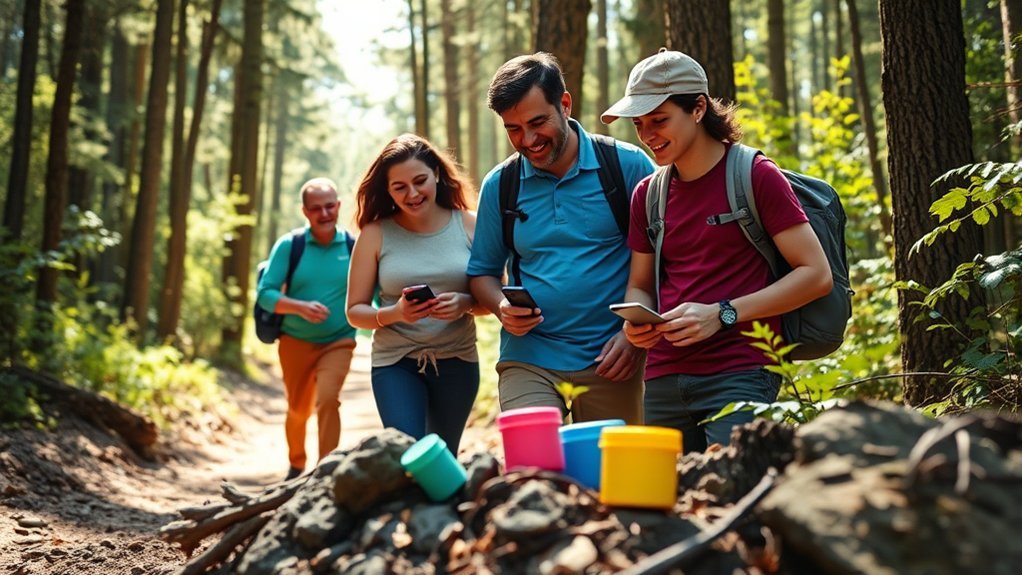
Geocaching turns the great outdoors into a high-tech treasure hunt that’ll engage even the most screen-attached kids. You’ll use GPS navigation to locate hidden containers while learning coordinate systems, distance calculation, and map reading. This modern treasure mapping activity teaches problem-solving as children decode clues and navigate terrain.
Orienteering takes these skills further by removing digital dependence. You’ll master compass use, topographic map interpretation, and landmark identification while racing between checkpoints. Kids develop spatial reasoning and critical thinking as they choose optimal routes through forests, parks, or urban environments.
Both activities build confidence through achievement. When you find that hidden cache or reach the final checkpoint, you’ve proven your navigation abilities.
These adventures create tech-savvy explorers who understand both digital tools and traditional wayfinding methods.
Outdoor Science Experiments and Weather Studies

While navigation skills sharpen the mind, the outdoors offers countless opportunities to explore scientific principles in action.
You can set up weather stations to track temperature, humidity, wind speed, and precipitation patterns. Recording daily observations helps you understand meteorological concepts and predict weather changes. These hands-on measurements make abstract science tangible and relevant.
Soil analysis reveals the hidden world beneath your feet. You’ll examine pH levels, test for nutrients, and study soil composition while learning about ecosystems and plant growth. Collect samples from different locations to compare properties and understand how soil affects local vegetation.
Simple experiments like observing cloud formations, measuring shadows to calculate sun angles, or studying water quality in local streams transform outdoor spaces into living laboratories where scientific concepts become real.
Gardening and Plant Life Cycle Projects

Getting your hands dirty with gardening projects connects you directly to life’s fundamental processes. You’ll observe plant growth from seed to harvest, tracking each developmental stage while understanding photosynthesis, root systems, and nutrient absorption.
Start a vegetable garden where you can measure growth rates, document flowering patterns, and analyze how sunlight exposure affects yields.
Track your plants’ transformation with careful measurements, detailed observations, and experiments that reveal how environmental factors shape garden success.
Composting techniques transform this learning experience by demonstrating decomposition and nutrient cycling. You’ll create rich soil amendments while reducing waste, teaching environmental responsibility alongside biology.
Build a compost bin, layer green and brown materials, and monitor temperature changes as microorganisms break down organic matter.
Consider starting a pollinator garden to attract bees and butterflies, expanding your understanding of ecosystem interdependence.
These hands-on projects make abstract biological concepts tangible and memorable.
Archaeological Digs and Historical Site Exploration
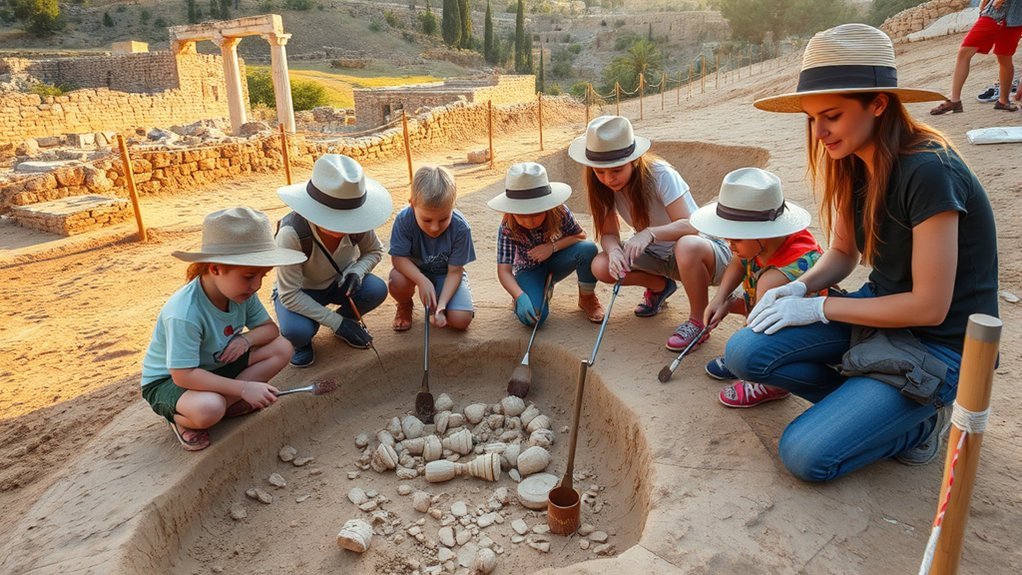
Transforming into a time detective through archaeological digs teaches you research methods, critical thinking, and cultural appreciation in ways textbooks can’t match.
You’ll master excavation techniques while uncovering ancient artifacts that connect you directly to past civilizations.
Many museums and historical societies offer youth archaeology programs where you can:
- Learn proper grid mapping and stratigraphic recording methods
- Practice identifying pottery shards, tools, and bone fragments
- Document findings through photography and detailed field notes
Historical site exploration complements hands-on digs by contextualizing discoveries.
You’ll examine preserved structures, interpret archaeological evidence, and understand how people lived centuries ago.
These experiences develop patience, attention to detail, and scientific methodology while making history tangible.
Whether participating in supervised excavations or visiting interpreted sites, you’re actively reconstructing human stories rather than passively reading about them.
In case you were wondering
What Safety Equipment Is Essential for Children During Outdoor Educational Activities?
You’ll need helmets that meet safety requirements for biking or climbing activities, a well-stocked first aid kit for treating minor injuries, sunscreen, insect repellent, and plenty of water to keep children hydrated during their outdoor learning adventures.
How Can Outdoor Activities Be Adapted for Children With Physical Disabilities?
You can adapt outdoor activities by creating inclusive environments with wheelchair-accessible trails, sensory gardens, and adaptive sports equipment. Partner children together, modify game rules, and use specialized gear ensuring everyone participates fully regardless of physical abilities.
What Is the Recommended Age Range for Different Outdoor Educational Activities?
You’ll find activity suitability varies by developmental stage. Age considerations suggest nature walks work for toddlers (2-4), scavenger hunts suit ages 5-8, camping fits 8-12, and complex activities like orienteering match teens 13+. Always assess individual readiness.
How Do Weather Conditions Affect Planning Outdoor Educational Activities?
While unexpected changes seem daunting, you’ll master weather forecasting to anticipate conditions effectively. Build activity flexibility into your plans by preparing indoor alternatives and backup dates, ensuring educational value isn’t lost when Mother Nature doesn’t cooperate with your schedule.
What Insurance or Liability Considerations Exist for Organized Outdoor Educational Programs?
You’ll need comprehensive risk management protocols and liability waivers signed by participants or guardians. You should also secure appropriate insurance coverage, conduct safety training, maintain emergency procedures, and document all activities to protect your organization legally.
Conclusion
You’ve discovered your toolkit for transforming the great outdoors into a living classroom. Like the explorers who once charted unknown territories, you’re now equipped to guide young minds through nature’s endless curriculum. Whether you’re following compass bearings like ancient navigators or unearthing artifacts that whisper forgotten stories, you’re crafting educational adventures that no four walls can contain. Step outside—your classroom awaits, vast as the horizon itself.