What Recycled Crafts Make Kids Happiest?
You’ll make kids happiest with recycled crafts that become purposeful play. Try toilet roll rockets, animals, and mini theaters for sequencing, storytelling, and self-regulation. Magazine collages and storyboards build narrative skills and attention. Cardboard box cities boost spatial reasoning, math talk, and cooperation. Bottle-cap games and musical makers strengthen fine-motor skills, rhythm, and turn-taking. Tin can planters and no-sew T‑shirt bags add real-life use, increasing motivation and ownership. Keep choice scaffolded and process-focused to spark creativity—and there’s more ahead.
Key Takeaways
- Projects that become toys—like cardboard box cities, bottle-cap games, and toilet-roll rockets—boost joy through pretend play and ownership.
- Hands-on, sensory builds—cutting, gluing, stacking, and decorating—raise engagement and satisfaction via fine-motor challenges and visible progress.
- Crafts with real-life use—T-shirt bags, tin-can planters, and fabric bookmarks—feel meaningful, increasing motivation and pride.
- Open-ended designs with choices—colors, materials, and roles—enhance autonomy, creativity, and happiness through self-expression.
- Music and movement makers—upcycled shakers and rhythm sticks—delight kids with sound exploration, coordination, and immediate feedback.
Toilet Roll Rockets, Animals, and Mini Theaters
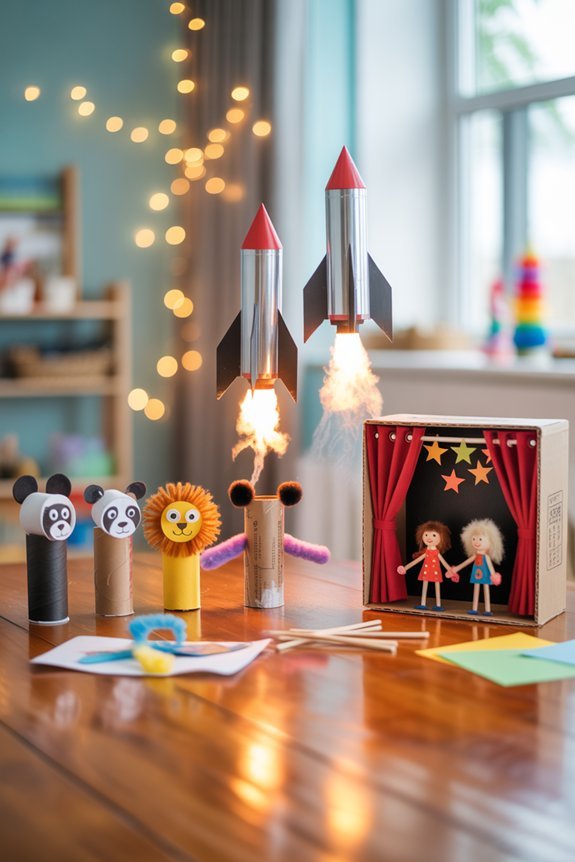
When you save toilet paper rolls, you unlock a versatile craft supply that supports fine-motor skills, problem-solving, and imaginative play. You’ll guide kids to cut, paint, and glue safely, building hand strength and coordination.
Try toilet roll crafts that become rockets, animals, and mini theaters. For rockets, add paper fins and a cone, then stage rocket launches with a countdown to practice sequencing and self-regulation.
For animals, encourage children to observe shapes—ears, tails, and patterns—supporting visual-spatial skills and creative decision-making.
For mini theaters, cut windows, add backdrops, and slide stick puppets through slots to practice storytelling, turn-taking, and perspective-taking.
Use recyclable scraps, non-toxic materials, and clear routines. Keep steps short, model techniques, and invite kids to test, revise, and proudly share.
Magazine Collages and Storyboard Art
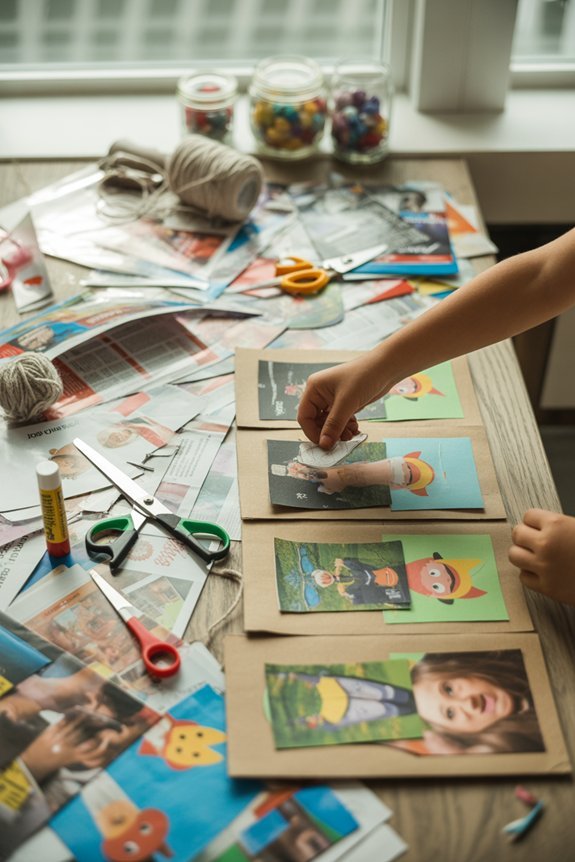
Two simple piles—old magazines and scrap paper—turn into rich tools for magazine collages and storyboard art. You’ll help kids cut, sort, and arrange images, then glue with purpose. Research on early literacy shows that sequencing pictures builds narrative skills and strengthens attention.
Use simple collage techniques: choose a color palette, group textures, and layer foregrounds and backgrounds. Invite kids to pick storyboard themes—“a rainy day adventure” or “a lost-and-found pet”—and sketch four boxes. Ask: What happens first? What changes? How does it end?
Offer safe scissors, glue sticks, and clear boundaries on page size to prevent overload. Model descriptive talk: “You chose warm colors for excitement.” Celebrate effort and revisions.
When kids author and assemble, they practice planning, vocabulary, and flexible thinking—joyfully.
Cardboard Box Cities and DIY Playsets
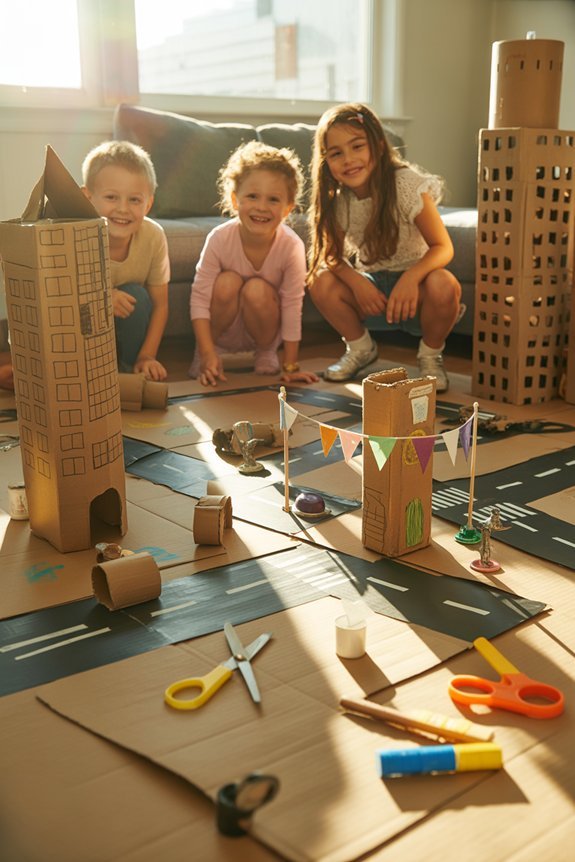
Storyboard squares grow into streets and skylines as you turn cardboard boxes into cities and DIY playsets. You’ll guide kids to plan neighborhood layouts, sketch roads with marker lines, and cut doors and windows to spark pretend play.
Research shows open-ended construction boosts spatial reasoning, math talk, and cooperative problem-solving. Keep pieces large, tape edges, and offer safe cutters suited to age.
Open-ended building sparks spatial reasoning, math talk, and teamwork—use big pieces, taped edges, and age-safe cutters.
- 1) Start small: one block becomes shops, parks, and cardboard castles. Children add signs, numbers, and maps, building literacy and navigation skills.
- 2) Rotate roles: city planner, builder, and storyteller. Turn-taking strengthens executive function and empathy.
- 3) Iterate: observe traffic jams or crowding, then redesign streets or zones. Iteration teaches testing, feedback, and resilience—key STEM habits.
Bottle Cap Games and Musical Makers
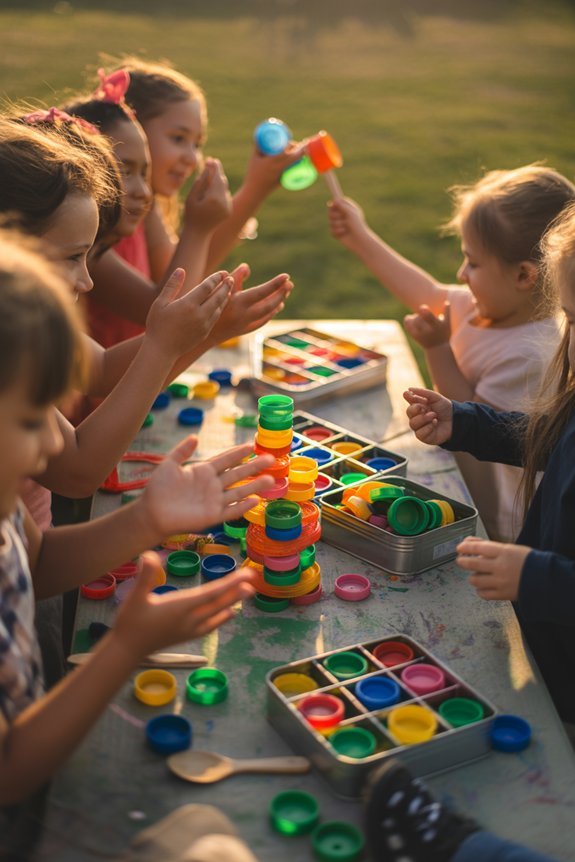
Turn bottle caps into simple DIY games that build fine-motor skills, counting, and turn-taking—research shows playful practice strengthens early math and self-regulation.
You can also make upcycled musical instruments, like shakers or mini cymbals, to explore rhythm and sound while supporting auditory discrimination and coordination.
Set clear steps, offer choices, and let kids test ideas so they stay engaged and successful.
DIY Bottle Cap Games
One simple way to spark play and creativity is to turn bottle caps into quick games and musical makers kids can design and use.
Try a bottle cap toss: tape shapes on the floor, then have kids aim by color or number. Or set up bottle cap basketball with a paper cup “hoop” at varied distances. These playful targets build hand–eye coordination, counting, and self-regulation.
- 1) Plan: Invite kids to choose rules and scoring. Choice boosts motivation and persistence.
- 2) Make: Let them decorate caps with symbols or sight words. Personalizing aids memory and language.
- 3) Play: Rotate roles—shooter, scorekeeper, referee—to practice math, fairness, and feedback.
Keep rounds short, celebrate effort, and adjust challenge to match skill so every child experiences success.
Upcycled Musical Instruments
After all that aim-and-score fun, keep those caps working by making simple instruments that invite rhythm, patterning, and self-expression.
Turn sturdy tins into upcycled drums: stretch a balloon over the top, secure with a rubber band, and glue on bottle caps as jingles around the rim. Kids can explore loud/soft and fast/slow while strengthening bilateral coordination.
For recycled maracas, fill two caps with beans or rice, tape them together, and attach a craft-stick handle. You’ll model steady beat, then let kids invent rhythms, echo patterns, and take turns leading.
Research shows rhythm play supports phonological awareness, attention, and self-regulation. You can scaffold choices—sound levels, tempos, decorations—so each child owns the process.
Keep safety tight: seal edges, supervise small parts, and offer noise breaks.
Tin Can Planters and Kitchen Container Crafts
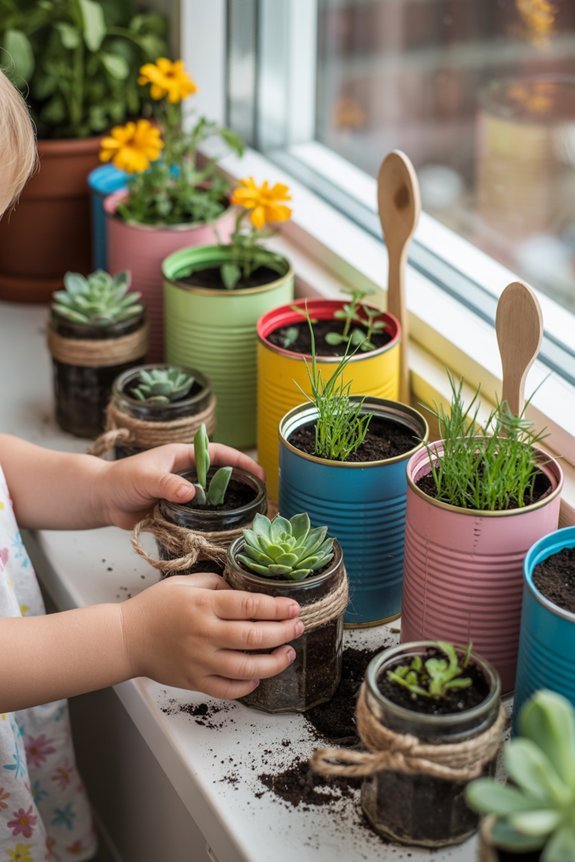
Start by preparing tins and plastic tubs safely: remove labels, smooth sharp edges with a can opener or sandpaper, and wash thoroughly to prevent cuts and germs.
Invite kids to choose age-appropriate tasks—taping rims, measuring soil, or sorting materials—since participation boosts fine-motor skills and ownership.
Then decorate with recyclables like fabric scraps, buttons, and paper offcuts, using non-toxic glue or tape to keep it colorful, secure, and classroom-safe.
Safe Can Preparation
Before kids turn tin cans into planters or kitchen caddies, you’ll make safety the first step. Rinse cans, remove labels, and dry completely to prevent rust and odors. Use a smooth-edge can opener; if edges feel sharp, sand lightly and add a strip of child-safe tape around the rim.
Pre-punch drainage or utensil holes with a nail and hammer on a wood block, keeping children at a safe distance. Store prepared cans in a labeled bin to model safe can storage and predictable routines that help kids focus.
1) Teach skills: You scaffold tasks—washing, sorting, and inspecting—so kids practice independence safely.
2) Reduce risk: You control tools, set limits, and check edges before handoff.
3) Increase joy: Safe prep frees energy for creative can repurposing and successful outcomes.
Decorating With Recyclables
With cans prepped and safe, invite kids to design planters and kitchen caddies using recyclables that spark choice and fine-motor practice. Offer recyclable materials—tin cans, yogurt tubs, spice jars—and set clear options: paint, washable markers, or paper wraps.
Add elastic bands for grip while decorating. Provide creative techniques like dot-painting, collage with tissue scraps, and rubber-stamping; these build bilateral coordination and planning.
Guide kids to measure ribbon around a can, tie labeled twine for herb names, and glue magnet strips for fridge caddies. Punch drainage holes for planters; for utensil holders, leave bases sealed.
Encourage patterns, simple faces, or nature themes to support visual organization. Celebrate function: kids see their planters thrive and caddies streamline snack prep—evidence of effort-to-outcome learning.
Fabric Scraps, T-Shirts, and No-Sew Creations
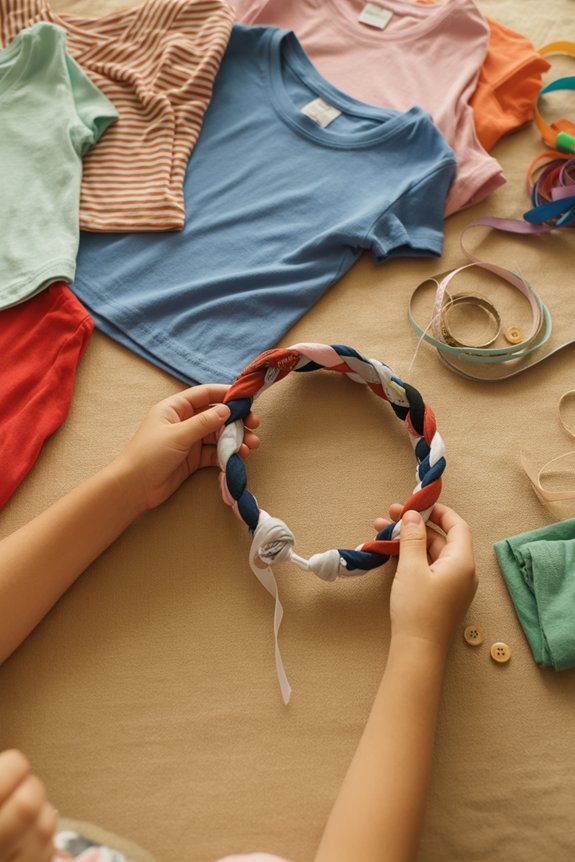
Although a sewing machine isn’t required, kids can transform fabric scraps and old T‑shirts into useful, creative projects that build fine-motor skills and confidence. You’ll guide cutting, knotting, and measuring while letting kids make choices about color and purpose.
Guide kids to cut, knot, and measure—turning scraps into confidence-building, purposeful creations.
Try quick wins: t shirt bags (cut sleeves, fringe the bottom, tie knots) and fabric bookmarks (stack scraps, glue, press under books). Both support hand strength and planning without overwhelm.
- Prioritize process over perfection: kids learn sequencing—measure, cut, assemble—which strengthens executive function.
- Offer scaffolded choices: two fabric options, one tool at a time; this reduces cognitive load and boosts autonomy.
- Embed real-life use: carry library books in t shirt bags, track reading with fabric bookmarks—purpose increases motivation and sustained attention.
In case you were wondering
How Do Recycled Crafts Impact Kids’ Environmental Awareness Long-Term?
Recycled crafts build lasting environmental awareness by letting you practice stewardship early. You connect actions to outcomes, develop a sustainability mindset, and strengthen creative expression. Regular, scaffolded projects, reflection, and family routines reinforce habits, internalize values, and sustain pro-environmental behaviors into adolescence.
What Age-Appropriate Tools Improve Safety During Recycled Crafting?
Equip toddlers with safety scissors, child friendly glue, blunt needles, and fingertip guards—like tiny armor—so you prevent cuts, minimize fumes, and support motor skills. You’ll supervise closely, pre-punch holes, stabilize materials, and scale tool sizes to developmental readiness.
How Can Teachers Assess Learning Outcomes From Recycled Craft Projects?
You assess outcomes by creating rubric development aligned to standards, observing process skills, and analyzing artifacts. You prompt project reflection through journals, peer feedback, and self-assessments. You track vocabulary use, problem-solving, collaboration, and transfer to new tasks—developmentally appropriate, child-centered, evidence-based.
Which Recycled Materials Pose Hidden Allergens or Irritants for Children?
You should flag hidden allergens in egg cartons, nut jars, latex balloons, wool yarn, scented detergents, and moldy cardboard. Avoid irritant materials like bleach bottles, glitter, dryer lint, pinecones, and fragrance-heavy packaging. Prioritize unscented, clean, nonporous items and individual allergy plans.
How Do Crafts Support Sensory Needs and Neurodiverse Learners?
Crafts support sensory needs by offering structured sensory exploration, predictable routines, and choice. You scaffold steps, model regulation, and vary textures, tools, and pacing to boost neurodiverse engagement, fine-motor control, communication, joint attention, and autonomy, while minimizing overwhelm with clear visuals.
Conclusion
You’ve got a treasure trove in your recycling bin, and kids light up when you turn it into play. Research shows hands-on making boosts fine-motor skills, creativity, and storytelling—so let them lead. You scaffold safety, offer choices, and celebrate process over perfection. From toilet roll rockets to tin can planters, each project is a doorway to problem-solving. Follow their curiosity, keep tools simple, and watch confidence grow like a bean sprout reaching for sun.