Surviving the Last Week of School: When Your Kid Has Already Checked Out
By the last week of school, your kid’s basically a backpacked zombie whose “brain is full” and you’re just trying to get them out the door without tears. Stop aiming for perfect; aim for “good enough to turn in.” Keep sleep, simple routines, and one or two must-do tasks (like: “Just bring your folder, please”) and let the rest slide. Add small fun—silly books, snack-style lunches, ice cream. Want fewer fights and less drama this week?
Key Takeaways
- Reset expectations: focus on essential assignments and basic participation, not perfect performance or every missing worksheet.
- Keep simple routines: consistent sleep, easy mornings, and one or two daily “anchor” habits to reduce chaos.
- Partner with teachers: ask what truly matters this week and ignore non-essential emails, projects, and extras.
- Use positive reinforcement: notice small efforts, praise tiny wins, and swap boring work for fun learning, games, or shared reading.
- Add small celebrations: let kids help pack snack-style lunches and mark the last day with a special treat to honor everyone’s effort.
Understanding Why Kids Mentally Clock Out Early

By the last week of school, kids’ brains are basically packing their bags and waiting by the door. You’re watching homework time turn into “stare at the wall” time and wondering what happened.
It’s not that your kid suddenly hates learning. It’s end of year fatigue. They’ve pushed through tests, projects, state exams, spirit week, and about nine thousand assemblies. Their brain is done cooking.
On top of that, the routine is breaking down. Teachers ease up, schedules go weird, and every kid can smell summer like french fries in the hallway. That makes mental disengagement way easier.
Why focus on fractions when vacation is doing cartwheels in their head? Their body’s at a desk, but their mind’s already at the pool all day.
Spotting the Signs Your Child Is Done (Even If School Isn’t)

Summer brain has officially left the building, but the school calendar hasn’t gotten the memo, and that’s when the weird behavior starts.
You see it in the mornings first. They’re moving like a sloth in wet socks, backpack half-open, homework “accidentally” forgotten again. Their teacher starts emailing about daydreaming, missing directions, and zero interest in group work—classic signs of disengagement.
At home, they snap over tiny things, melt down about “too many days left,” and claim they “can’t think anymore.” That’s not drama; that’s emotional exhaustion.
You might notice more stomachaches, mystery headaches, or sudden hatred of pants. Bedtime gets later, mornings get louder, and their usual spark feels dim.
When school still expects full-on effort, but your kid’s brain has already rolled out a beach towel, it’s pretty clear.
Resetting Your Own Expectations for the Final Stretch

Even if your kid is dragging through these last days, let’s be honest—you’re probably over it too. This is the week when permission slips vanish, lunches get weirder, and everyone’s running on fumes and caffeine.
So start resetting priorities. Ask yourself, “What actually matters this week?” Hint: it’s not the perfect themed outfit for Spirit Day. Maybe it’s just: kid gets there, mostly on time, wearing something that’s clean-ish.
Adjusting mindset doesn’t mean giving up. It means dropping the fantasy version of school and working with the real one. You trade A+ effort for “good enough to survive.”
You stop arguing over every missing pencil. You accept that the last week is more about landing the plane than polishing it. Let small stuff slide.
Simple Routines That Still Matter This Week

When the whole week feels like chaos on wheels, a few tiny routines are the only things standing between you and total meltdown.
Start with sleep. Keep bedtime routines simple but sacred: bath, book, lights out. No, your kid won’t die without one more episode. Sleep is how their brain survives the pizza parties and movie marathons.
In the morning, do quick morning check ins. Two minutes at breakfast: “What’s happening today? Anything you’re worried about? Anything you’re excited for?” It keeps you in their loop, even if the loop is mostly “We’re watching Frozen again.”
Stick with one or two anchor habits—backpack check by the door, snack in the bag. Tiny structure, less drama. You’ll feel calmer, and your kid will too.
Motivating Without Bribing, Begging, or Battling

To spark intrinsic motivation, help your kid feel some control.
Offer two real choices: desk or couch, pencil or pen, music or silence. Same task, more power.
Then connect the work to something they actually care about: friends, sports, summer plans.
Connect the assignment to what lights them up: friends, sports, summer adventures.
“Finish this, and your brain is free.”
You’re not the warden. You’re their coach.
Less drama, more peace for both of you.
Handling Last-Minute Projects and Missing Assignments

You’ve tried the “You can work on the couch with lo-fi beats” trick, and that’s cute… until your kid suddenly remembers a giant project due tomorrow that “totally slipped their mind.”
Now you’re staring at a blank poster board at 8:37 p.m., googling “What is the water cycle?” like you didn’t pass 4th grade.
Breathe. You’re not fixing twelve weeks tonight. You’re doing triage. Ask, “What’s due and what’s ‘it would be nice’?”
Then use project prioritization strategies: break the beast into chunks and timebox each one.
Try this sort:
- Must do tonight or it explodes your grade
- Should do, but won’t ruin life if it’s messy
- Extra credit, only if energy magically appears
- Missing stuff to log in assignment tracking tools for rescue
Partnering With Teachers During the End-Of-Year Chaos

Even though it feels like teachers are part of some secret end-of-year plot, most of them are just as tired, frazzled, and over it as you are.
Instead of going full conspiracy mode, email the teacher and ask, “What actually matters this week?” You don’t need a novel, just a quick list: tests, must-do work, anything your kid could still fix.
Skip the panic. Ask the teacher what actually matters this week—tests, must-dos, fixable stuff.
That’s teacher collaboration at its best: you two on the same side, trying to drag one small human across the finish line.
Keep classroom communication simple. If email feels slow, write a short note, or message through the school app. You’re not bothering them—you’re helping them keep one more kid from mentally living at the pool already.
Teachers secretly love parents who ask.
Managing Behavior When Rules Start to Feel Optional

Right about now, it feels like your kid thinks school rules expired last week along with their attention span.
At home, you’re seeing the spillover: eye rolls, “do I’ve to?” and sudden amnesia about basic chores. This is where behavior management matters most.
Think of rule reinforcement like keeping the guardrails up when the road gets twisty. You don’t need new rules; you just need louder, clearer ones.
Try:
- State the rule in ten words or less, then repeat.
- Connect it to something they care about: screens, friends, later bedtime.
- Follow through on consequences, even when you’re fried.
- Notice tiny wins out loud, like a sports announcer.
You’re not being strict; you’re giving their tired brain structure. That’s how you survive this chaos.
Preparing for the Shift From School Days to Summer Mode
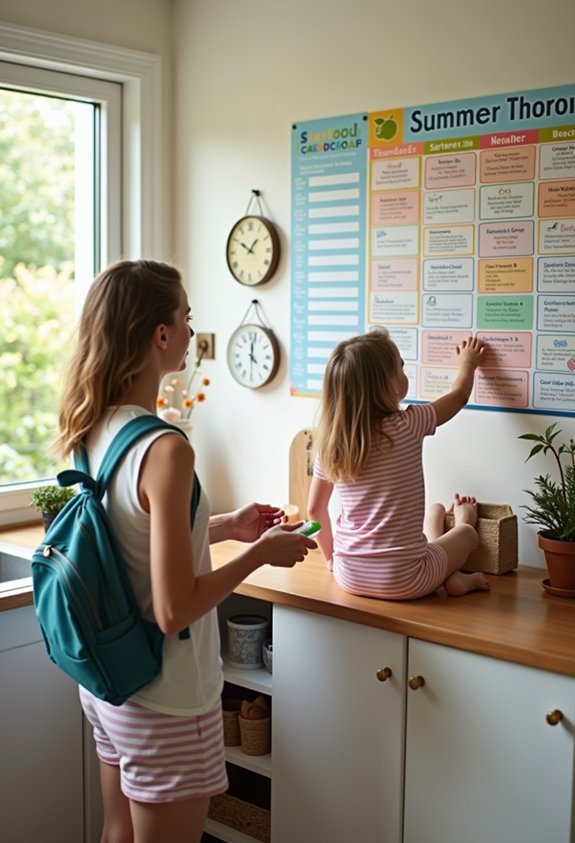
School rules may be hanging on by a thread, but guess what’s coming next: the wild jungle known as summer break. Your kid already smells the freedom.
So use this week to start shifting from strict school mode to “summer, but not chaos” mode.
Begin with tiny transition strategies. Maybe bedtime moves thirty minutes later, but screens still go off at a set time.
Test-drive a loose morning plan: breakfast, teeth, quick chore, then summer activities preview, like picking tomorrow’s park or library trip.
Talk about what’ll stay the same: respect, basic chores, no turning into a couch goblin.
When kids know what’s coming, the first real day of break doesn’t hit like a tornado. You stay calmer, and they melt down less.
Ending the School Year on a Positive, Low-Stress Note

By the last week, you’re not really “finishing the year” so much as “trying not to fully lose it in public.”
At this point, it’s less academic rigor and more “please don’t melt down in public.”
Homework is random, kids are wired, and you’ve got 47 emails about class parties, field day, and “just one more” spirit dress-up thing.
So lower the bar. Like, way down. Your goal isn’t perfect; it’s peace and basic hygiene.
Use positive reinforcement like it’s glitter: messy but magical for stress reduction.
Catch your kid doing one small thing right and hype it up.
To keep the vibe light, try:
- Skip extra worksheets; read a silly book together.
- Turn boring lunches into “clean-out-the-fridge snack buffets.”
- Give yourself permission to ignore non-essential emails.
- Celebrate survival with a last-day ice cream run for you, too, tonight.
In case you were wondering
How Do I Handle My Child Refusing to Attend the Last Few School Days?
You first validate your child’s feelings, then calmly insist on school attendance as a non‑negotiable routine. Collaborate on motivation strategies: small rewards, choices about outfits or lunches, and after‑school plans. Loop in teachers for support.
What if My Child’s Anxiety, Not Boredom, Is Driving Their End-Of-Year Shutdown?
You treat the shutdown as anxiety, not defiance, and explore anxiety triggers with your child. Collaborate with teachers, request accommodations, and practice coping strategies at home—breathing, scripts, exits—so school feels safer. Validate feelings; avoid pressure.
How Can Divorced or Separated Parents Stay Consistent This Chaotic Final Week?
You stay consistent by agreeing on simple parenting strategies, sharing schedules, and clarifying expectations. Use co parenting communication, avoid blaming, and focus on your child’s feelings, routines, and sleep so transitions feel predictable, not chaotic.
Should I Adjust Medications or Therapies as School Ends and Routines Change?
Yes, you might adjust things, but do it thoughtfully: schedule medication evaluations, coordinate therapy adjustments, monitor sleep, track mood, and share notes with providers so you respond, not react, to your child’s shifting summer rhythm.
How Much Extra Screen Time Is Reasonable During This Low-Structure Transition Week?
You can allow roughly one to two extra hours daily, as long as you keep clear screen time limits, tie them to routines, and balance activities with outdoor play, social time, chores, and offline hobbies.
Conclusion
Okay, deep breath. You’ve got this weird limbo week. Your kid’s brain has already gone on summer vacation with a tiny suitcase and flip-flops, but you’re still the pilot landing the plane. Keep routines light, expectations realistic, and battles tiny. Cheer the small wins. Laugh at the chaos. Partner with teachers, not against them. Finish the year like a slow clap—awkward at first, but somehow it turns into a standing ovation. You’ll remember you survived.