17 Reading Games That Boost Literacy Skills

You’ll discover 17 engaging reading games that transform literacy learning into exciting experiences your students will love. These activities target essential skills like sight word recognition through Bingo, phonemic awareness via Phonics Hopscotch, and vocabulary building with Synonym and Antonym Go Fish. Games like Story Cube Roll and Tell develop narrative abilities, while Comprehension Jenga and Character Hot Seat strengthen critical thinking. Prediction Dice and Timed Reading Challenges boost fluency and inference skills. Each game activates multiple learning pathways simultaneously, making literacy development feel less like work and more like play your children actively seek out. The following sections explore how these proven strategies work in detail.
Key Takeaways
- Sight Word Bingo and Go Fish variations make vocabulary acquisition engaging through game formats that reduce learning anxiety.
- Phonics Hopscotch combines physical movement with letter-sound practice, strengthening memory retention through multisensory learning approaches.
- Story Cube Roll and Tell develops narrative skills by encouraging children to build logical story structures using dice.
- Comprehension Jenga and Character Hot Seat transform reading analysis into interactive activities with different question difficulty levels.
- Timed Reading Challenges and Prediction Dice Game improve fluency and critical thinking through competitive, evidence-based gameplay.
Sight Word Bingo

Sight Word Bingo transforms the classic game into a powerful literacy tool that helps young readers master high-frequency words they’ll encounter in nearly every text. You’ll create cards featuring common words like “the,” “and,” “said,” and “was,” then call them out as children mark their boards.
The beauty lies in bingo card customization—you can adjust difficulty levels based on your child’s reading stage. Beginners start with simple three-letter words, while advanced players tackle more complex vocabulary. This flexibility ensures every child experiences success while building sight word recognition.
Customize bingo cards to match your child’s reading level, ensuring steady progress from simple three-letter words to advanced vocabulary.
You’ll notice improvements quickly. The repetitive nature reinforces word memory without feeling like traditional drilling. Kids stay engaged through friendly competition, and the game format reduces learning anxiety.
Play regularly for fifteen minutes, and you’ll see reading fluency soar.
Phonics Hopscotch
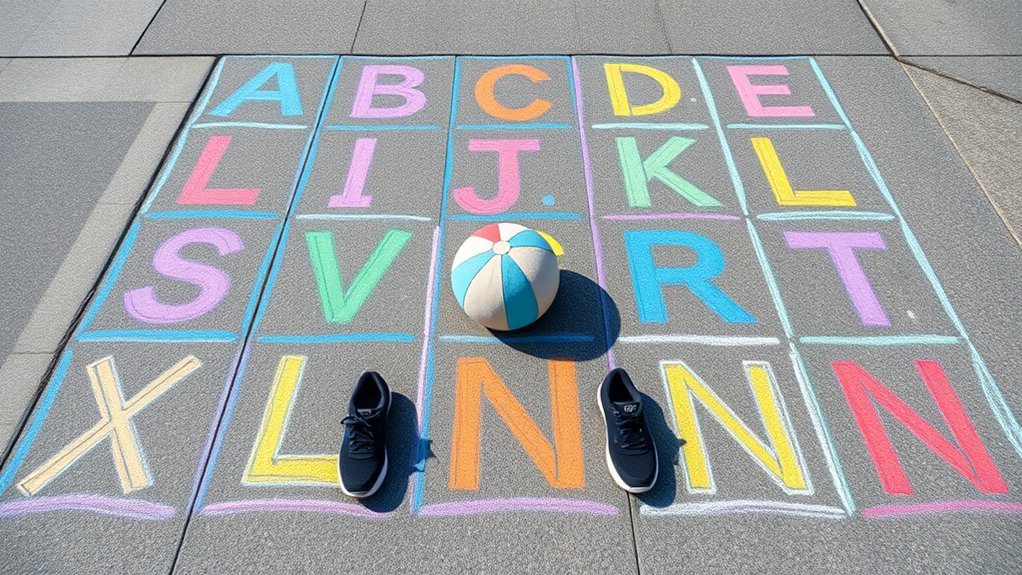
Phonics Hopscotch merges physical activity with letter-sound learning, turning your sidewalk or hallway into an interactive reading classroom. You’ll draw or tape hopscotch squares, placing letters or letter combinations in each space. As your child hops, they’ll call out the sound each letter makes, reinforcing phonics pathways through movement and repetition.
You can create hopscotch variations that target specific skills. Try consonant blends like “ch,” “sh,” or “th” in some squares, while others feature vowel teams such as “ai” or “ee.”
When your child lands on a square, they’ll say the sound and name a word containing it. This multisensory approach strengthens memory retention because they’re simultaneously moving, speaking, and thinking about letter-sound relationships, making abstract phonics concepts tangible and memorable.
Story Cube Roll and Tell
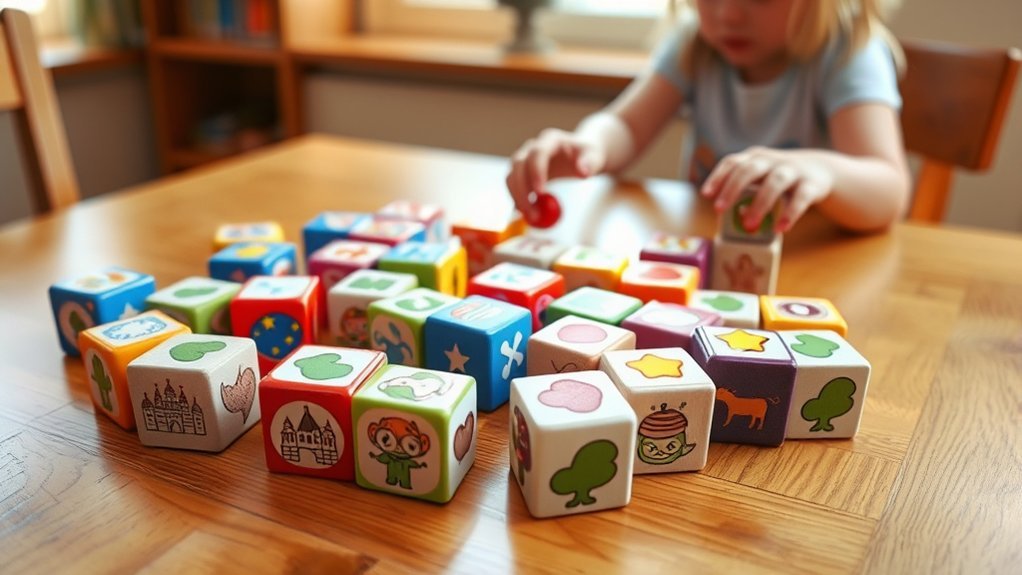
Story Cube Roll and Tell transforms narrative building into a hands-on game that develops sequencing, vocabulary, and creative thinking skills. You’ll create or purchase dice featuring images, symbols, or words on each face. When your child rolls the cubes, they construct stories using the pictures that appear, strengthening their narrative skills naturally.
Start with three cubes for younger learners, then add more as confidence grows. Encourage your child to connect the images logically, building beginning, middle, and end structures. This story creation process teaches cause-and-effect relationships while expanding descriptive language.
You can customize blank cubes with stickers matching your child’s interests or current reading themes. Set challenges like including specific vocabulary words or creating stories in different genres.
The tactile rolling action keeps engagement high while developing essential literacy foundations.
Alphabet Scavenger Hunt
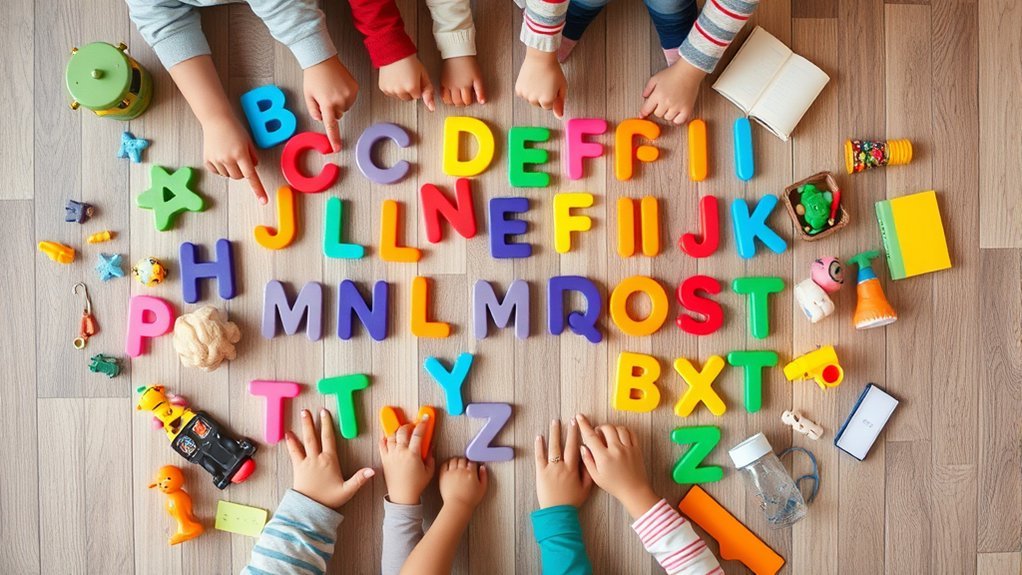
Alphabet Scavenger Hunt turns letter recognition into an active exploration that gets children moving while learning. You’ll give your child a letter to find, and they’ll search for objects starting with that sound throughout your home or yard.
Effective scavenger hunt strategies include starting with familiar letters like those in your child’s name. You can create letter cards to draw from a basket, making each hunt unpredictable and exciting.
Start with letters from your child’s name and draw random letter cards from a basket to keep the hunt engaging.
As your child discovers items, have them say the letter sound and object name aloud, reinforcing alphabet recognition through repetition.
Progress from single letters to finding multiple items per letter, or challenge older children to locate objects for entire words. This hands-on approach transforms abstract letters into concrete, memorable experiences that strengthen reading foundations.
Reading Relay Race

While scavenger hunts build letter recognition through stationary objects, racing games add speed and physical energy to sight word practice. You’ll divide students into teams, placing word cards at the opposite end of your space. Each player sprints to grab a card, reads it aloud, then races back. This format naturally incorporates physical activity while building reading speed.
Your teamwork strategies should encourage peer support—teammates can help decode challenging words. Add comprehension tactics by requiring players to use their word in a sentence before tagging the next runner.
The competitive spirit drives engagement techniques that transform reluctant readers into enthusiastic participants. These motivation boosters work because they combine literacy challenges with movement. You’re not just teaching words; you’re creating memorable experiences that strengthen retention.
Word Family Sorting Game
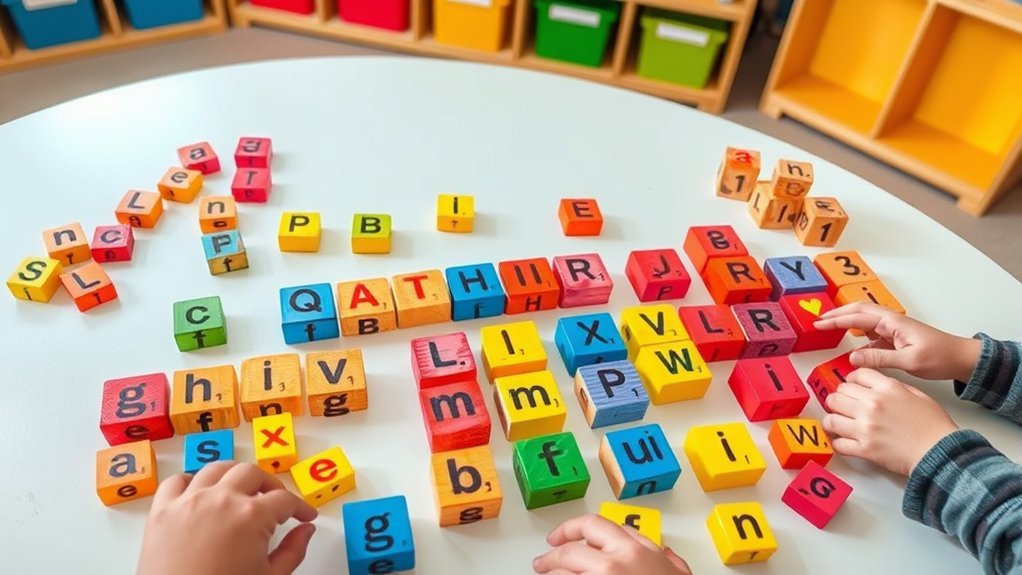
Four simple bins transform phonics instruction when you introduce word family sorting. You’ll watch students quickly grasp phonetic patterns as they categorize words ending in -at, -an, -it, and -og. This hands-on approach makes abstract concepts concrete.
Word family sorting turns phonetic patterns into tangible learning experiences, helping students physically connect similar word endings through categorical play.
Set up your word sorting station with these materials:
- Labeled containers for each word family you’re targeting
- Word cards featuring common examples like “cat,” “bat,” “man,” and “can”
- Picture cards to support emerging readers who need visual cues
- Timer to add excitement and track progress over time
You can adapt these family games for individual practice or small group competition. Students develop decoding skills while manipulating physical cards, and the immediate feedback helps reinforce correct patterns.
The activity builds confidence as children recognize similarities across multiple words.
Comprehension Jenga
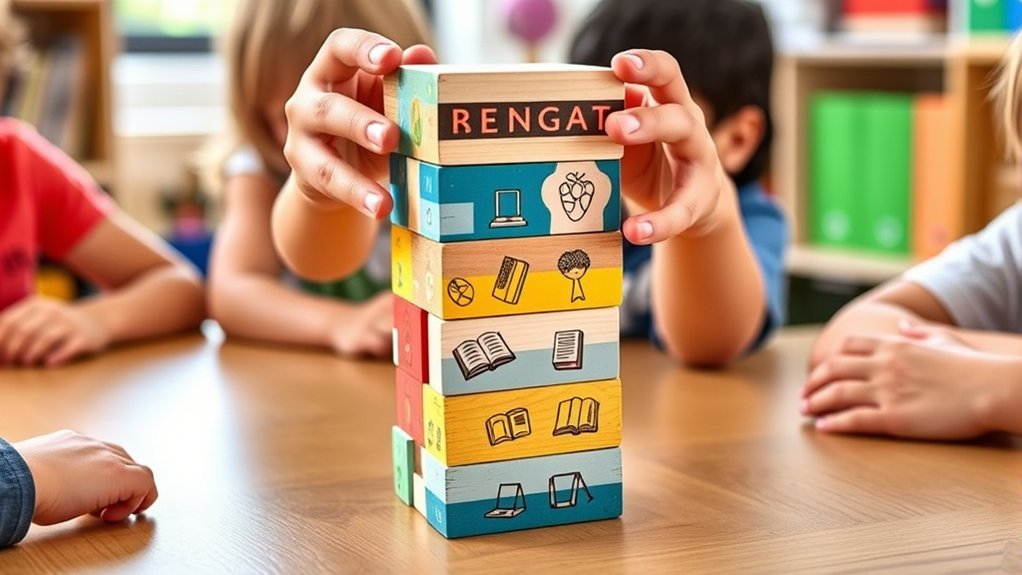
After students read a passage or story, stack your Jenga blocks with comprehension questions written on each piece. Players pull blocks and must answer questions before placing them on top. This engaging approach transforms passive reading into active learning while developing critical comprehension strategies.
Write questions targeting different thinking levels: literal questions about plot details, inferential queries requiring evidence-based conclusions, and evaluative prompts asking for personal connections. You’ll reinforce multiple comprehension strategies simultaneously.
Consider these jenga adaptations to increase difficulty: color-code blocks by question complexity, add vocabulary definitions, or include “challenge” blocks requiring students to summarize entire chapters.
You can also create themed sets for specific texts, making review sessions memorable and interactive. This kinesthetic approach particularly benefits tactile learners who struggle with traditional comprehension worksheets.
Rhyming Memory Match
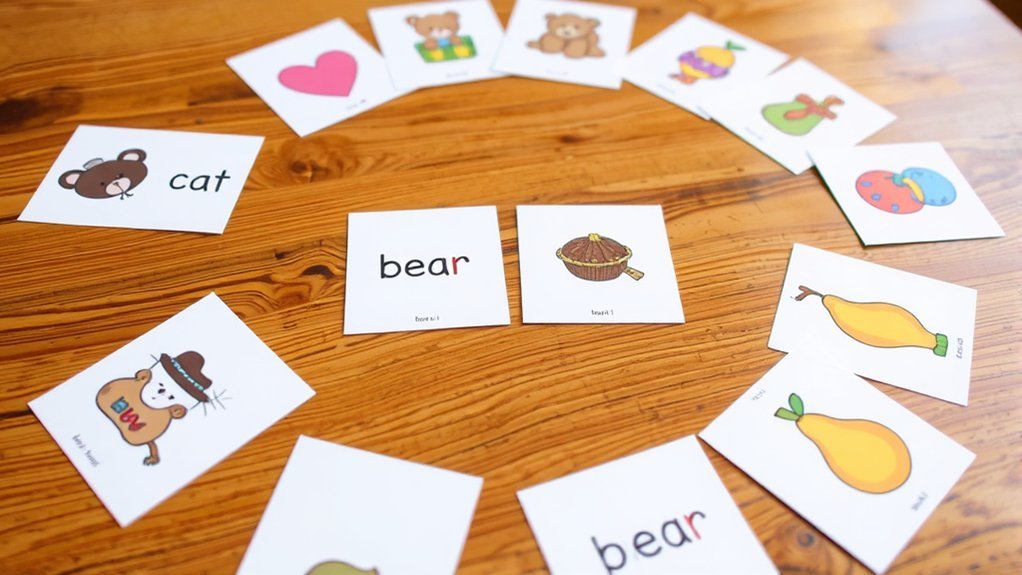
Phonemic awareness develops naturally when students play this classic memory game with a literacy twist. You’ll create pairs of cards featuring rhyming words like “cat/hat” or “tree/bee,” placing them face-down in a grid. Players flip two cards per turn, searching for rhyming matches while strengthening memory recall and phonological skills simultaneously.
Memory meets literacy in this rhyming card game that turns phonemic awareness practice into an engaging challenge students will request repeatedly.
To set up this engaging activity:
- Prepare 12-20 card pairs with clear images and words
- Start with simple word families (CVC patterns work best)
- Increase difficulty gradually by adding complex rhyme patterns
- Allow students to say words aloud before determining matches
This game reinforces sound pattern recognition while building vocabulary. You’ll notice students naturally begin generating their own rhyming words as they play, demonstrating genuine phonemic awareness growth through enjoyable, repeated practice.
Sentence Building Blocks
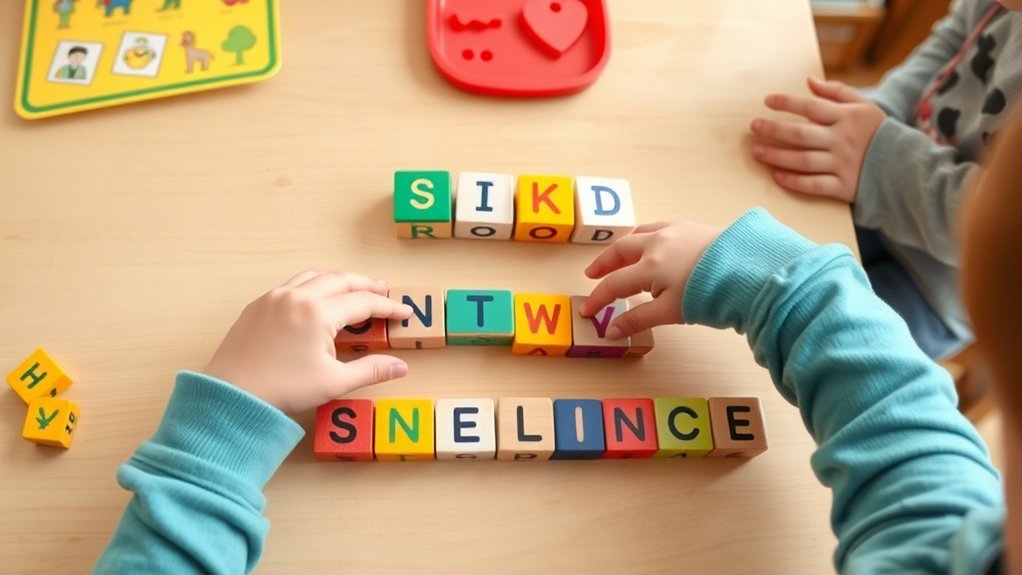
Manipulatives transform abstract grammar concepts into tangible learning experiences when you introduce sentence building blocks to your classroom.
You’ll provide students with physical or digital cards containing individual words, punctuation marks, and phrases that they can arrange and rearrange to explore sentence structure.
This hands-on approach strengthens grammatical awareness while encouraging language creativity through word arrangement experiments. Students engage in syntax practice as they discover how different phrase formations change meaning and flow.
They’ll naturally develop sentence expansion skills by adding adjectives, adverbs, and prepositional phrases to basic statements.
The tactile nature of this language play reinforces writing skills and communication clarity.
You’ll observe students testing multiple combinations, discussing their choices, and understanding how word order impacts comprehension—making grammar instruction engaging rather than intimidating.
Vocabulary Charades

Movement and performance bring vocabulary acquisition to life when you introduce charades into your literacy curriculum. This dynamic approach transforms passive vocabulary building into an interactive experience where students demonstrate word meanings through expressive gestures and body language.
Effective charades variations strengthen word association skills:
- Theme-based rounds: Focus on specific categories like emotions, occupations, or action verbs.
- Partner guessing: Students work in pairs to act out and identify challenging vocabulary terms.
- Timed challenges: Set time limits to increase engagement and quick-thinking skills.
- Written clues: Combine acting with brief written hints for complex abstract concepts.
You’ll notice students retain definitions better when they physically embody word meanings. This multisensory approach engages kinesthetic learners while building confidence in vocabulary usage across all reading levels.
Letter Sound Musical Chairs
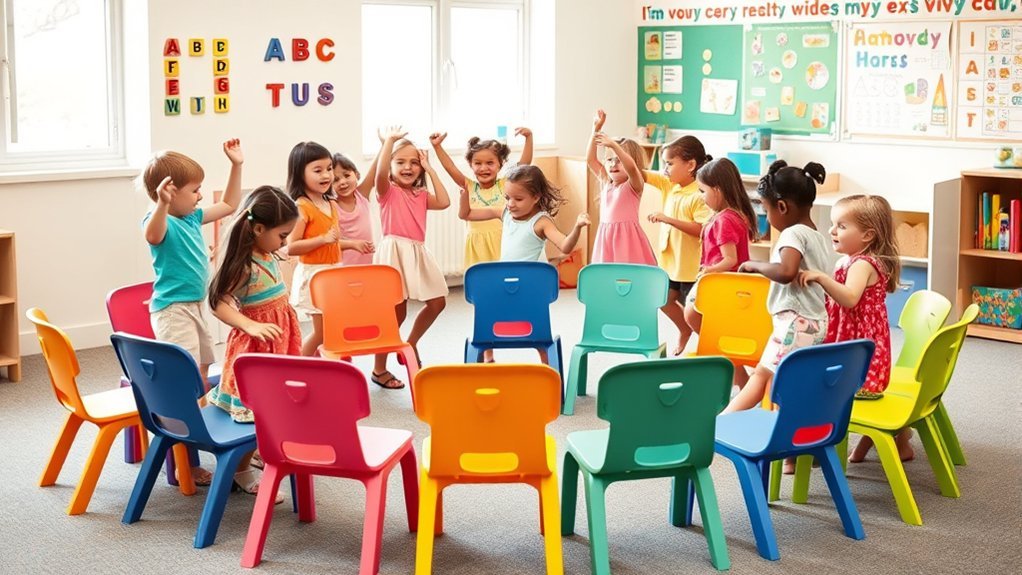
Combine the excitement of musical chairs with phonics instruction to create an energetic game that reinforces letter-sound relationships. Place letter cards on chairs arranged in a circle. As musical rhythm plays, students walk around identifying each letter. When the music stops, they claim a seat and say the sound associated with their letter.
This kinesthetic activity transforms phonics practice into playful engagement while supporting auditory learning. You’ll notice improved letter recognition as children physically interact with the alphabet. The interactive movement keeps energy high and attention focused.
Sound association becomes natural through repetition and competition. Students develop cognitive development skills by quickly processing visual symbols and producing corresponding sounds. This approach works especially well for active learners who benefit from combining physical activity with academic content.
Reading Fluency Timed Challenges

Timed reading challenges add measurable goals to fluency practice, shifting students’ focus from letter sounds to reading speed and accuracy.
These timed assessments transform routine fluency exercises into engaging reading challenges that students can track over time.
Timed assessments turn everyday fluency practice into measurable reading challenges that reveal student progress through trackable data.
Performance tracking becomes straightforward with these fluency benchmarks:
- One-Minute Sprints: Students read grade-level passages while tracking words per minute.
- Beat Your Best: Readers attempt to surpass their previous timed readings scores.
- Partner Pacing: Pairs take turns timing each other, promoting accountability.
- Progress Charts: Visual displays show improvement toward reading goals.
You’ll find that pacing strategies naturally develop as students participate in regular fluency practice.
The competitive element motivates reluctant readers while providing concrete data about their progress.
Context Clue Detective

Unknown words don’t have to stop readers in their tracks when they’ve mastered the art of using context clues. Context Clue Detective transforms vocabulary challenges into engaging mystery-solving adventures that sharpen comprehension skills.
You’ll present students with passages containing unfamiliar words, challenging them to use surrounding sentences as evidence. They’ll analyze hints like definitions, examples, synonyms, or contrasting information to deduce meanings. Award points for correct interpretations and bonus points when they identify which type of context clue they used.
This game develops critical detective skills that extend beyond vocabulary. Students learn to make inferences, connect ideas, and think analytically about text.
You can increase difficulty by introducing more complex passages or obscure words. Regular practice helps readers become independent problem-solvers who confidently tackle challenging texts.
Prefix and Suffix Puzzles

Breaking words into their building blocks reveals patterns that unlock hundreds of new vocabulary terms at once. Prefix matching and suffix sorting transform abstract word parts into concrete tools your students can manipulate and master.
Morphological awareness turns word parts into puzzle pieces—teaching one prefix or suffix simultaneously unlocks dozens of vocabulary words.
Create hands-on puzzles that strengthen morphological awareness:
- Root Word Cards: Distribute base words like “read” or “play,” then challenge students to attach prefix and suffix tiles.
- Speed Sorting: Set a timer while learners categorize words by their prefixes (un-, re-, pre-) or suffixes (-ful, -less, -tion).
- Meaning Match: Pair word parts with definitions, then combine them to form complete words.
- Build-a-Word Race: Compete to construct the longest valid word using available affixes.
These tactile activities make abstract concepts tangible, helping students decode unfamiliar words independently.
Character Hot Seat
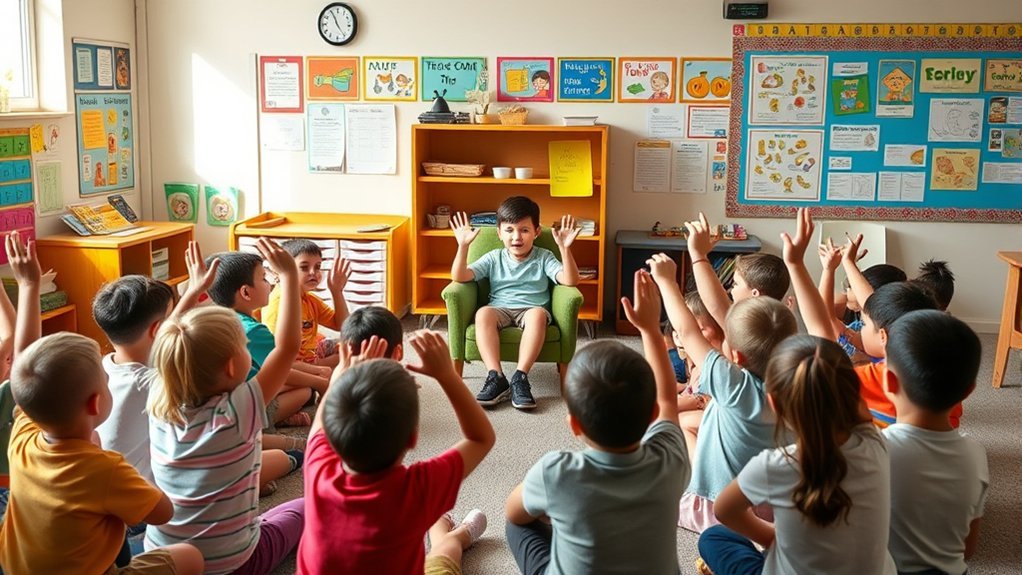
When students step into a character’s shoes and defend their decisions under questioning, they develop deeper comprehension and critical thinking skills.
Character Hot Seat transforms readers into literary figures who must answer probing questions about character motivations and character relationships.
You’ll select one student to portray a character while classmates interrogate them about character conflicts and character traits. This interactive game reveals character development as students justify actions and explain character backstories.
They’ll analyze character arcs by defending choices throughout the narrative’s progression.
Encourage questions comparing character comparisons between protagonists and antagonists. Students must think critically about why characters behave certain ways, strengthening their analytical abilities.
This dramatic approach makes abstract literary concepts tangible, helping readers internalize complex narrative elements through active participation.
Synonym and Antonym Go Fish
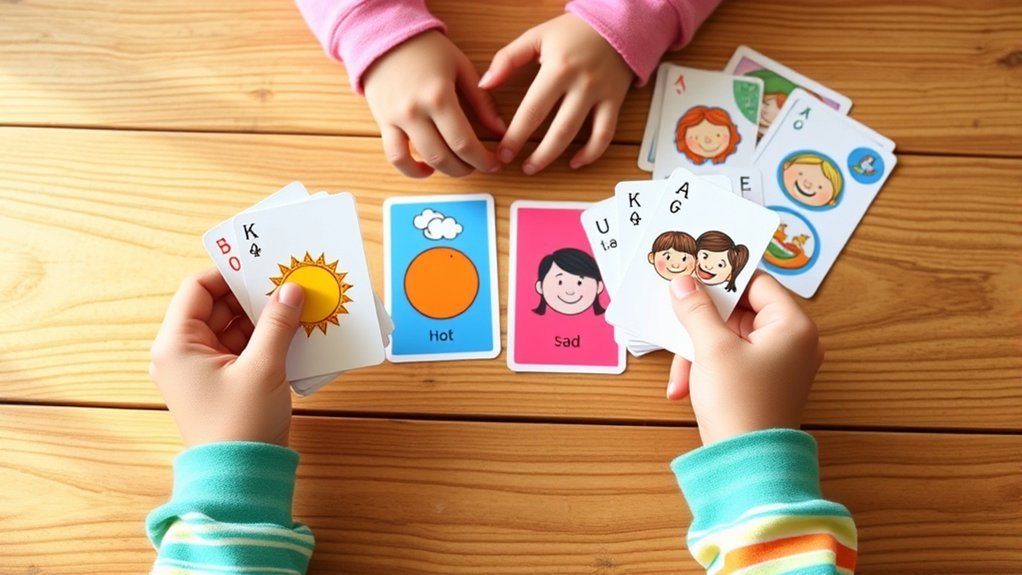
While dramatic character analysis builds comprehension, vocabulary games strengthen the building blocks of language itself. Synonym and Antonym Go Fish transforms the classic card game into a powerful vocabulary tool. You’ll create cards with words, and players must request matches by finding synonyms or antonyms from opponents.
Transform vocabulary learning through playful competition—students debate word relationships while mastering synonyms and antonyms in this engaging card game adaptation.
This synonym challenge and antonym adventure works through these steps:
- Write target words on cards (use 20-30 pairs)
- Deal five cards per player, placing remaining cards face-down
- Players ask opponents for synonyms or antonyms of their cards
- Collect pairs to win points
You’ll notice students naturally discuss word meanings while playing. They’ll debate whether words truly match, building critical thinking alongside vocabulary.
This game scales easily—use simple words for beginners or complex terminology for advanced learners.
Prediction Dice Game
As students master vocabulary foundations, they’re ready to tackle higher-order thinking through prediction skills.
The Prediction Dice Game transforms inferencing into an interactive challenge that’ll keep your learners engaged.
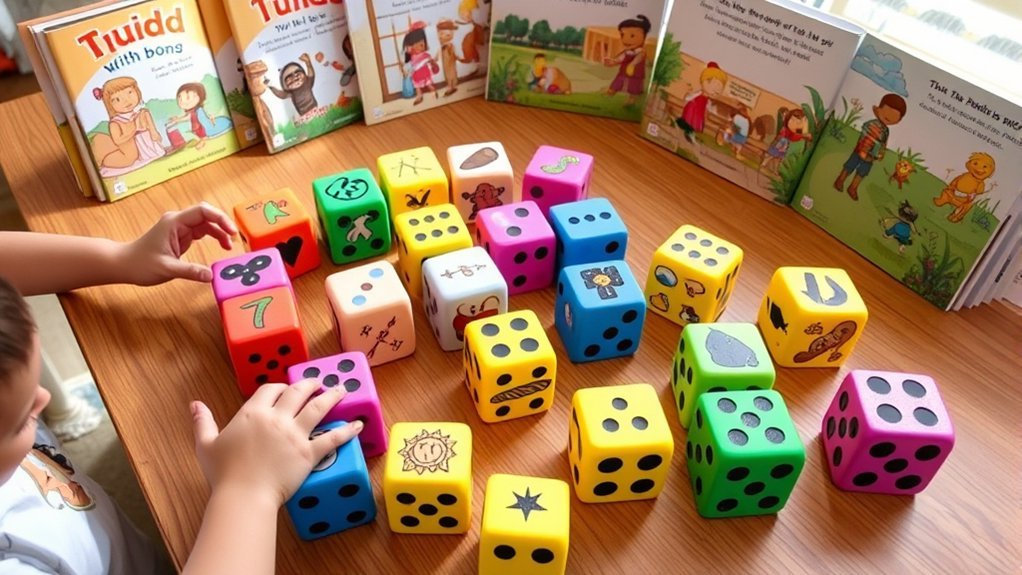
You’ll need two dice and a collection of story starters or book covers. Students roll the dice to determine which prediction scenarios they’ll tackle—one die selects the story, while the other assigns the prediction type (character actions, plot outcomes, or setting details).
During dice rolling, students must justify their predictions using text evidence or visual clues. They’ll earn points for logical reasoning rather than correct guesses, emphasizing the thinking process over answers.
This game strengthens comprehension while building confidence in analytical skills, making it perfect for small groups or literacy centers.
In case you were wondering
How Do I Assess if These Reading Games Are Improving My Child’s Literacy?
Track your child’s progress by monitoring their reading speed, comprehension, and vocabulary growth weekly. Use skill evaluation tools like reading assessments or observe improvements in their confidence and fluency during game sessions to measure literacy advancement effectively.
What Age Groups Are Most Appropriate for Literacy-Focused Reading Games?
Literacy-focused reading games work best for ages 2-12. You’ll find toddler games emphasizing letter recognition and phonics for younger children, while elementary strategies target comprehension, vocabulary, and fluency skills for kids in grades K-5.
How Often Should Children Play Reading Games for Optimal Skill Development?
You’d think more is always better, but that’s not quite true. For optimal skill development, you’ll want daily engagement of 15-20 minutes. A balanced approach prevents burnout while building consistent reading habits your child’ll actually maintain.
Can Reading Games Replace Traditional Literacy Instruction in the Classroom?
No, reading games can’t replace traditional instruction entirely. While reading game effectiveness shows strong supplemental benefits, traditional instruction comparison reveals games work best alongside teacher-led lessons. You’ll achieve optimal results by combining both approaches in your classroom.
How Do I Adapt Reading Games for Children With Learning Disabilities?
You’ll unlock doors when you incorporate visual aids and sensory integration into reading games. Modify pacing, add tactile elements, and break tasks into smaller steps. You’re creating pathways that honor each child’s unique learning style beautifully.
Conclusion
You’ve now got a treasure trove of engaging activities to gently shepherd your young learners toward reading mastery. These games won’t feel like traditional instruction—they’re carefully disguised learning opportunities that’ll help children navigate the sometimes challenging waters of literacy development. Whether you’re addressing areas needing improvement or reinforcing existing strengths, you’ll find these playful approaches make the journey less daunting. Remember, even reluctant readers can become enthusiastic participants when learning feels less like work and more like play.