Why Math Games Transform Elementary Learning Forever
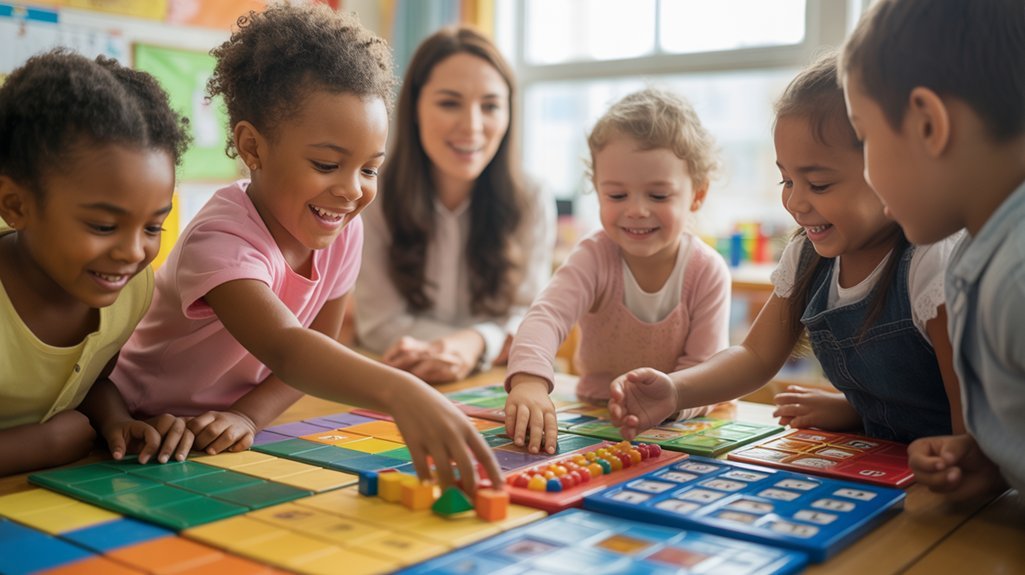
Math games transform your child’s learning by activating multiple brain regions simultaneously—something worksheets can’t replicate. When kids play, their prefrontal cortex builds strategy while their hippocampus locks in memories, and dopamine release strengthens retention. You’ll notice reduced anxiety as mistakes become learning opportunities rather than failures. Games build genuine number sense through hands-on manipulation, accommodate every learning style naturally, and turn assessment into observation rather than stress. The neurological advantages create mathematical understanding that lasts a lifetime, and the specific mechanisms behind this transformation reveal why traditional methods fall short.
Key Takeaways
- Math games activate multiple brain regions simultaneously, creating stronger neural pathways than traditional memorization methods for lasting comprehension.
- Hands-on gameplay builds foundational number sense through tangible manipulation of dice, tokens, and game pieces that abstract symbols cannot provide.
- Game-based learning reduces math anxiety by creating low-stakes environments where mistakes become valuable learning opportunities rather than failures.
- Teachers gain authentic assessment insights by observing students’ problem-solving strategies and computational thinking during natural gameplay.
- Collaborative game experiences accommodate diverse learning styles while fostering peer learning, community building, and confidence at individualized paces.
The Science Behind Game-Based Mathematical Learning
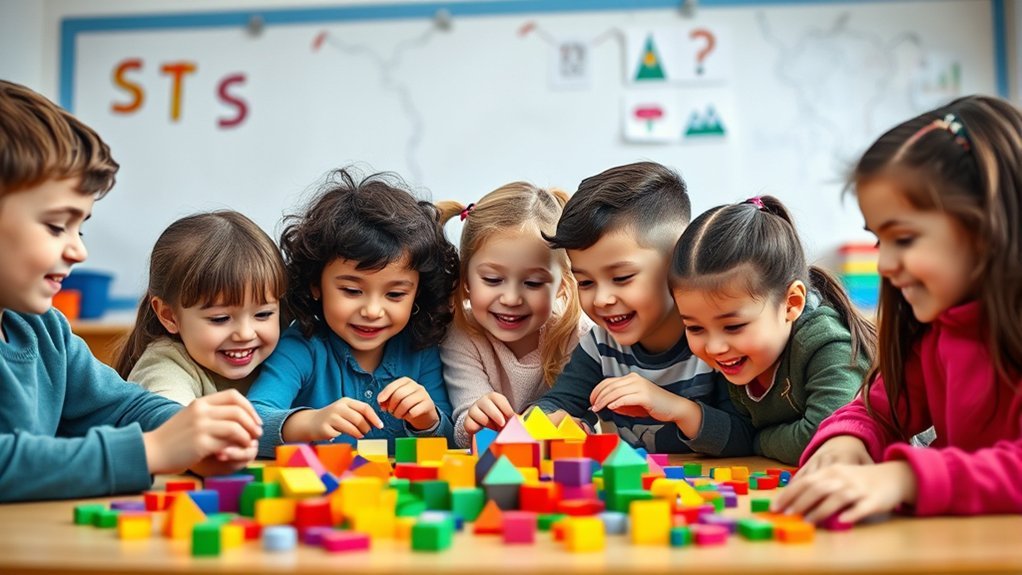
When children play math games, their brains activate multiple neural pathways simultaneously, creating stronger connections than traditional rote memorization ever could. Research shows that cognitive engagement peaks when learning feels like play rather than work. Your child’s brain releases dopamine during gameplay, which strengthens memory retention and makes mathematical concepts stick.
Playful learning transforms abstract numbers into tangible experiences. When kids manipulate game pieces, solve puzzles under time pressure, or compete with peers, they’re building neural networks that support long-term mathematical thinking.
You’ll notice they retain information better because games provide immediate feedback and emotional investment. This neurological advantage explains why students who regularly engage with math games demonstrate improved problem-solving skills, faster computational abilities, and greater confidence in tackling complex mathematical challenges throughout their academic journey.
How Play Activates Multiple Brain Regions for Deeper Understanding
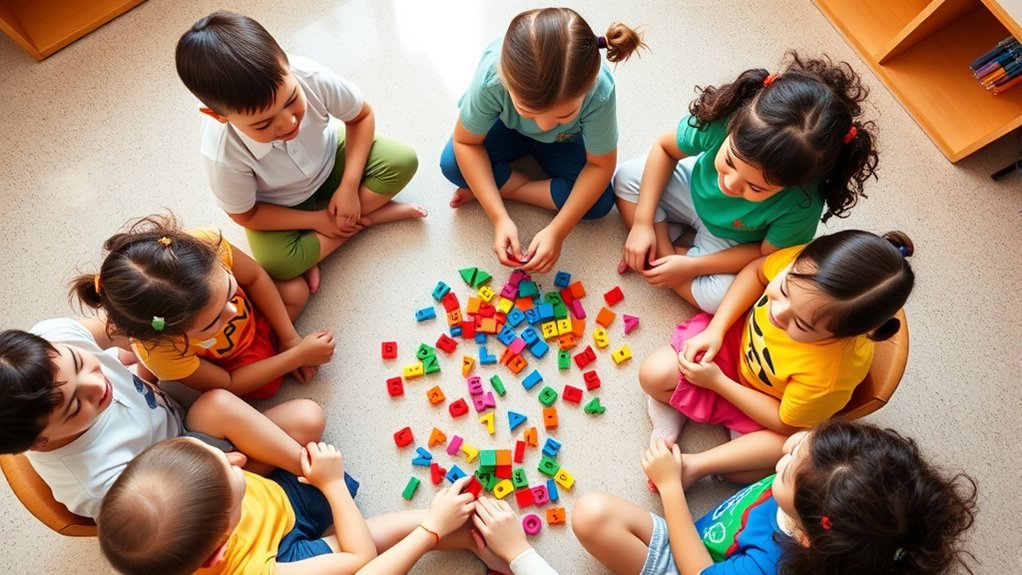
As your child rolls dice to calculate sums or races to identify patterns on a game board, their brain lights up like a neural fireworks display. Multiple regions activate simultaneously during playful learning—the prefrontal cortex processes strategy, the hippocampus encodes memories, and the amygdala regulates emotional responses to winning and losing.
This widespread brain activation creates stronger neural pathways than traditional worksheet methods. When your child experiences math through play, they’re not just memorizing formulas; they’re building interconnected understanding across cognitive domains.
The motor cortex engages through physical manipulation of game pieces, while social brain networks activate during collaborative play.
Research shows this multi-region engagement produces deeper comprehension and longer retention. Your child’s brain literally rewires itself through repeated playful mathematical experiences, establishing foundations that last a lifetime.
Building Number Sense Through Hands-On Game Experiences
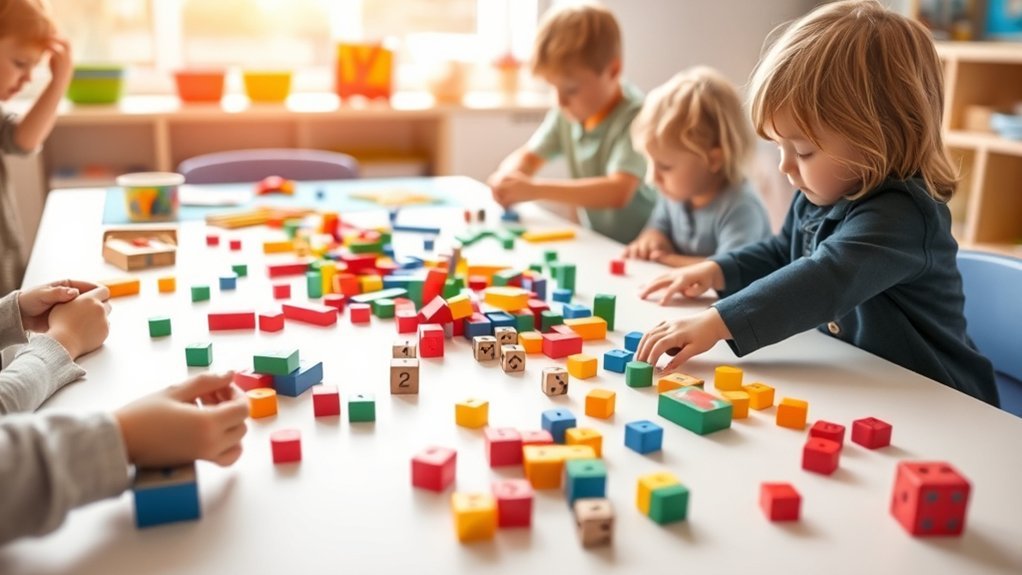
Number sense—the intuitive understanding of quantity, magnitude, and numerical relationships—develops most naturally when children can touch, move, and manipulate concrete objects during gameplay.
When your students physically handle dice, cards, or counting tokens, they’re building mental models that abstract symbols alone can’t provide.
Game experiences create authentic contexts where number sense becomes practical. Rolling dice teaches subitizing—recognizing quantities without counting. Moving game pieces forward or backward reinforces addition and subtraction concepts. Trading tokens builds understanding of equivalence and place value.
Games transform abstract mathematics into concrete action—each roll, move, and trade building genuine understanding through meaningful play.
You’ll notice struggling learners suddenly grasp concepts they couldn’t understand through worksheets. The tangible feedback from hands-on games helps children self-correct and develop numerical intuition.
They’re not memorizing procedures; they’re experiencing mathematical relationships through purposeful play that makes numbers meaningful and memorable.
Differentiating Instruction: Games That Reach Every Learning Style
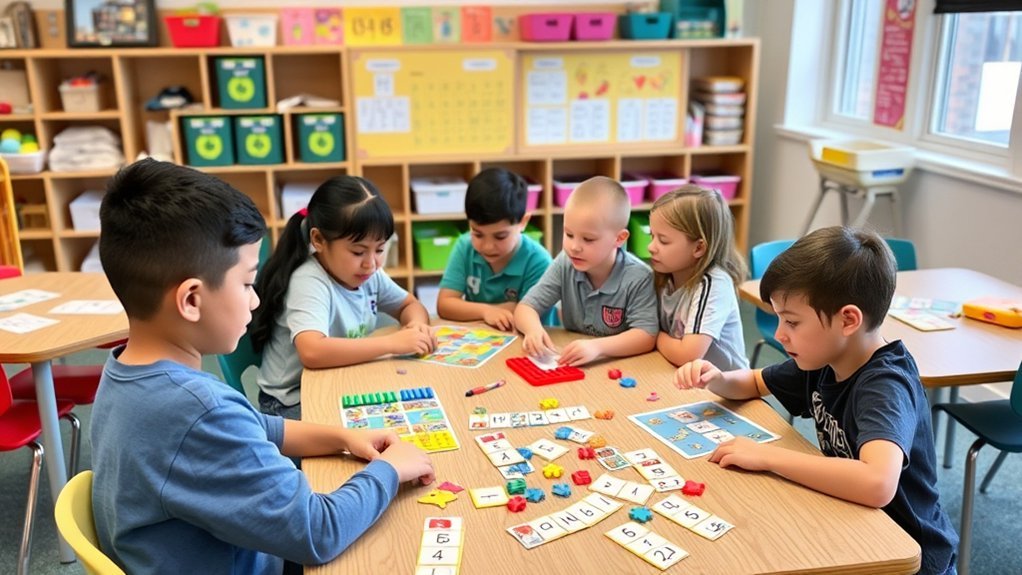
Math games naturally accommodate different learning styles without requiring you to create separate lesson plans for each student.
Visual learning happens when children see patterns on dice or colorful game boards. Auditory engagement emerges through counting aloud and discussing strategies with peers. Tactile experiences occur when students manipulate cards, counters, or spinners.
You’ll notice games foster strategic thinking as children plan their next moves. They provide personalized feedback instantly—players know immediately if their answer works. The competitive spirit motivates some learners, while cooperative learning appeals to others who prefer team-based challenges.
Most importantly, games offer adaptive challenges. Struggling students can use simplified rules, while advanced learners tackle complex variations. This flexibility means everyone participates meaningfully at their own level simultaneously.
Reducing Math Anxiety and Building Confidence Through Low-Stakes Practice
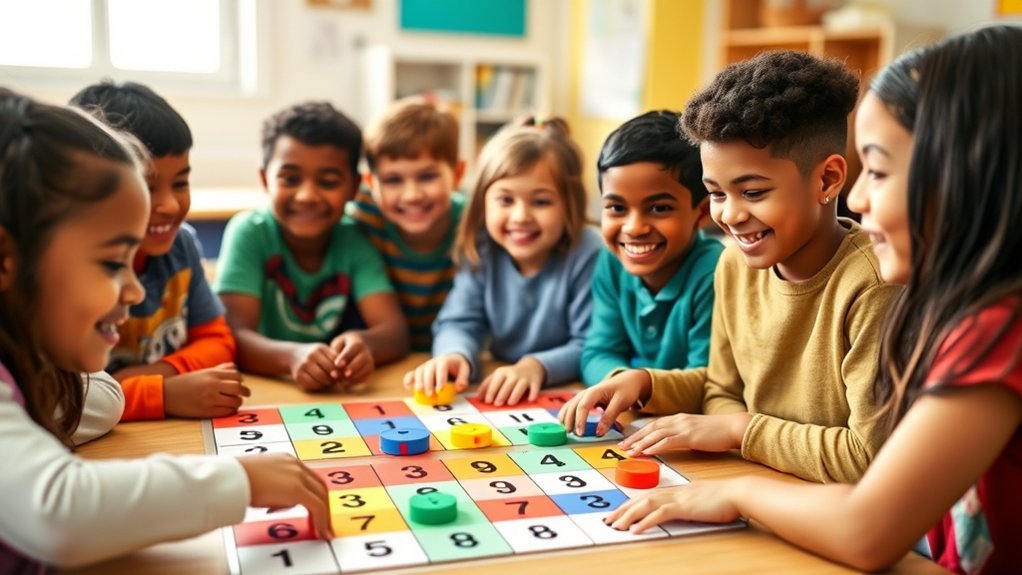
When children view mathematics as a series of tests and timed assessments, anxiety builds with each passing grade. You’ll notice that math games eliminate this pressure by creating low-stakes environments where mistakes become learning opportunities rather than failures.
Your students can experiment, fail, and try again without fear of judgment or permanent records. This approach directly addresses math anxiety by removing the performative aspect of traditional assessments.
Through repeated gameplay, you’re building confidence as children master concepts at their own pace. They’ll develop problem-solving skills naturally, celebrating small victories that accumulate into genuine mathematical proficiency.
Games transform “I can’t do math” into “Let me try again.” You’re fostering resilience and positive associations with numbers, creating lifelong learners who approach challenges with curiosity instead of dread.
Collaborative Problem-Solving: Social Skills Meet Mathematical Thinking
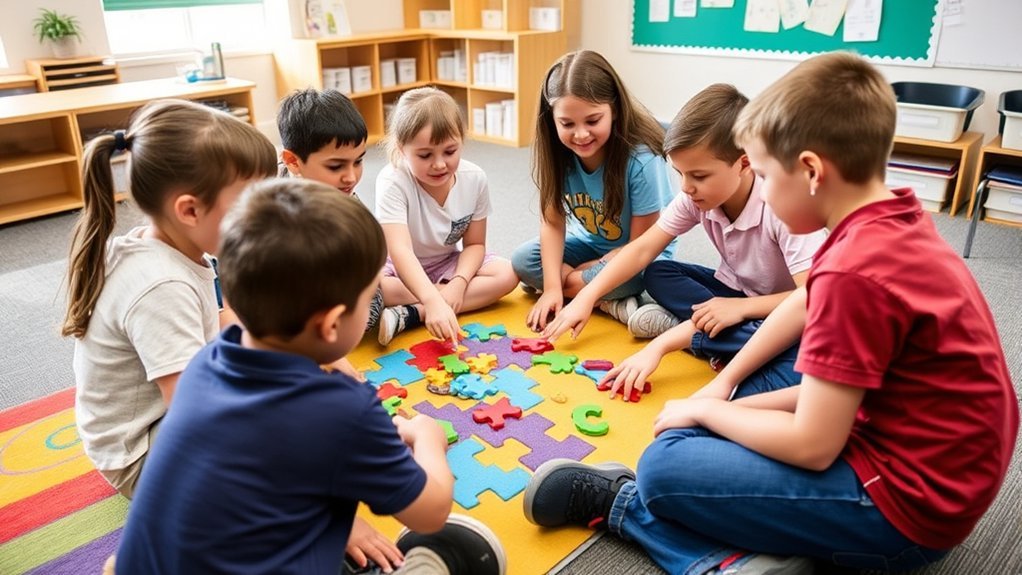
Beyond building individual confidence, math games create powerful opportunities for students to work together toward shared goals. When your students tackle mathematical challenges collaboratively, they’re developing essential teamwork dynamics while sharpening their problem-solving abilities.
You’ll notice students naturally take on different roles—some explain strategies, others verify solutions, and many ask clarifying questions. This interaction teaches them to articulate mathematical reasoning clearly and listen actively to peers’ approaches.
The empathy building that occurs during collaborative math games extends far beyond the classroom. Students learn to appreciate diverse thinking styles, celebrate teammates’ breakthroughs, and support struggling partners without judgment.
They discover that mathematical success isn’t about competing against classmates but combining strengths to solve problems together, preparing them for real-world collaboration.
From Concrete Manipulatives to Abstract Concepts: The Natural Progression
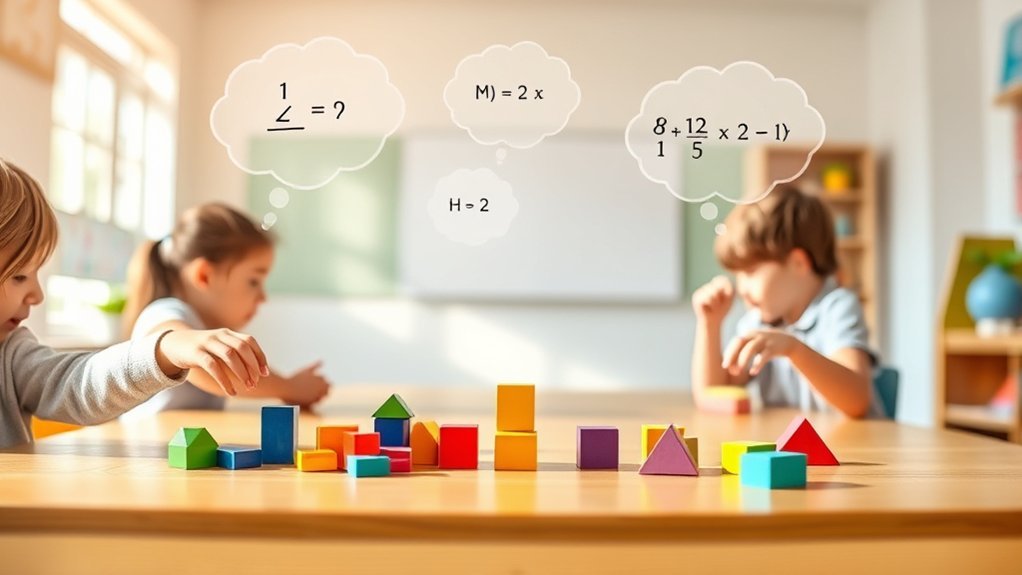
As your students transition from hands-on materials to symbolic representations, they’re following a developmental pathway that mirrors how humans have understood mathematics for millennia.
Math games facilitate this journey by embedding concrete experiences within engaging contexts. When children manipulate physical objects to solve game challenges, they’re building mental models that later support abstract reasoning.
You’ll notice students naturally progress through three stages: first, they need tangible materials like blocks or counters; next, they work with pictorial representations; finally, they operate with numbers and symbols alone.
Games accelerate this progression because they provide repeated practice without tedium. Each round reinforces concepts while gradually reducing dependence on physical props. The game structure itself becomes the scaffold, allowing students to internalize mathematical relationships and confidently navigate increasingly abstract thinking.
Assessment Without Pressure: Observing Mastery During Gameplay
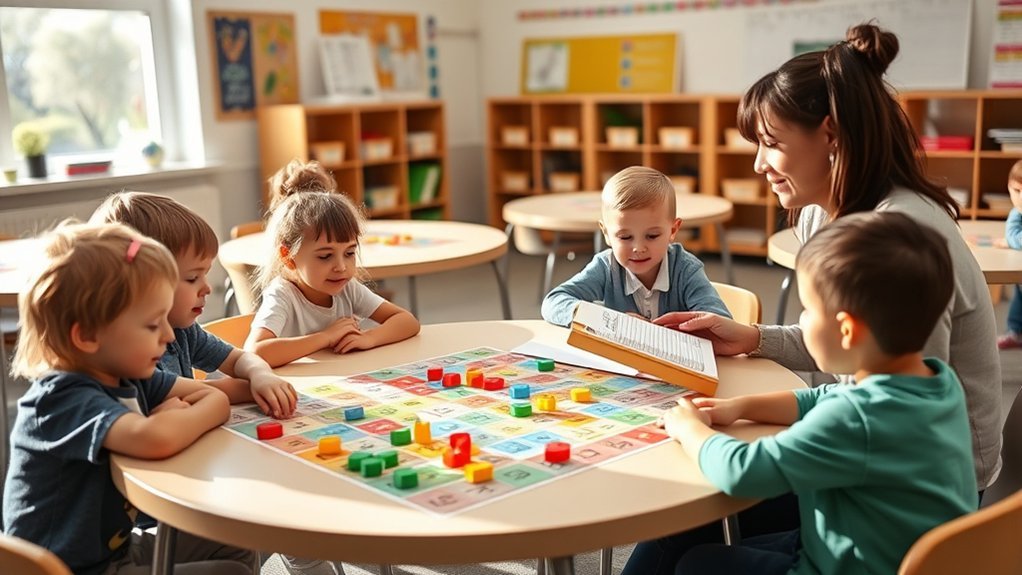
While students focus on winning the next round, you’re gathering authentic data about their mathematical understanding. Game-based learning transforms assessment into a natural observation process rather than a stressful testing event.
You’ll notice computation strategies, problem-solving approaches, and conceptual gaps as children play. This playful assessment reveals what traditional tests miss—how students actually think through problems. When a child miscalculates during a dice game, you’re witnessing their current understanding in action.
Formative feedback flows naturally during gameplay. You can ask questions, suggest alternative strategies, or introduce new challenges without disrupting engagement. Students remain relaxed, making their responses more authentic.
This observational approach builds a comprehensive picture of each learner’s mathematical development, allowing you to adjust instruction immediately based on genuine performance rather than anxiety-influenced test results.
Creating a Classroom Culture Where Mathematical Curiosity Thrives
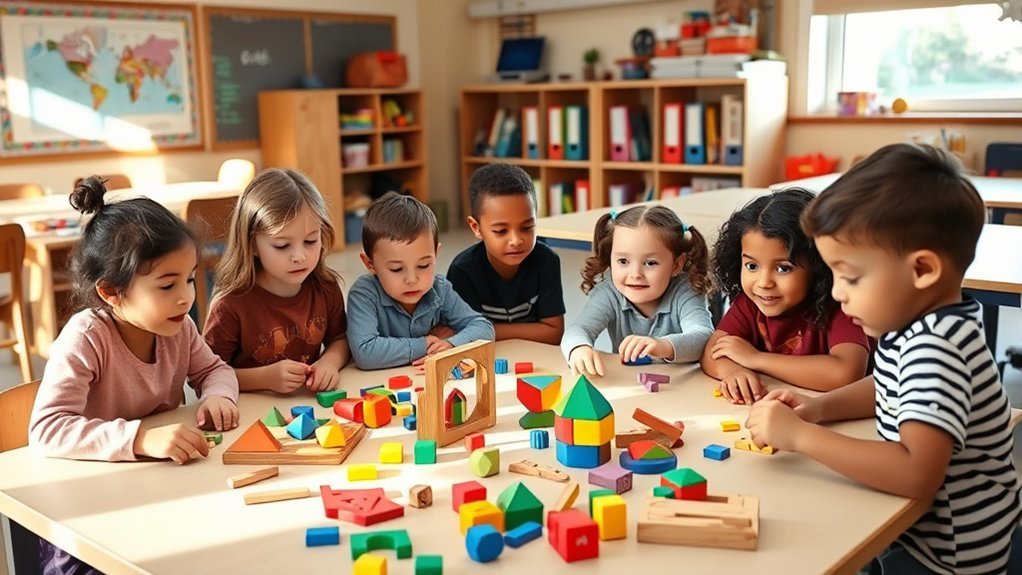
Mathematical curiosity flourishes when students feel safe to experiment, make mistakes, and ask “what if?” Game-based learning naturally supports this environment because games normalize trial and error as part of the process.
You’ll notice students become risk-takers when they’re not worried about “wrong answers.” They’ll test strategies, debate solutions, and discover patterns independently. This shift happens because games remove the stigma of failure—every attempt becomes a learning opportunity.
Foster this culture by celebrating creative problem-solving approaches, not just correct answers. Encourage students to explain their thinking and challenge each other’s strategies respectfully. You’re inspiring curiosity when you ask open-ended questions like “Could you solve this differently?” or “What pattern do you notice?”
Celebrate creative problem-solving over correct answers by asking open-ended questions that spark curiosity and encourage students to explain their mathematical thinking.
Fostering collaboration through partner and small-group games amplifies this effect, as students learn from each other’s mathematical reasoning and perspectives.
In case you were wondering
What Are the Best Math Games to Start With for Kindergarten Students?
You’ll want to start with simple number recognition games like “Number Hunt” and basic counting challenges such as “Counting Bears.” These build foundational skills through hands-on play, helping your kindergarteners identify numbers and count objects confidently.
How Much Class Time Should Teachers Dedicate to Math Games Weekly?
You’ll want to dedicate 15-20% of your weekly class time to math games. You’ll build skills, you’ll boost engagement, you’ll strengthen concepts. Ideal game frequency includes three 15-minute sessions weekly, ensuring consistent practice without overwhelming your curriculum goals.
Do Math Games Align With Standardized Testing Requirements and Curriculum Standards?
Yes, quality math games provide excellent standards alignment while offering natural testing preparation. You’ll find they reinforce curriculum objectives through engaging practice, helping students master essential skills that directly translate to standardized test success and academic confidence.
What Budget-Friendly Materials Work Best for Creating Homemade Math Games?
“Waste not, want not”—you’ll find the best budget-friendly materials in your recycling bin. Recyclable game materials like cardboard, bottle caps, and egg cartons make excellent DIY math manipulatives that’ll transform your learning games without breaking the bank.
How Can Parents Support Game-Based Math Learning at Home Effectively?
You’ll support game-based math learning by scheduling regular interactive activities with your children. Prioritize family engagement during daily routines—turn cooking, shopping, or board games into math opportunities. Celebrate effort over answers to build confidence and enthusiasm.
Conclusion
You’ve seen how transforming struggle into exploration reshapes young minds. When you replace traditional methods with play-based approaches, you’re not just teaching arithmetic—you’re nurturing mathematicians who won’t fear challenges ahead. These strategies don’t eliminate difficulties; they reframe obstacles as puzzles worth solving. Your classroom becomes a space where temporary setbacks fuel growth rather than discouragement. By embracing game-based learning, you’re investing in confident problem-solvers who’ll carry mathematical resilience throughout their academic journey and beyond.