10 Problem-Solving Games for Stronger Family Bonds
You’ll transform family time by incorporating problem-solving games like escape room challenges that turn your living room into an adventure, jigsaw puzzles with competitive twists, mystery board games for deductive reasoning, and building challenges using household materials. Strategy card games bridge generational gaps, while STEM construction sets teach engineering concepts through play. Add improvised storytelling sessions, weekly riddle competitions, and collaborative workshops to strengthen communication and critical thinking. These activities create lasting bonds through shared challenges, and there’s much more to discover about maximizing each game’s potential.
Key Takeaways
- Home escape room challenges build teamwork through customized puzzles and clue sequences that strengthen family bonds.
- Classic jigsaw puzzles and building challenges using household materials develop patience, spatial reasoning, and collaborative problem-solving skills.
- Mystery board games and strategy card games unite generations while developing critical thinking, deduction, and tactical planning abilities.
- Improvised storytelling and weekly riddle competitions foster creativity, lateral thinking, and emotional connections through shared mental challenges.
- STEM construction sets and puzzle-solving workshops provide hands-on learning experiences that normalize mistakes and build resilience together.
Escape Room Challenges: Bringing Adventure Home
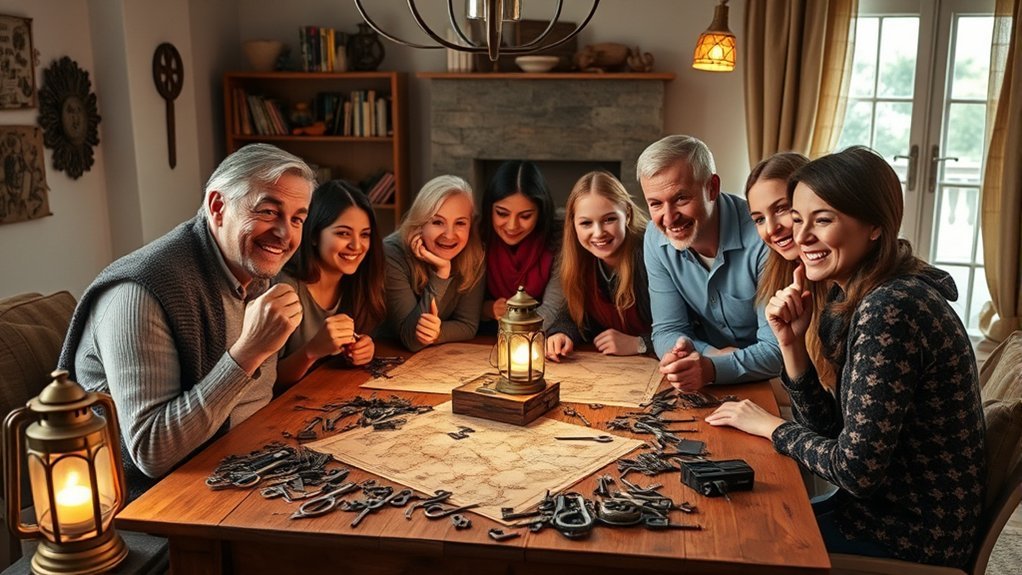
When you transform your living room into an escape room, you create an immersive adventure that demands teamwork and creative thinking from every family member.
You’ll find that escape room themes ranging from mystery detective scenarios to pirate treasure hunts naturally encourage collaboration and communication.
Puzzle creation becomes your gateway to customized challenges that match your family’s skill levels.
Craft puzzles that fit your family perfectly—from simple riddles for kids to complex codes that challenge even the sharpest adults.
You can design riddles, hide clues throughout rooms, and create lock-and-key sequences using household items.
Your kids will decode messages while parents solve logic puzzles, making everyone essential to success.
The time pressure adds excitement without real stakes, teaching your family to work efficiently under stress.
You’re building problem-solving skills while strengthening bonds through shared accomplishments and plenty of laughter along the way.
Classic Jigsaw Puzzles With a Collaborative Twist
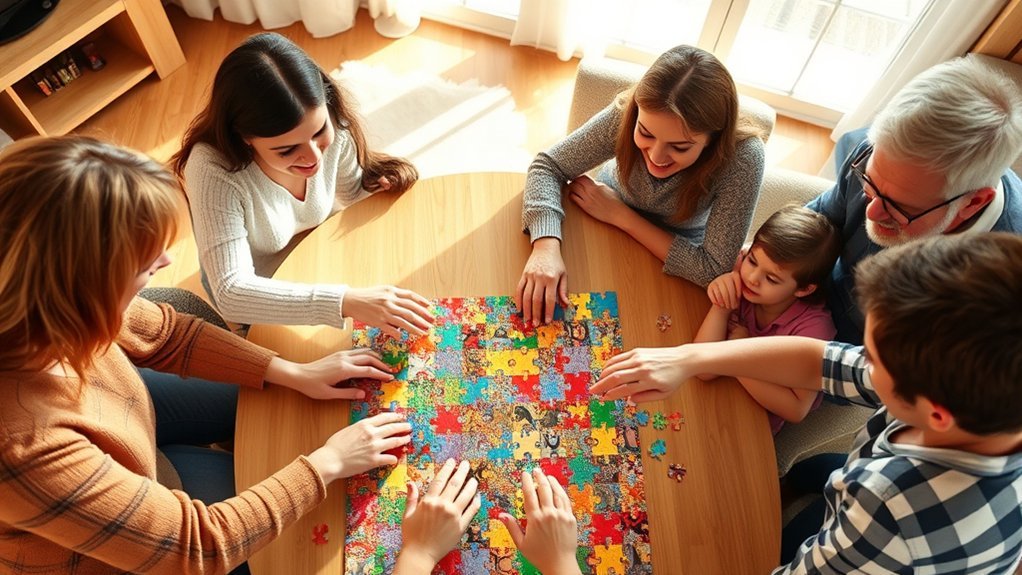
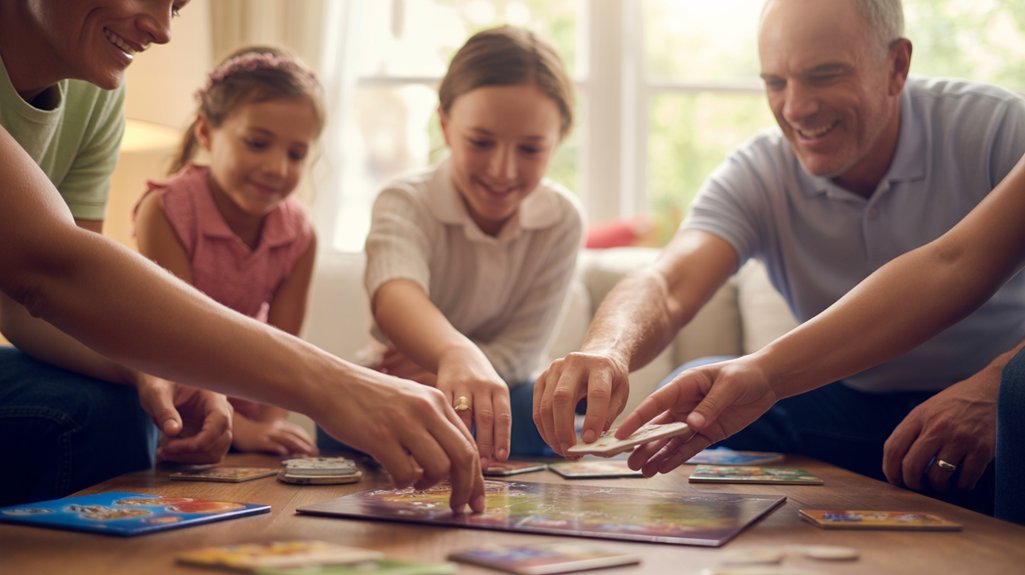
Jigsaw puzzles offer a quieter yet equally engaging way to strengthen family connections through collaborative problem-solving.
You’ll find that modern interactive puzzle themes transform traditional jigsaws into dynamic experiences. Choose puzzles with hidden images that reveal themselves as you progress, or select ones featuring family photos for personalized engagement.
Organize family puzzle competitions where teams race to complete sections, fostering healthy rivalry while building cooperation skills. Assign different strategies: some members sort by color, others by edge pieces, creating complementary roles that teach delegation and trust.
You can elevate the challenge by mixing pieces from multiple puzzles or working without the reference image.
These variations keep experienced puzzlers engaged while teaching younger family members patience, spatial reasoning, and the satisfaction of achieving shared goals through persistent teamwork.
Mystery Board Games That Spark Deductive Reasoning

While jigsaw puzzles build patience, mystery board games inject excitement into family problem-solving by casting everyone as detectives working to crack complex cases. These games demand sharp clue deduction as you’ll examine evidence cards, track alibis, and eliminate suspects systematically.
You’re not just rolling dice—you’re analyzing motives, questioning testimonies, and connecting seemingly unrelated facts.
Mystery games transform players into active investigators who scrutinize evidence, challenge statements, and weave disparate clues into coherent solutions.
Games like “Mysterium” and “Sherlock Holmes Consulting Detective” excel at fostering character analysis, requiring your family to interpret behavioral patterns and identify inconsistencies in suspect stories.
Each player contributes unique perspectives, turning investigation into collaborative discussion. Your teenagers might spot visual clues you’ve missed, while younger children notice dialogue contradictions.
This cognitive diversity strengthens your family’s collective reasoning abilities while teaching critical thinking skills that extend beyond game night.
Building Challenges With Household Materials

Cardboard boxes, tape, and string transform into engineering laboratories when you challenge your family to construct towers, bridges, or marble runs from everyday items. These DIY building activities cost nothing while teaching structural integrity, physics, and spatial reasoning.
Set specific constraints like height requirements or weight-bearing capacity to intensify the problem-solving experience. Creative engineering emerges when you limit materials, forcing innovative solutions. Paper cups become support columns, aluminum foil transforms into connectors, and newspaper rolls create sturdy beams.
Time-based challenges add excitement as family members race to complete their structures. You’ll witness different thinking styles as children and adults approach problems uniquely. Parents often plan methodically while kids experiment fearlessly.
These contrasts spark discussion about multiple solution paths, teaching everyone that engineering embraces diverse approaches to overcome obstacles.
Strategy Card Games for All Ages
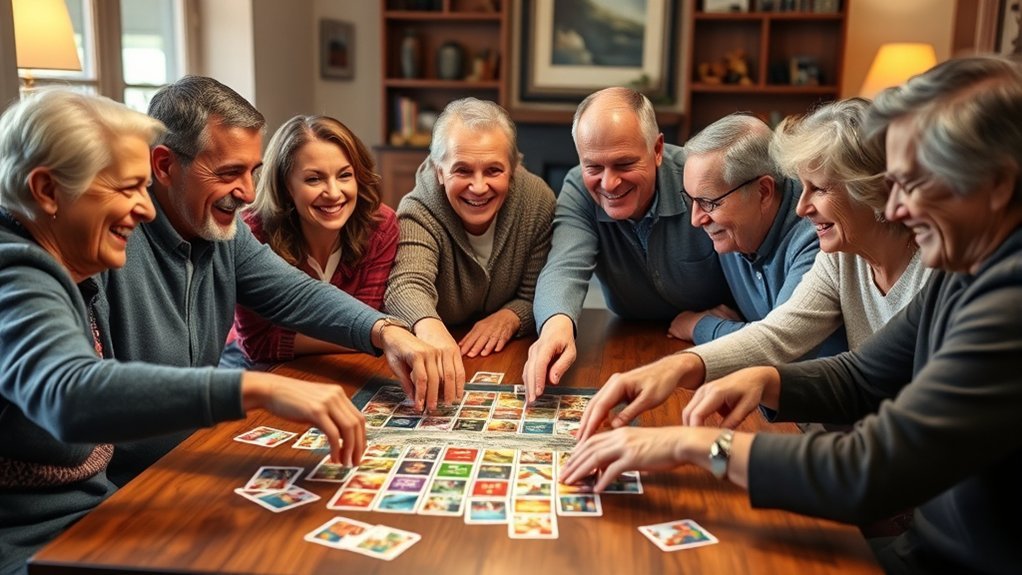
Around kitchen tables worldwide, strategy card games unite generations through calculated risks and tactical thinking. You’ll discover that deck building games like Dominion let your family construct powerful card combinations while adapting to opponents’ strategies.
Card drafting mechanics in games such as Sushi Go! teach children resource management and prioritization as they select cards from rotating hands.
These games sharpen critical thinking through:
Strategy card games develop essential cognitive skills including pattern recognition, resource management, risk evaluation, and the ability to adapt plans dynamically.
- Pattern recognition – spotting combinations and predicting opponent moves
- Resource allocation – managing limited cards for maximum impact
- Risk assessment – weighing immediate gains against long-term strategies
- Adaptive planning – adjusting tactics based on changing game states
You’re not just shuffling cards—you’re creating moments where your teenager helps grandma master complex strategies, building connections through shared mental challenges.
Outdoor Scavenger Hunts With Brain-Teasing Clues

Trading card tables for open air, scavenger hunts transform your neighborhood into an interactive puzzle playground where physical activity meets mental agility.
You’ll design nature clues that require observation and deduction—riddles about tree bark patterns, calculations based on house numbers, or cryptic directions using landmark features.
Family teamwork becomes essential when you split into pairs or work together solving multi-step challenges. Create clues that demand different skills: one person decodes while another searches, combining strengths for faster solutions.
Start simple with younger children using picture-based puzzles, then increase complexity with logic sequences and wordplay. Hide QR codes linking to bonus riddles, or incorporate math problems where answers reveal the next location.
You’re building problem-solving stamina while exploring your community together.
Cooperative Video Games That Require Teamwork

While outdoor adventures build physical teamwork, cooperative video games develop strategic collaboration through shared digital challenges that require constant communication and coordinated problem-solving.
You’ll discover that co op adventures like “Overcooked,” “It Takes Two,” and “Portal 2” force family members to rely on each other’s strengths while navigating complex puzzles.
These games strengthen bonds through:
- Shared decision-making under pressure that teaches conflict resolution
- Role specialization where each player contributes unique abilities
- Real-time adaptation of team strategies based on changing scenarios
- Collective celebration of victories earned through mutual effort
You’ll find these experiences create lasting memories while developing critical thinking skills.
The key is selecting age-appropriate titles that challenge without frustrating, ensuring everyone participates equally in problem-solving discussions.
Logic Puzzles and Riddle Nights
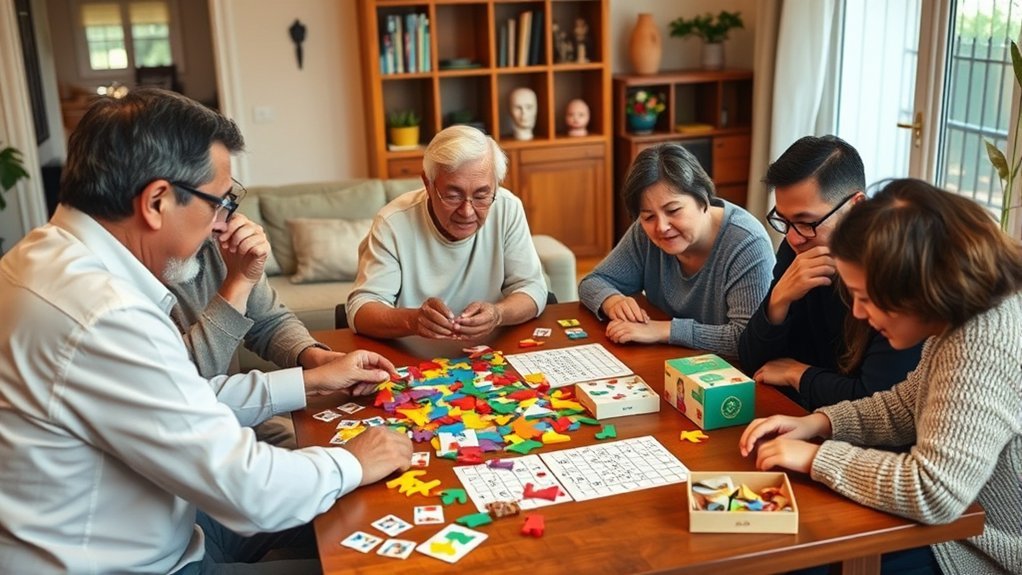
Beyond screens and controllers, logic puzzles and riddle nights strip problem-solving down to its purest form—brain versus challenge.
You’ll discover that hosting weekly riddle competitions transforms your dining table into an arena where everyone’s wit shines. Start with age-appropriate brain teasers, then gradually increase difficulty as your family’s collective reasoning strengthens. Logic riddle competitions encourage lateral thinking while creating memorable moments of “aha!”
Consider attending puzzle solving workshops together at local libraries or community centers. These sessions expose your family to diverse problem-solving techniques—from Sudoku strategies to cryptic crosswords.
Puzzle workshops at libraries offer families hands-on exposure to diverse problem-solving methods beyond what home practice alone can provide.
You’re not just solving puzzles; you’re building a shared vocabulary of logical reasoning. The beauty lies in accessibility. Armed with nothing but pencils and paper, you’re creating traditions that sharpen minds while deepening connections.
STEM-Based Construction Sets and Engineering Games
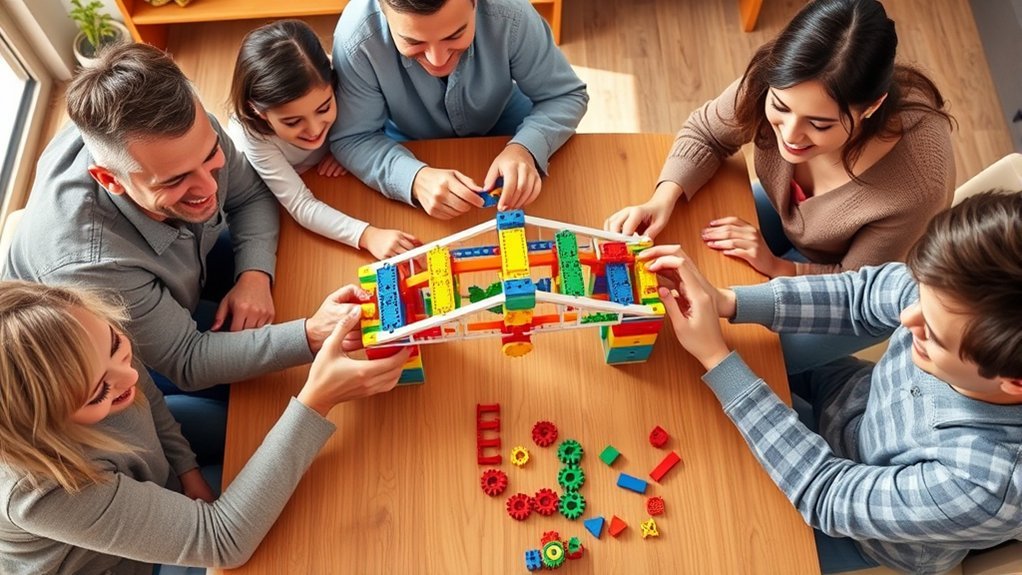
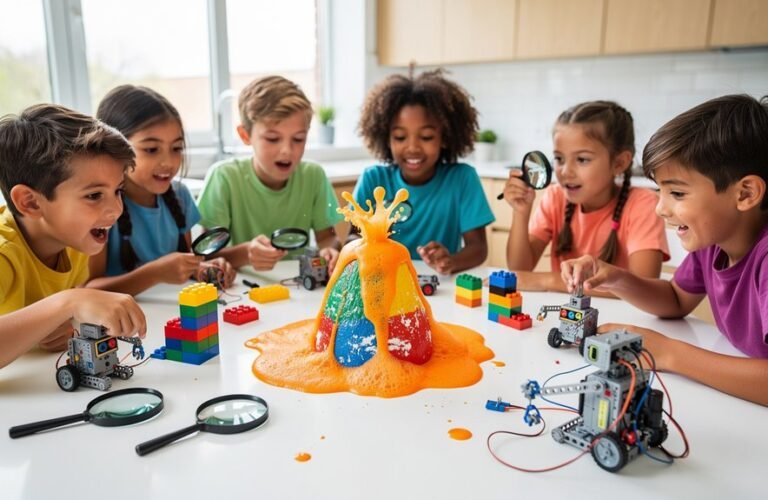
When wooden blocks give way to gears, circuits, and motors, your family enters a realm where imagination meets engineering principles. STEM challenges transform playtime into collaborative learning experiences where everyone contributes unique perspectives.
Through engineering design processes, you’ll tackle real-world problems together, from building bridges that support weight to creating functional machines. Construction teamwork naturally emerges as family members delegate tasks, share resources, and troubleshoot obstacles.
These activities sharpen problem solving skills while fostering communication and patience.
Key benefits of STEM-based construction play:
- Develops spatial reasoning and mechanical understanding through hands-on experimentation
- Encourages iterative thinking as failed designs lead to improved solutions
- Bridges generational gaps when parents and children learn technical concepts together
- Builds resilience by normalizing mistakes as essential learning opportunities
Improvised Storytelling and Creative Problem Scenarios
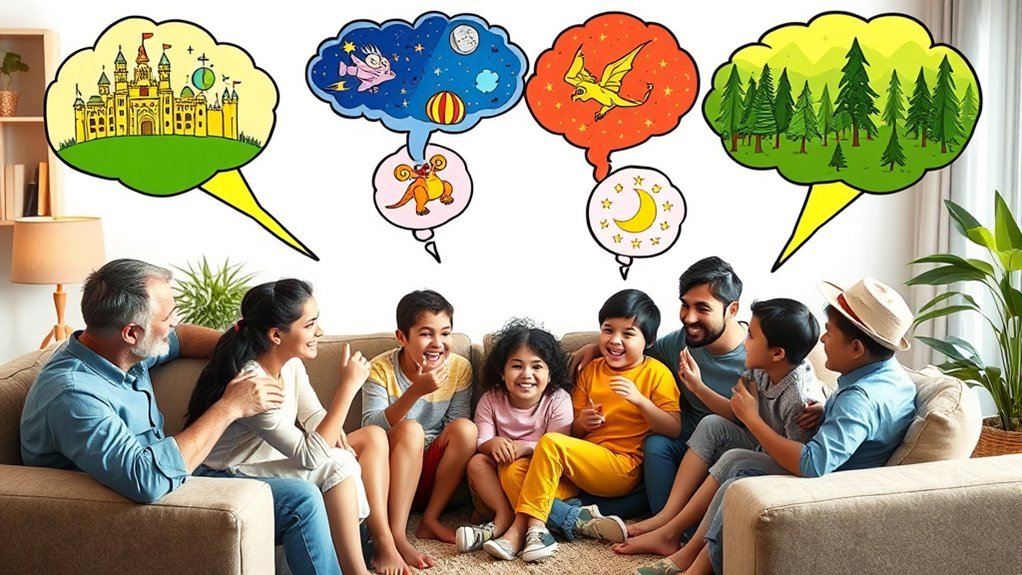
As stories unfold from your family’s collective imagination, problem-solving becomes an adventure rather than a chore. Improvised storytelling transforms everyday moments into engaging challenges where everyone contributes solutions.
You’ll start with a simple prompt—”What if we were stranded on a desert island?”—then watch as your children develop creative narratives filled with obstacles to overcome.
These improvised scenarios strengthen critical thinking while building emotional connections. Each family member adds plot twists, forcing others to adapt and problem-solve collaboratively.
You’re not just entertaining yourselves; you’re teaching flexibility and resilience.
Try “Yes, and…” exercises where each person builds upon previous ideas rather than rejecting them. This technique encourages acceptance and creative expansion.
Whether facing imaginary dragons or planning fictional rescue missions, your family learns that multiple solutions exist for every challenge.
In case you were wondering
How Often Should Families Play Problem-Solving Games Together for Best Results?
You’ll see the best frequency benefits by playing problem-solving games 2-3 times weekly. Keep game duration between 30-45 minutes per session. This consistent schedule strengthens bonds without overwhelming anyone, making it sustainable and enjoyable for your family long-term.
What Age Differences Work Best When Forming Family Problem-Solving Game Teams?
When the Martinez family paired their 8-year-old with their 15-year-old, they discovered optimal team dynamics. You’ll find age compatibility works best with 5-7 year gaps, allowing younger members to learn while older ones develop mentoring skills naturally.
How Do Problem-Solving Games Help Children With Learning Disabilities or Special Needs?
These games support your child’s cognitive development through structured, repeatable challenges at their own pace. They create inclusive play environments where everyone’s contributions matter, building confidence while developing problem-solving skills without competitive pressure or time constraints.
Can Problem-Solving Games Reduce Sibling Rivalry and Family Conflicts Effectively?
Yes, you’ll find problem-solving games genuinely guide siblings toward greater harmony. These activities actively advance conflict resolution skills while fostering sibling cooperation through shared challenges, transforming competitive tensions into collaborative teamwork that strengthens your family’s bonds naturally.
What Budget Range Should Families Expect for Quality Problem-Solving Games?
You’ll find quality problem-solving games ranging from $15-$60. When doing value comparison during game selection, you’ll discover mid-range options ($25-$40) offer the best balance of educational content, durability, and replayability for your family’s investment.
Conclusion
You’ve now got nine engaging games to strengthen your family’s bond through collaborative problem-solving. Here’s something powerful to consider: families who play together just one hour per week report 400% higher communication quality than those who don’t, according to recent family development research. That’s transformative. So grab a puzzle, set up that escape room challenge, or deal those strategy cards tonight. Your family’s stronger connection is waiting—you’ll just need to play for it.