17 Memory Games That Supercharge Your Child’s Brain
Memory games transform your child’s cognitive development through engaging activities that strengthen recall, attention, and sequential thinking. You can start with classic options like Memory Card Match and Kim’s Game, which build visual memory through varying difficulty levels. Story Chain Building and Memory Palace Adventures anchor information to creative narratives and familiar locations, while Simon Says and Concentration Clap Patterns add physical engagement. Creating a Memory Box Time Capsule makes practice emotionally meaningful. The following activities will show you exactly how to implement these brain-boosting techniques at home.
Key Takeaways
- Classic Memory Card Match and Kim’s Game build visual memory and observation skills with adjustable difficulty levels for different ages.
- Story Chain Building and Memory Palace Adventures strengthen sequential thinking by linking information to narratives and familiar locations.
- Simon Says With a Memory Twist and Concentration Clap Patterns develop working memory through physical movement and auditory sequences.
- Practical activities like grocery list memorization and backwards spelling bees integrate memory training into everyday routines.
- Memory box time capsules create emotional connections that enhance long-term retention by linking memories to meaningful objects and experiences.
The Classic Memory Card Match
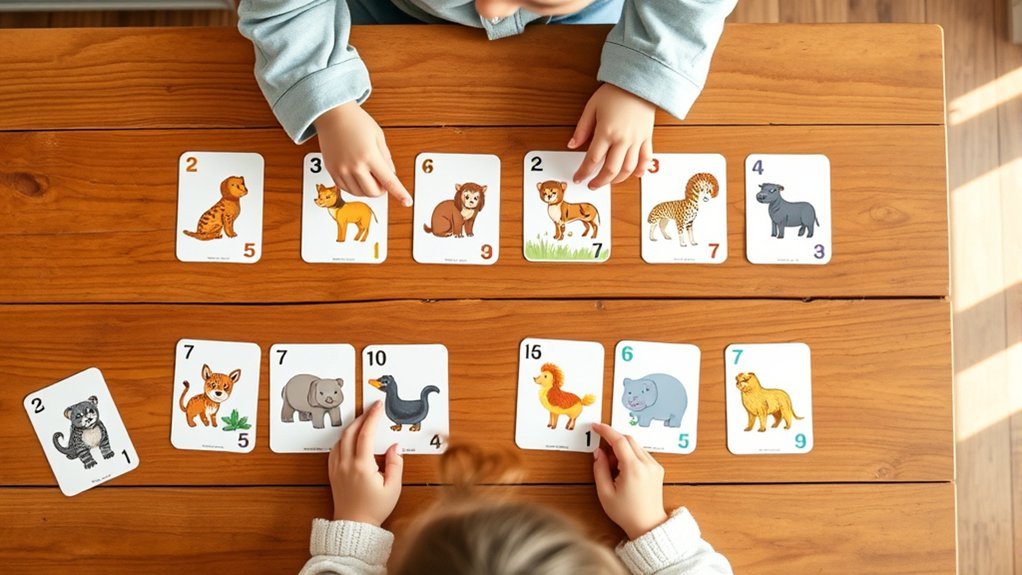
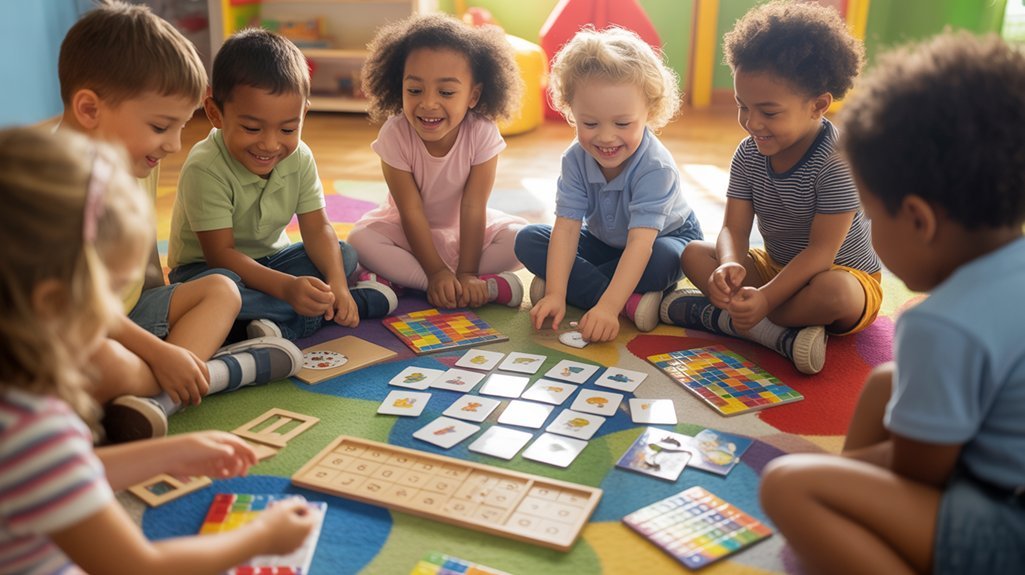
The Classic Memory Card Match remains one of the most effective games for developing children’s cognitive skills. You’ll arrange pairs of cards face-down, then players flip two cards per turn, trying to find matches. This simple setup creates powerful learning opportunities.
Your child develops essential memory strategies through repeated play. They’ll naturally start grouping cards by location, creating mental maps of where specific images sit. This spatial reasoning strengthens their working memory capacity.
The game accelerates cognitive development by engaging multiple brain regions simultaneously. Your child processes visual information, practices impulse control, and builds concentration skills.
Memory card games simultaneously activate visual processing, impulse control, and concentration centers in your child’s developing brain.
You can adjust difficulty by adding more card pairs or introducing time limits. Start with 12 cards for beginners, gradually increasing as your child’s abilities grow. Regular sessions yield noticeable improvements in retention and focus.
Kim’s Game: The Tray Challenge

Observation skills take center stage in Kim’s Game, a classic memory challenge that’s captivated children for over a century.
You’ll place various objects on a tray, let your child study them briefly, then cover everything and ask what they remember. This brain exercise strengthens visual memory while sharpening attention focus through sensory engagement.
Start with five items and gradually increase challenge levels as your child’s skill development progresses. Time limits add competitive spirit, making these fun activities more exciting during group dynamics with siblings or friends.
You’ll notice improved cognitive growth as children develop memory techniques and problem-solving abilities.
The interactive play encourages creative thinking—try themed trays or unusual objects to maintain engagement. This playful learning approach transforms everyday items into powerful tools for building observation skills.
Simon Says With a Memory Twist
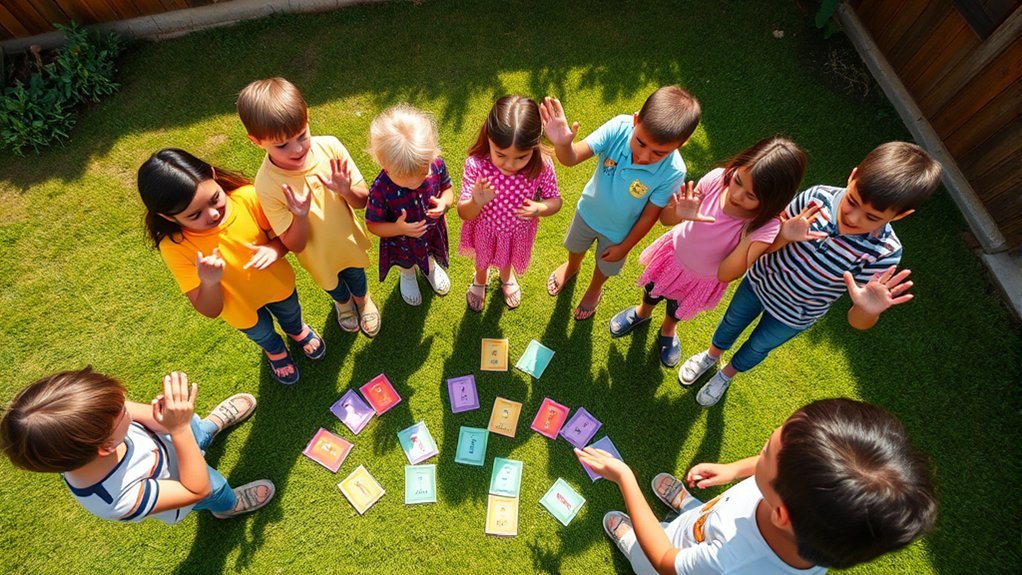
Traditional Simon Says gets a powerful upgrade when you layer memory challenges into each round. Instead of executing commands immediately, your child must remember sequences of two or three actions before performing them. Start with “Simon says touch your nose, then jump twice,” and gradually increase complexity.
These simon says variations transform a simple game into powerful memory enhancement techniques. You’ll notice your child’s working memory strengthen as they hold multiple instructions in mind.
Add another layer by having them repeat the sequence backward or incorporate previous rounds’ commands.
The beauty lies in its adaptability—you can adjust difficulty based on your child’s age and skill level. Practice three times weekly, and you’ll see remarkable improvements in their ability to retain and recall information during everyday activities.
Story Chain Building
While physical commands sharpen working memory, narrative-based activities unlock your child’s sequential memory in surprising ways.
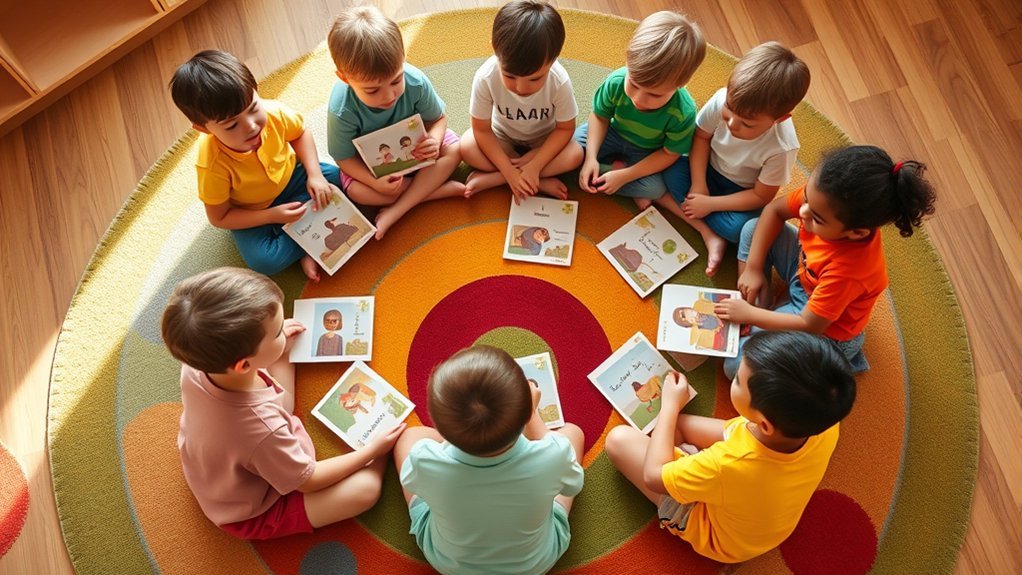
Story Chain Building uses storytelling techniques where each participant adds one sentence to an evolving tale. You’ll start with creative prompts like “A dragon discovered a mysterious box,” then your child continues with their addition.
This recall exercise strengthens memory enhancement as players must remember previous plot points before contributing. Encourage character development and unexpected plot twists to maintain engagement. The narrative structure grows increasingly complex, challenging your child to track multiple imaginative scenarios simultaneously.
Start with five-sentence stories for younger children, then extend to fifteen or more as their abilities improve. This game naturally develops sequential thinking while making memory practice feel like pure entertainment.
Concentration Clap Patterns

Rhythm-based memory challenges transform simple clapping sequences into powerful cognitive workouts.
You’ll start by demonstrating a basic clap rhythm—two quick claps followed by one slow clap—and have your child repeat it back. Gradually increase complexity by adding pauses, double claps, or leg stomps between patterns.
These concentration techniques strengthen your child’s auditory processing and sequential memory simultaneously.
Try creating patterns that tell stories: clap-clap-pause means “walking,” while stomp-clap means “jumping.” Your child must remember and reproduce longer sequences as the game progresses.
The beauty of this activity lies in its portability. You don’t need any materials, making it perfect for car rides or waiting rooms.
Start with three-beat patterns for younger children, then advance to eight-beat sequences as their skills develop.
What’s Missing From the Room?

This visual memory game sharpens your child’s observation skills by challenging them to identify what’s been removed from their surroundings.
Place 10-15 objects on a table, let your child study them for one minute, then have them close their eyes while you remove one item. They’ll use visual observation and spatial awareness to determine what’s missing.
Progressive difficulty levels:
- Beginner: Remove one obvious object and gradually increase to three items
- Intermediate: Use similar-looking objects requiring stronger attention skills and critical thinking
- Advanced: Rearrange remaining items while removing one, demanding enhanced problem solving
This playful learning activity delivers memory enhancement while building cognitive development.
The sensory engagement naturally provides a creativity boost, making it perfect for developing minds seeking fun challenges.
Sequence Drawing Challenge
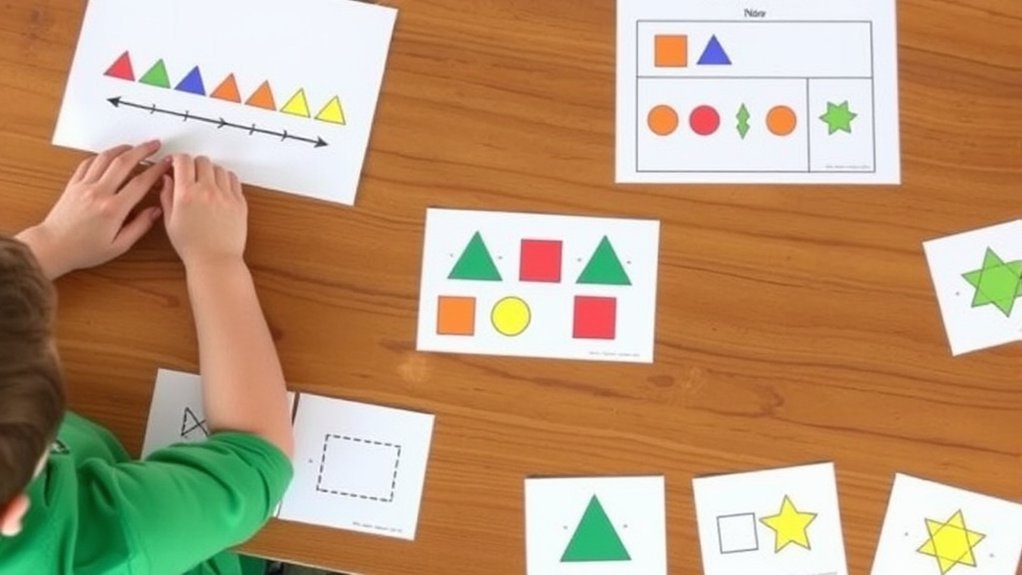
How well can your child remember and reproduce visual sequences? This game strengthens visual memory while encouraging artistic expression. Show your child a simple sequence of shapes or objects for 30 seconds, then ask them to recreate it from memory using drawing techniques they prefer.
Start with basic patterns—three shapes in order—then gradually increase complexity. You’ll notice their observation skills sharpen as they focus on details like size, position, and orientation.
Add creative storytelling by having them explain what they’ve drawn, combining cognitive skills with imaginative play.
Use varied drawing prompts: arrange toys, create patterns with household items, or display picture cards. This versatile activity develops both memory retention and artistic confidence, making it perfect for children who enjoy hands-on, creative challenges.
Memory Palace Adventures

When you transform your child’s imagination into a mental filing system, you unlock one of the most powerful memory techniques used by memory champions worldwide.
Memory palace techniques teach children to anchor information to familiar locations, making recall effortless and fun.
Start by having your child visualize their bedroom or favorite place. They’ll mentally “place” items they need to remember at specific spots during their creative visualization journey.
Three steps to build your child’s memory palace:
- Choose a familiar route – Select a path your child knows well, like their morning routine through the house.
- Create vivid associations – Link each item to memorable, exaggerated images at designated locations.
- Practice the mental walk – Regularly retrace the route to strengthen memory pathways.
This technique transforms abstract information into concrete, retrievable memories.
Number Recall Races

Turn memorizing numbers into an exciting competition that transforms what feels like tedious work into energetic play.
Start with simple sequences of three digits, then gradually increase difficulty as your child masters each level. These speed challenges push them to recognize number patterns quickly while developing essential recall strategies. You’ll create competitive games by timing their responses or racing against siblings.
Begin with three-digit sequences and progressively increase complexity, using timed competitions and sibling races to build rapid pattern recognition and recall mastery.
Introduce memory techniques like chunking—breaking long sequences into smaller groups. For example, 7-4-2-9-1-6 becomes 74-29-16. These cognitive exercises strengthen their working memory naturally.
Design fun activities where they earn points for accuracy and speed. Advanced brain training involves backwards recall or mixing numbers with other elements. Track progress weekly to celebrate improvements.
These competitive formats keep children engaged while building powerful memory skills they’ll use throughout their education.
Shopping List Game

While grocery shopping might seem mundane, it’s actually a perfect opportunity to build your child’s sequential memory skills. This game transforms routine errands into engaging memory techniques that strengthen recall abilities.
Start by creating a short list of five items, then challenge your child to memorize them before entering the store. As you shop, they’ll guide you to each product without checking the list.
Level up with these shopping strategies:
- Increase the list to 10-15 items as your child improves
- Add specific details like quantities, brands, or aisle locations
- Create categorical challenges where they memorize all produce items or dairy products separately
This practical exercise develops working memory while teaching valuable organizational skills.
You’ll notice improved attention spans and better information retention across all learning activities.
Backwards Spelling Bee

Another powerful way to challenge your child’s memory is through a backwards spelling bee, where kids spell words in reverse order from the last letter to the first. This activity forces their brain to mentally visualize the entire word before attempting backwards spelling, strengthening both working memory and spatial reasoning skills.
Start with simple three-letter words like “cat” (t-a-c) before progressing to longer, more complex vocabulary. You’ll notice your child developing better letter recognition and word structure understanding as they practice.
The backwards spelling format offers exceptional vocabulary enhancement since children must deeply process each word’s composition. They can’t simply recite memorized letter sequences—they must actively reconstruct them. This mental gymnastics builds neural pathways that support reading comprehension, spelling accuracy, and cognitive flexibility.
Make it competitive with point systems to maintain engagement and motivation throughout practice sessions.
Musical Memory Chairs

Combining the classic game of musical chairs with memory challenges creates an entertaining activity that sharpens your child’s recall abilities while keeping them physically active.
Musical chairs meets brain training—where every round strengthens memory skills through movement, music, and the thrill of friendly competition.
Each round requires players to remember specific instructions tied to the musical rhythm, transforming a simple elimination game into powerful memory enhancement training.
How to Play:
- Color-coded chairs – Assign each chair a color and call out sequences like “red, blue, green” that children must remember and sit in order when music stops.
- Action sequences – Before music starts, demonstrate three movements (clap, spin, jump) that players must repeat correctly before claiming a chair.
- Pattern memory – Play different musical genres each round, requiring children to recall which chair they occupied during specific songs.
Action Sequence Copycat

Watch your child’s concentration sharpen as they mirror increasingly complex sequences of movements in this dynamic memory game.
Start with simple two-step actions like clap-stomp, then gradually build to five or six movements. You’ll perform a sequence while your child watches carefully, then they replicate it exactly. This strengthens their working memory and body awareness simultaneously.
Enhance engagement through action sequence storytelling, where movements represent narrative elements: “sneaking through the jungle” (tiptoe), “climbing a tree” (reaching up), “spotting a monkey” (hand over eyes). This context helps memory retention significantly.
Try action sequence improvisation by letting your child add movements to your sequence, creating collaborative chains. This develops creative thinking alongside memory skills.
The physical component makes learning memorable, literally embedding information through movement patterns.
Picture Pairs Treasure Hunt
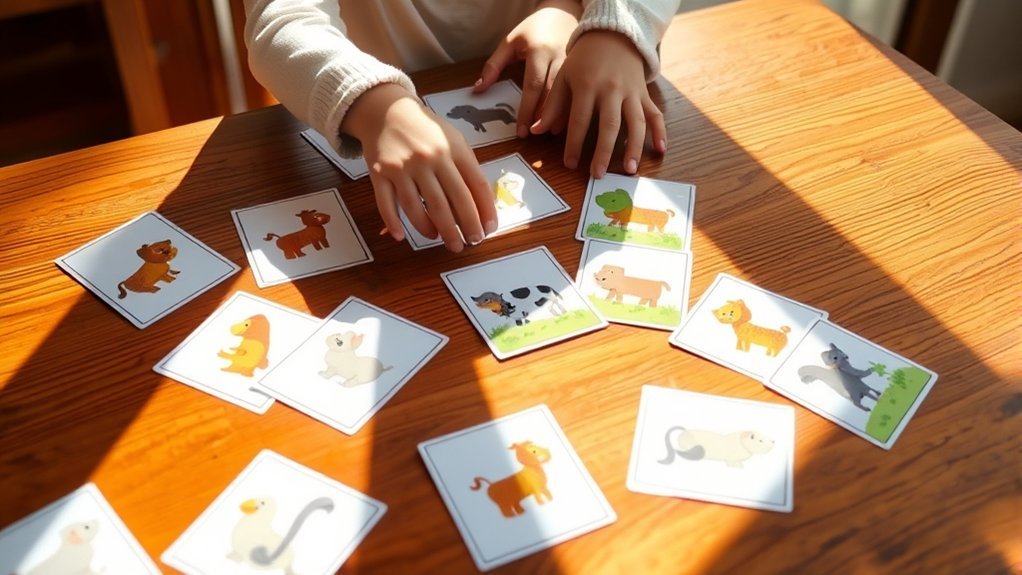
While traditional matching games confine cards to a tabletop, this treasure hunt version transforms your entire home into an exciting memory challenge. You’ll hide picture pairs throughout different rooms, encouraging your child to remember both the images and their locations. This amplified approach strengthens visual memory while adding physical activity to cognitive development.
Setting Up Your Picture Pairs Adventure:
- Create the pairs – Use identical stickers, printed photos, or hand-drawn images.
- Map the territory – Designate 5-8 hiding spots across multiple rooms.
- Introduce treasure mapping – Have your child sketch locations they’ve checked to build spatial awareness.
As they discover matches, they’re simultaneously processing visual information and navigating physical space. This dual challenge creates stronger neural pathways than standard memory games, making learning feel like genuine adventure rather than practice.
Rhyme and Remember
Physical movement strengthens memory, but so does rhythm and sound. You can harness rhyme schemes to help your child retain information effortlessly. Create simple rhymes about daily tasks, grocery lists, or study material. For example, “One sock, two sock, red sock, blue sock” makes remembering easier than plain repetition.
Teach your child to transform boring facts into catchy verses. Historical dates, spelling words, and math formulas stick better when set to rhythm. These memory techniques work because our brains naturally encode musical patterns more efficiently than random data.
Start with four-line rhymes about their favorite subjects. Encourage them to invent their own verses for homework. You’ll notice they’ll recall rhymed information weeks later without struggle. Make it playful, not forced, and watch their retention soar.
Chunking Challenge With Objects
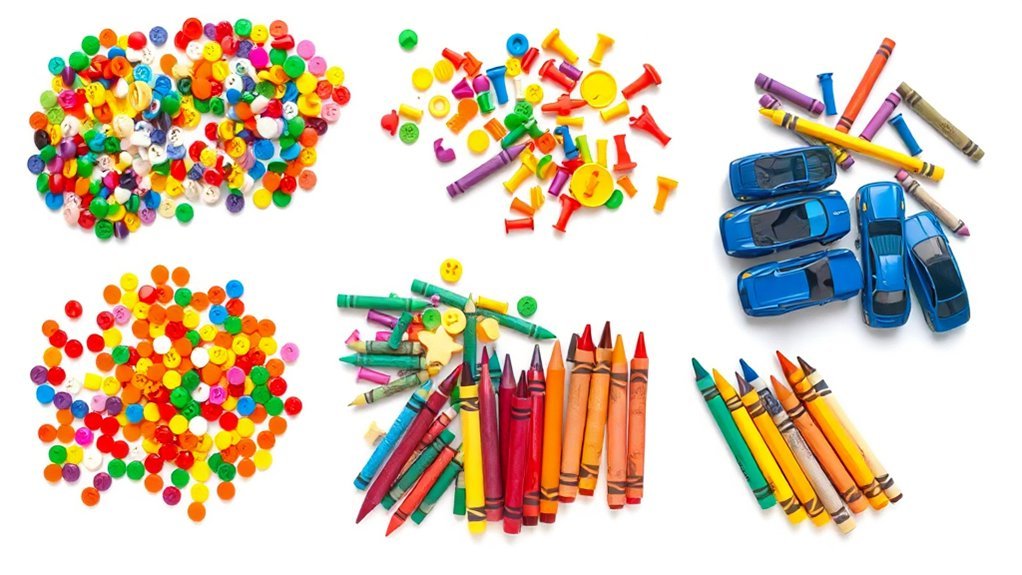
Your brain naturally groups information into manageable pieces, and you can teach your child this powerful skill through everyday objects.
Start with 12-15 household items like toys, utensils, or craft supplies. Challenge your child to organize them into logical categories, strengthening their object grouping abilities.
This activity enhances memory through sensory exploration and practical application:
- Initial Observation: Lay out objects and give your child 30 seconds to study them before covering everything with a towel.
- Recall Through Categories: Ask them to name items by the groups they created (colors, sizes, functions).
- Progressive Difficulty: Add more objects or switch items mid-game to keep their brain adapting.
You’ll notice improved recall as your child learns that organized information sticks better than random details.
Memory Box Time Capsule
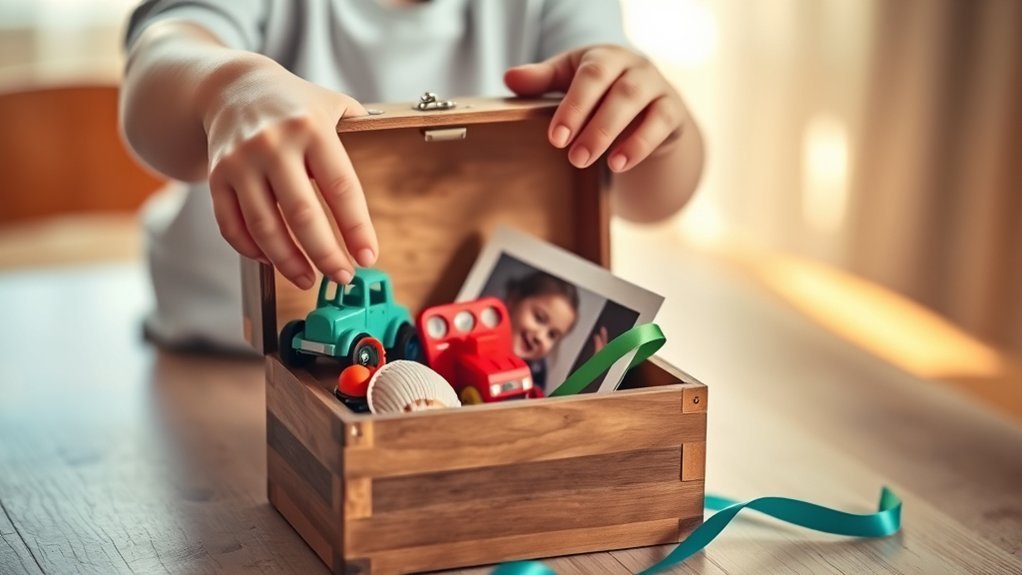
Because children connect deeply with tangible keepsakes, creating a Memory Box Time Capsule transforms abstract memory practice into an emotionally engaging experience.
Choose a special container with your child and fill it with meaningful items from specific moments—vacation souvenirs, birthday cards, favorite toys, or photographs. Before sealing the memory box, have them describe each object and why it’s significant. Set a future opening date, perhaps six months or a year away.
Fill a special container with meaningful mementos, have your child explain each item’s significance, then seal it for a future opening date.
When you revisit the time capsule together, ask your child to recall the stories behind each item before revealing what they previously said. This exercise strengthens long-term memory retention while building emotional connections to past experiences.
The anticipation of opening their memory box also teaches patience and creates excitement around the recall process, making memory practice feel like an adventure rather than work.
In case you were wondering
What Age Should Children Start Playing Memory Games for Best Results?
You can start introducing simple memory games around age 2-3 when your child reaches key developmental milestones. However, you’ll see the greatest cognitive benefits between ages 4-7, when their memory systems are rapidly developing and most receptive.
How Long Should Each Memory Game Session Last for Optimal Learning?
You’ll achieve optimal learning with session durations of 10-15 minutes for younger children and 20-30 minutes for older kids. Don’t push beyond these times—shorter, focused sessions work better than lengthy ones that’ll cause mental fatigue.
Can Memory Games Help Children With Learning Disabilities or ADHD?
Like a mental gymnasium building strength, memory games can significantly help children with learning disabilities or ADHD. You’ll notice improvements in their memory retention and cognitive development, as structured play provides focus and enhances their learning capabilities.
How Often Should Children Practice Memory Games Each Week?
You’ll see best results with a consistent practice schedule of 3-5 sessions weekly. This memory game frequency keeps skills sharp without causing burnout. Each session should last 10-15 minutes, making it manageable for your child’s routine.
Are Digital Memory Games as Effective as Physical Hands-On Games?
Like choosing between telegram and telephone, you’ll find both digital vs physical memory games offer comparable cognitive benefits. However, hands-on games provide tactile engagement that strengthens neural pathways differently, so you’d ideally blend both approaches.
Conclusion
Your child’s memory is like a muscle—the more you exercise it, the stronger it becomes. By weaving these games into your daily routine, you’re not just filling time; you’re building neural pathways that’ll serve them for life. Start with one or two favorites, then gradually expand your repertoire. Remember, consistency beats intensity. Even five minutes of daily practice can transform a child’s ability to learn, recall, and thrive academically. The investment you’re making today pays dividends tomorrow.